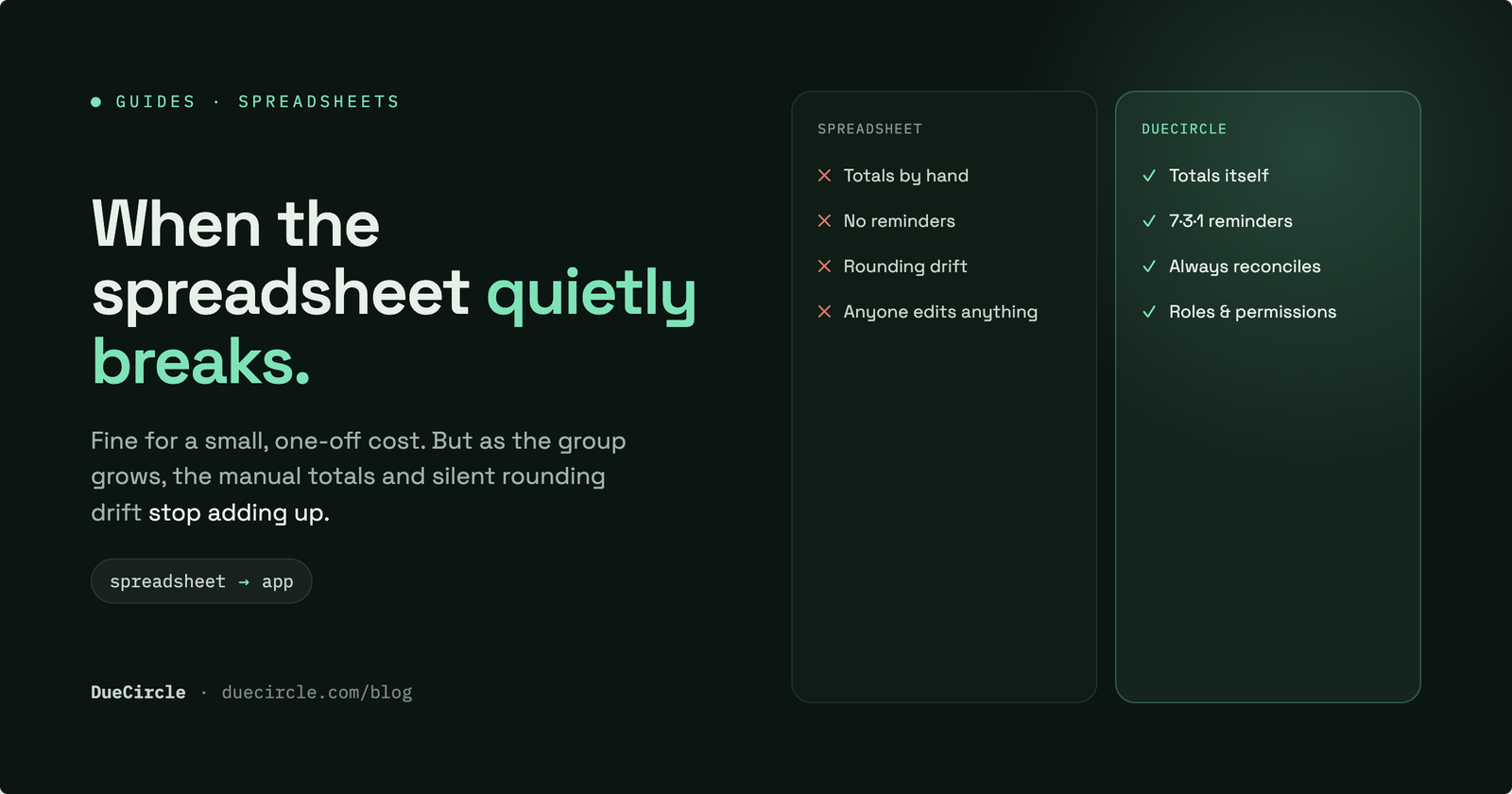
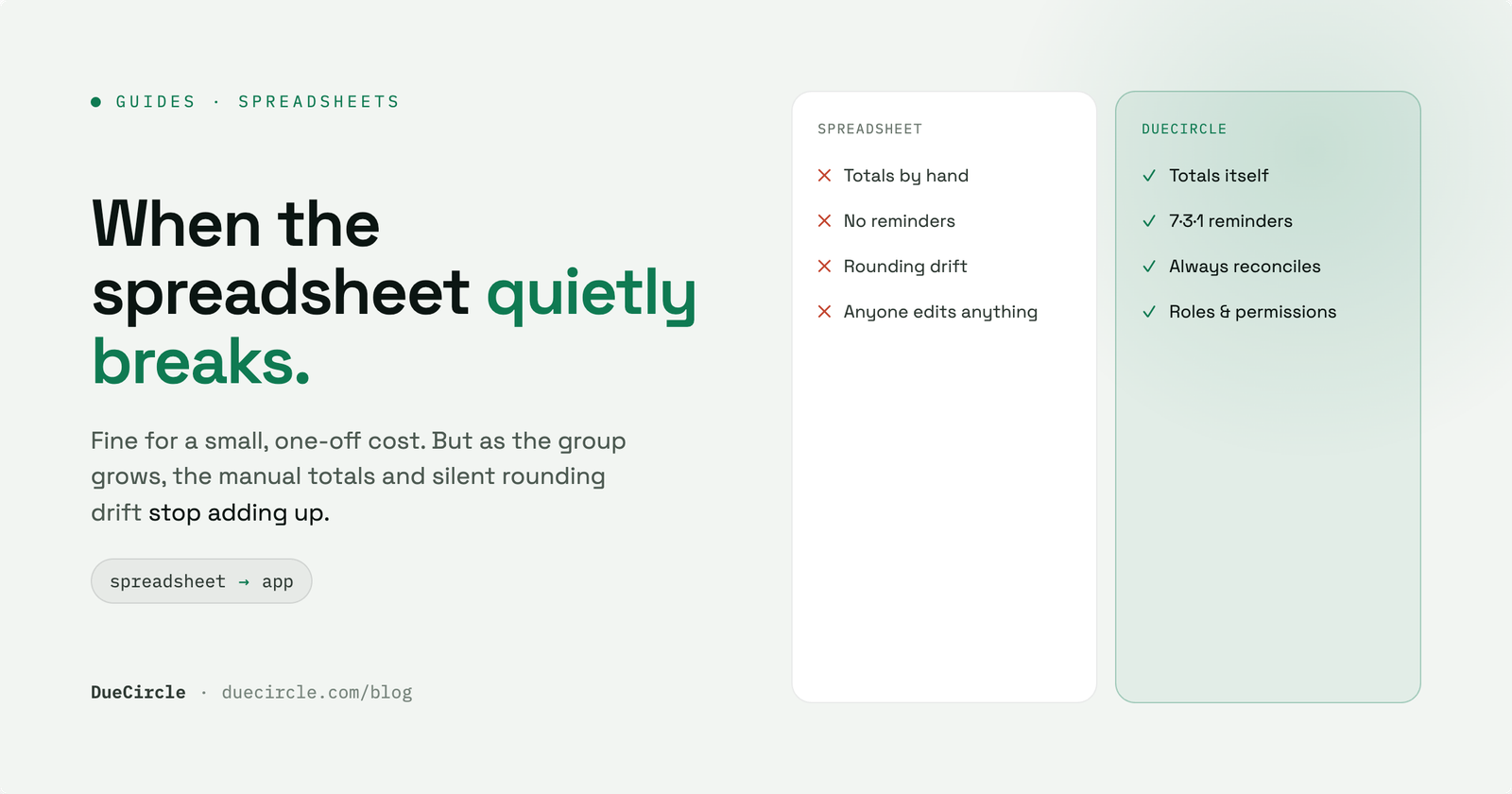
A shared expense spreadsheet is one of the most reasonable tools you can reach for. It is free, everyone understands the grid, and for a weekend away or a single dinner it does the job without ceremony. There is no reason to feel behind for using one.
The trouble is that spreadsheets rarely stay small. A tab that started as a quick tally of who paid for the taxi grows columns, gains contributors, and slowly turns into something you maintain rather than something that helps you. This piece is about spotting that moment: where a spreadsheet genuinely works, where it quietly breaks down, and the point at which a dedicated tool earns its place.
Where a spreadsheet genuinely works
For a one-off, small, single-owner situation, a spreadsheet is hard to beat. If one person is happy to keep the file, the group is a handful of people, and the whole thing wraps up in a week, the maths is trivial and the overhead is close to zero. You type in a few numbers, sum a column, and divide.
It also gives you two things worth keeping: complete control and full transparency. You can see every formula, change anything, and no one has to trust a system they cannot inspect. For a shared holiday fund or a short project with clear boundaries, that is often all you need.
The advice here is not that spreadsheets are bad. It is that they have a comfortable range, and problems begin when the shared money outgrows it.
Where it quietly breaks down
The failures rarely announce themselves. A formula that once covered rows one to twenty stops at the row someone inserted, and the total is wrong in a way nobody notices for weeks. Copy a cell to the wrong place and a division silently changes. Because the sheet always shows a confident number, an error looks exactly like a correct answer.
Rounding is a related, slower problem. Split an odd amount three ways and the pennies have to land somewhere. A spreadsheet will happily show 33.33 three times and leave a penny unaccounted for. Repeat that across dozens of entries and the drift becomes real money that never quite reconciles.
Then there is everything a grid simply does not do. It will not remind anyone that rent is due. It will not work out the smallest set of payments to clear the group. It will not convert currencies as you go, so a trip across borders becomes a second job of exchange rates and manual columns.
The moment several people start editing
A spreadsheet is calm when one person owns it. The strain arrives the moment two or three people edit the same file. Someone works from an emailed copy that is already out of date. Two people add the same expense. A sort reorders rows while a formula still points at the old positions.
Even with a shared online sheet, there is no notion of who is allowed to change what. Any editor can overwrite any figure, and there is no clear record of who entered a given cost or why. When a number is disputed, you are reconstructing history from memory rather than reading it off the page.
This is usually the first genuine tipping point. Not the size of the numbers, but the number of hands. Shared money that several people touch needs structure the grid was never designed to provide.
The other tipping points
A few situations reliably push a spreadsheet past its useful range. Recurring costs are one: rent, utilities, subscriptions and anything that repeats needs reminders and a running history, not a fresh row typed from memory each month. Ongoing arrangements between flatmates or partners fall squarely here.
Phones are another. Most shared expenses are logged in the moment, standing at a till or splitting a bill at the table, and editing a dense spreadsheet on a small screen is genuinely unpleasant. If the place you record costs is not the place you can comfortably reach, entries get delayed and then forgotten.
Multiple currencies are the third. Once a group spends across borders, manual conversion columns become fragile and hard to trust. At that point the question is no longer whether a spreadsheet can be made to work, but whether it is worth the effort of keeping it upright.
What you keep, and what you gain
The fear in moving off a spreadsheet is usually about losing control and transparency. A tool built for shared money should preserve both. DueCircle keeps every expense visible to the group, records who added what, and uses roles so it is clear who can edit and who cannot. You still see the full picture; you just stop maintaining the machinery by hand.
What you gain is the work the grid could not do. Money is handled as exact integers, so splits always reconcile and the stray penny has a home rather than drifting. Settle-up proposes the fewest payments to clear everyone. Recurring bills send reminders, budgets track month on month, and several currencies are handled without a conversion column of your own.
It is worth being plain about the boundary. DueCircle never connects to a bank. It records and splits what the group tells it, which keeps it private and keeps you in control, the same qualities that made the spreadsheet appealing in the first place. It is free, and it runs comfortably on a phone.
Deciding without over-thinking it
You do not need a rule for every case. If the shared money is small, brief and owned by one person, keep the spreadsheet with a clear conscience. It is the right amount of tool for the job.
If, instead, you recognise several signs from the checklist, the sheet has probably stopped saving you time and started costing it. That is the honest point to switch: not because spreadsheets are wrong, but because the shared money in front of you has grown into something a purpose-built tracker handles more calmly, more accurately, and with far less upkeep.
Published 5 June 2026.