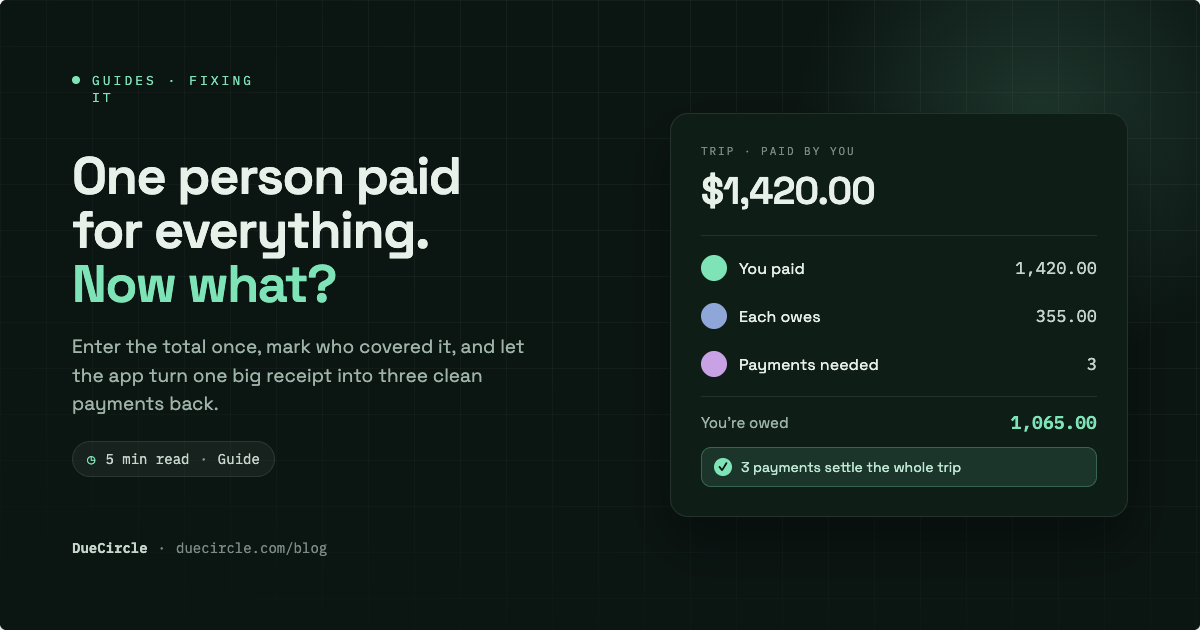
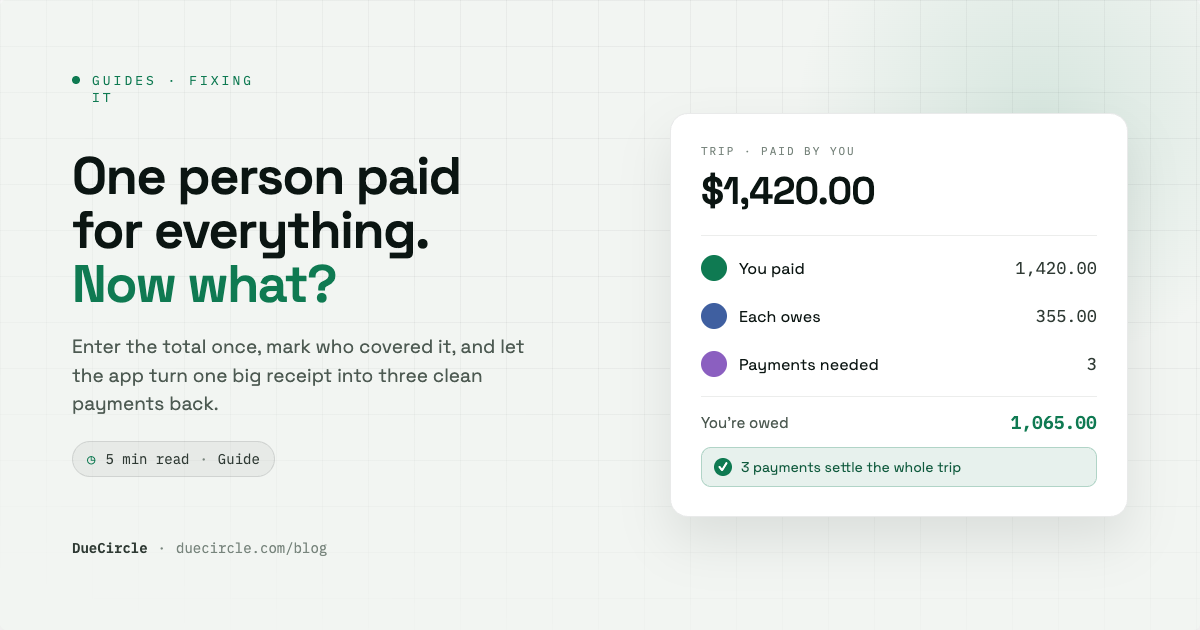
It is the most ordinary thing in the world. The bill lands, one person taps their card because it is quickest, and everyone waves a hand and says 'we will sort it later'. Later, as you may have noticed, has a habit of never quite arriving.
When one person paid for everything, the fair fix is simple in theory: split the cost back and make them whole again. The catch is doing it without a dozen half-remembered IOUs drifting around the group chat for a fortnight. Here is how to keep it clean.
Why one card ends up covering everything
Someone always pays. The queue is moving, the waiter is hovering, and it is genuinely faster for one person to tap than for six people to fumble with UPI at the counter. That person is doing everyone a small favour, and it should stay a favour.
The favour only sours when the paying-back goes vague. A single ₹9,000 dinner is easy to forget in pieces — ₹1,500 here, ₹1,500 there — especially when nobody wrote down who was even at the table that night.
So the goal is not to stop one person paying, which is often the sensible thing to do. It is to record it properly the moment it happens, while everyone still remembers the evening and nobody has to reconstruct it from a blurry photo of the receipt.
Decide how to split it back
Before you divide anything, agree on what is actually fair for this particular cost. Equal is the sensible default, but it is not always the honest answer, and a lopsided bill split evenly can leave someone quietly annoyed.
DueCircle lets you pick the method for each expense, so a bill where two people ordered half the menu can be split the way it truly happened rather than flattened into an even share.
Your options for a single expense are:
- Equal — everyone shared it more or less the same, so split it straight
- By shares — the two who ordered the tasting menu carry more than the one who had a soup
- By exact amounts — when you know precisely what each person's part came to
- By percentage — when someone agreed to cover, say, 40 percent
- Exclude anyone who was not part of it — the friend who only had water opts out
Record it as one expense, not five IOUs
The classic mistake is turning one dinner into five separate 'you owe me' messages scattered across a chat. Log it once instead, with the person who paid marked as the payer, and let the app work out each person's share for you.
Say Meera covered a ₹9,000 dinner for five friends and you split it equally. That is ₹1,800 each. DueCircle records Meera as having paid the full ₹9,000, assigns ₹1,800 to each of the other four, and shows that Meera is owed ₹7,200 in total — her own ₹1,800 share is hers to keep, not something she owes herself.
Now the four amounts live in one place, tied to one expense, with Meera clearly marked as the person to repay. No screenshots, no scrolling back through the chat to reconstruct who ordered the paneer and who was even there.
Settle in a few payments, not a flurry
When one person fronts several outings in a row, the debts all pile up in a single direction — everyone owes the same person. That is actually the easiest case there is to clear, because the money only needs to flow one way.
DueCircle reads the balances and suggests who should pay whom, matching the largest debtor to the largest creditor, so the group settles in a small number of payments rather than everyone sending odd little transfers all week long.
Making the generous person whole
People quietly stop offering to pay for the whole table when it costs them a fortnight of awkward reminders afterwards. The way to keep that generosity alive is to make repaying them effortless, obvious, and quick.
Once the others pay Meera back outside the app, she marks each payment recorded and the balance falls to zero. DueCircle is free, keeps the group's numbers private, and never holds or moves the money itself — it just remembers who paid, works out who owes what, and makes sure the person who covered everything does not end up silently out of pocket.
Published 20 July 2026.