A bill you pay alone is easy to remember, because there is exactly one person it can go wrong for. Rent is due, you pay it, and nobody else is involved. The moment a bill is shared, that clarity disappears. Now there are three or four people who could have paid it, which usually means nobody has, and no single person is certain either way.
This is the quiet failure mode of shared households. The internet bill does not get forgotten because anyone is careless. It gets forgotten because responsibility for it is spread so thinly that it evaporates. A bill reminder app fixes this not by nagging harder, but by giving each recurring bill a due date, an owner and a paper trail that everyone can see.
Why shared bills slip through the gaps
A recurring bill has two properties that make it easy to miss. It arrives on a schedule you are not thinking about, and in a shared home it belongs to everyone and therefore to no one. Diffused responsibility is a well-documented human tendency: the more people who could act, the less likely any individual is to feel that they must.
The usual coping mechanisms are fragile. A note on the fridge is invisible after a day. A message in the group chat scrolls away under other conversation. A mental reminder depends on the one person who happens to remember, which quietly turns them into the household chaser, the one who has to ask.
None of these methods survive the thing that actually matters, which is the passage of a month. Rent, council tax, electricity, broadband and a streaming subscription do not announce themselves. They simply fall due, and if the shared understanding of who pays what is vague, one of them will be late.
Set the bill up once, with a due date and a recurrence
The first change a bill reminder app makes is to stop treating each month as a fresh surprise. You add a recurring bill once. You give it an amount, a due date and how often it repeats, whether that is monthly, quarterly or annually. From then on every occurrence is created and tracked for you.
This matters because the work of remembering is front-loaded into a single calm moment rather than repeated, anxiously, twelve times a year. You are not setting a reminder for July rent. You are describing rent, once, as a thing that is due on the first of every month, and letting the schedule take care of the rest.
Because DueCircle records money as exact whole units and supports splits by equal share, percentage or custom shares, the amount each person owes is settled at setup too. The bill is no longer a lump that someone has to divide under pressure. It is already apportioned before it falls due.
Reminders at seven, three and one days, then an overdue marker
A due date on its own is passive. It sits in the app and waits to be looked at. What turns a due date into something reliable is a sequence of reminders that arrive while there is still time to act.
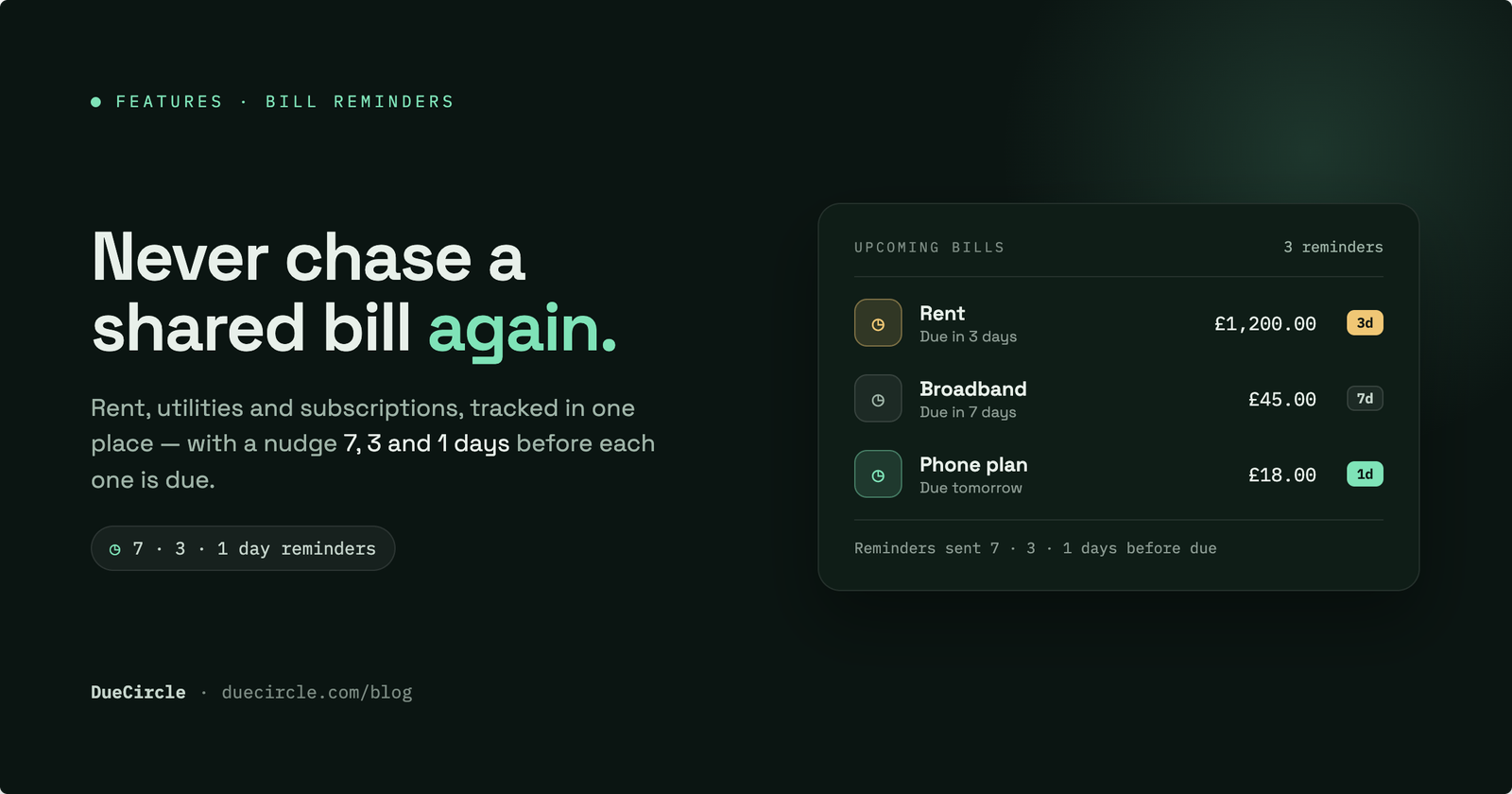
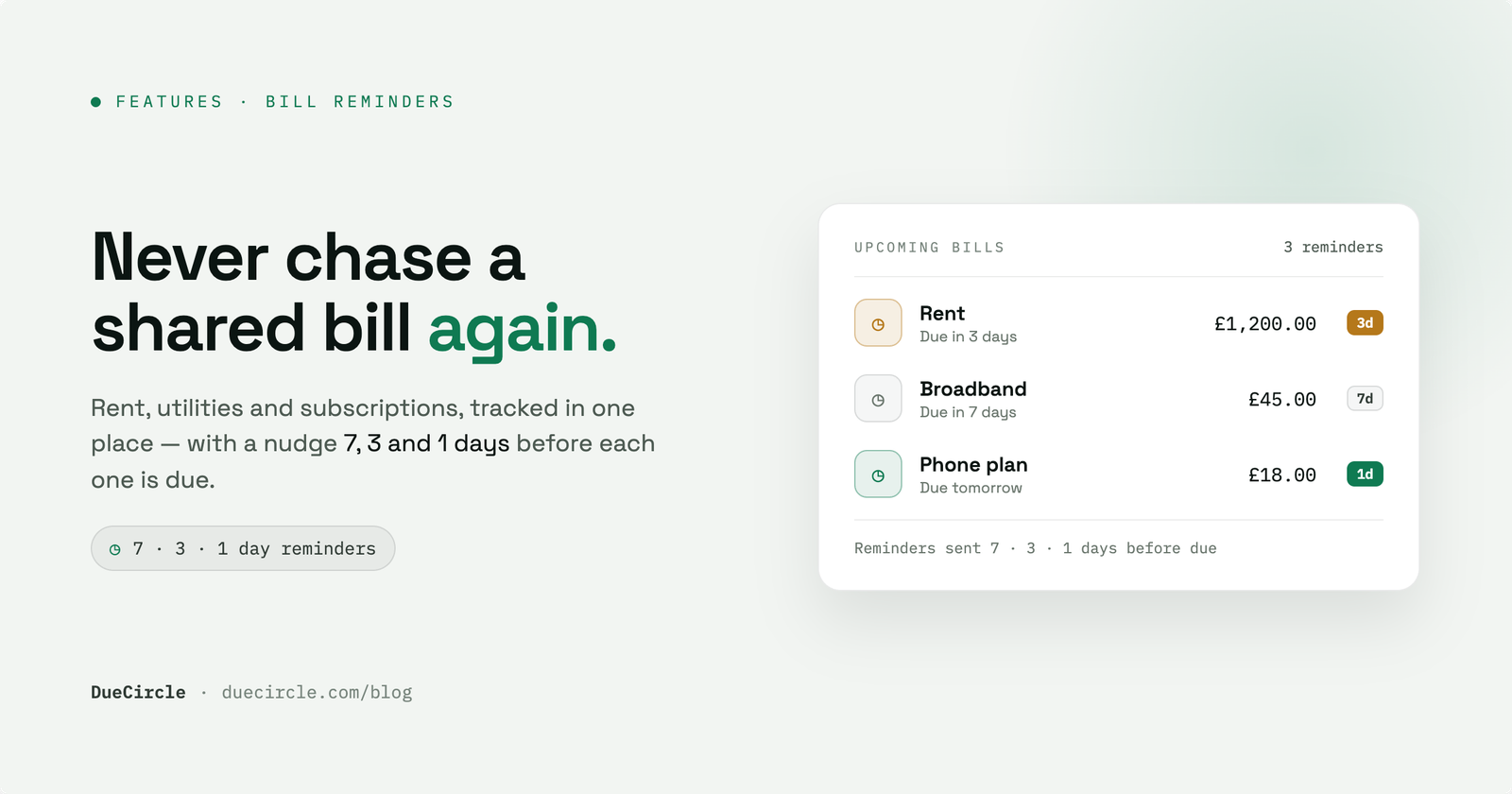
DueCircle reminds the group at seven, three and one days before a bill is due. The seven-day notice gives whoever is responsible time to move money if they need to. The three-day notice is the practical prompt to actually pay. The one-day notice is the last quiet word before it is late. Three gentle touches, spaced so they inform rather than pester.
If a bill does pass its due date unpaid, it is marked overdue and kept in view. It cannot be quietly scrolled past and forgotten. An overdue bill stays visible until it is dealt with, which means a missed payment surfaces as a small, fixable problem rather than a large one that only appears when a service is cut off.
Assign who is responsible, so it is never ambiguous
Reminders solve timing. They do not, on their own, solve ownership. A reminder that goes to everyone equally can still be answered by everyone assuming someone else has it in hand. The fix is to name a person.
Each recurring bill in DueCircle can be assigned to whoever is responsible for paying it. Rent might sit with one flatmate, the electricity with another, the shared subscription with a third. The reminders still reach the group, but there is now an unambiguous answer to the only question that causes late payments, which is simply, whose job is this.
This is what removes the chaser role from a household. Nobody has to remember on everyone else's behalf, because the app remembers, and nobody has to ask who is paying, because the bill already says. The social friction of money between people who live together comes largely from asking, and assignment quietly retires the question.
Record the payment, with proof
Knowing a bill is due is half the story. Knowing it has actually been paid is the other half, and it is the half that stops the same bill from being paid twice or chased needlessly.
When the responsible person pays, they record the payment against that occurrence, and can attach proof, such as a receipt or a screenshot of the transfer. The bill moves from due to paid, the overdue risk clears, and everyone in the group can see that it is settled without having to take anyone's word for it.
That record does more than close one month. It builds a plain history of who paid what and when, which is exactly what you want when you settle up at the end of a month or when someone moves out. There is no reconstruction from memory, because the ledger already holds it, and because DueCircle never connects to anyone's bank, that history lives with the group and nowhere else.
A month of recurring bills, in practice
Consider a flat of three sharers. At the start of a tenancy they add their recurring bills once, assign each to a person and choose how it splits. After that, a typical month runs itself.
Each bill announces itself in good time, is paid by the named person, is recorded with proof, and settles cleanly against everyone's share. No fridge notes, no chat that scrolls away, and no single person carrying the whole household's memory.
- 1st, rent, assigned to Ama, split equally three ways, reminders land on the 25th, 29th and 31st.
- 8th, electricity, assigned to Ben, split by percentage to reflect the room with the heater, reminders on the 1st, 5th and 7th.
- 15th, broadband, assigned to Cara, split equally, paid and marked with a receipt on the 14th.
- 20th, the shared streaming subscription, assigned to Ama, a small equal split that used to be the one everyone forgot.
- 28th, water, quarterly rather than monthly, set once so it reappears on schedule without anyone re-entering it.
Published 11 July 2026.