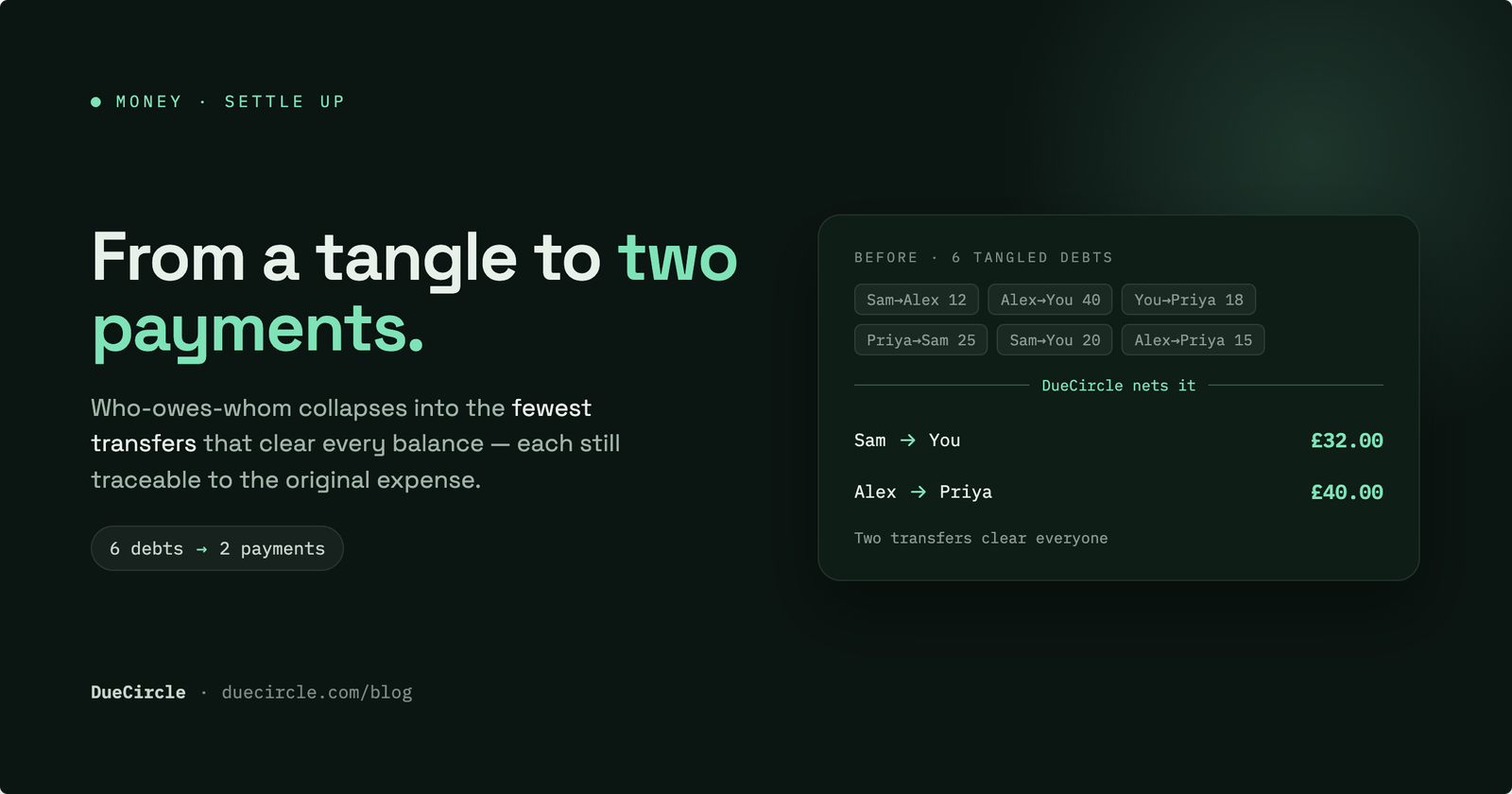
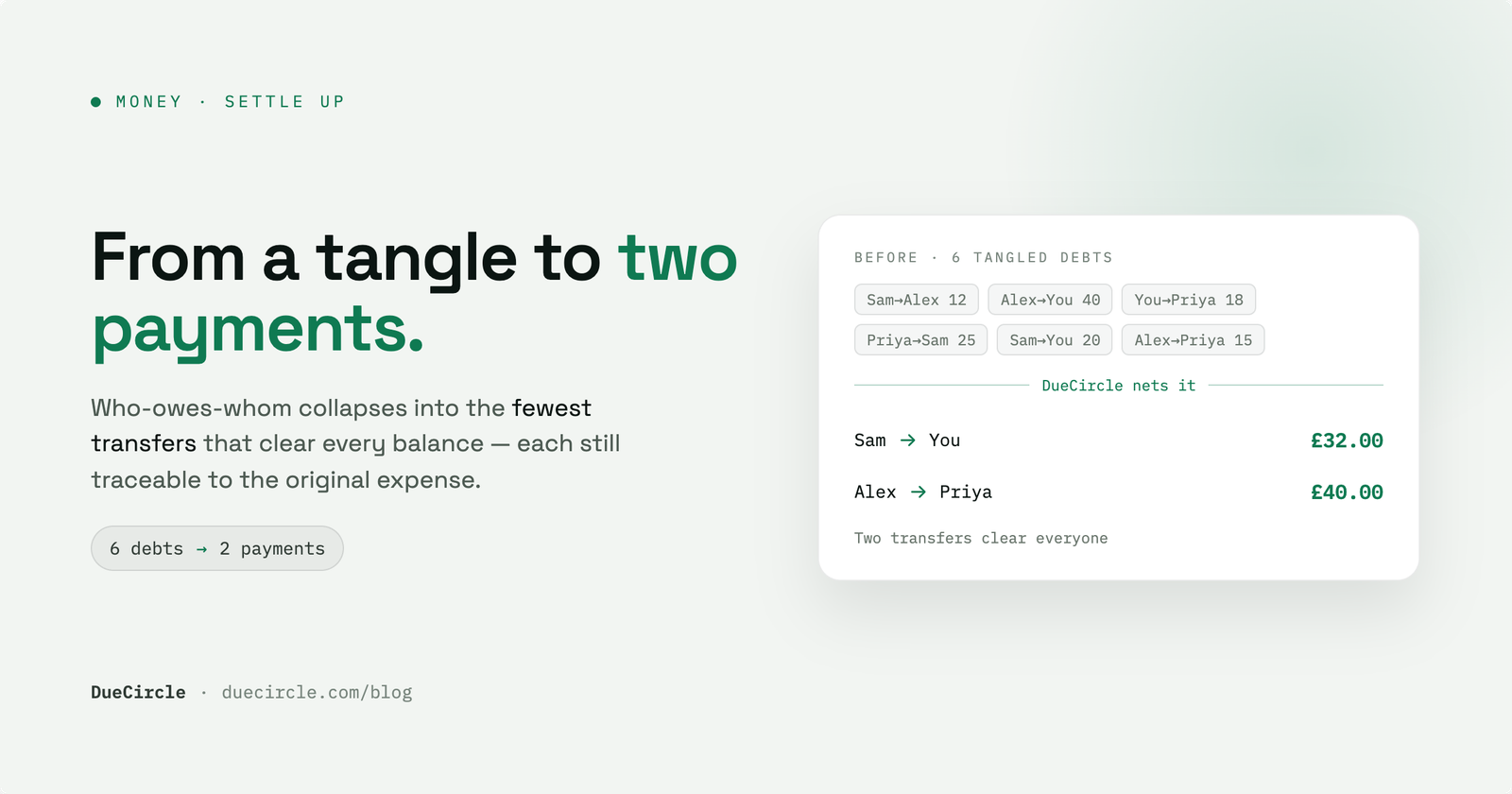
The trip is over, or the shared house has closed its books for the month. Someone covered the villa deposit, someone else kept paying for dinners, and a third person quietly bought every round of coffee. Now the group chat fills with half-remembered sums and the sentence nobody wants to say first: so who owes whom.
The tangle feels worse than it is. When A owes B, B owes C, and C owes A, it looks like a knot. It is really just three numbers that have not been added up yet. A settle up calculator does that addition for you, then works out the smallest set of payments that clears everyone at once.
The real problem is the tangle, not the total
Most groups do not struggle with the maths of a single expense. They struggle with the accumulation. Ten expenses across four people, each split differently, produces a web of small obligations that no one can hold in their head. Paid person by person, it can mean six or seven separate transfers, several of which cancel each other out.
The instinct is to settle each expense on its own: you paid for lunch, so I send you my share of lunch; I paid for the taxi, so you send me your share of the taxi. This works, but it is the long way round. Every transfer is a moment where someone can forget, mistype an amount, or send to the wrong person.
The better approach ignores individual expenses at the point of payment and looks only at where each person has ended up overall. That single figure per person is the key to untangling everything.
Net balances: one number per person, summing to zero
For each person, add up everything they paid on the group's behalf, then subtract everything they owed as their share of the expenses. The result is a single net balance. If it is positive, the group owes them. If it is negative, they owe the group.
Because every pound spent was paid by exactly one person and shared among some group of people, these net balances always sum to zero. The money that is owed and the money that is due are two views of the same total. This is not an accident of a particular trip; it is true of any honest set of shared expenses.
Once you have net balances, the individual expenses no longer matter for settling. It does not matter that your minus forty came from three dinners and a train ticket. All that matters is that you are minus forty and someone else is plus forty.
A worked example: four friends, one weekend
Suppose Aisha, Ben, Cara and Dan share a weekend away. Over two days they record four expenses, each split equally among all four, so every person's fair share of the total is the same.
Here is what each person paid, and where that leaves them once their equal share is subtracted.
- Aisha paid the £320 cottage. Ben paid £80 for groceries. Cara paid £40 for petrol. Dan paid £0. Total spent: £440.
- Each person's fair share is £440 divided by four, which is £110.
- Aisha: paid £320, owed £110, net +£210. Ben: paid £80, owed £110, net −£30. Cara: paid £40, owed £110, net −£70. Dan: paid £0, owed £110, net −£110.
- The three negatives add up to −£210, matching Aisha's +£210. The group balances to zero.
- Settled expense by expense, Ben, Cara and Dan would each send small amounts for the cottage, then reconcile groceries and petrol separately — five or six transfers in all.
- Settled by net balance, only three payments are needed, all to Aisha: Ben pays £30, Cara pays £70, Dan pays £110. Everyone is cleared.
Debt simplification: the fewest transfers that clear everyone
In the example above, everyone who owed money happened to owe the one person who was owed, so three payments were unavoidable and also minimal. In messier groups, several people are owed and several owe. Debt simplification is the step that pairs them up to use as few transfers as possible.
The principle is simple: match those who owe against those who are owed, largest against largest, until every balance is zero. A group of six with three creditors and three debtors rarely needs more than five payments, and often fewer. You never need more transfers than one less than the number of people who have a non-zero balance.
Fewer transfers is not just tidier. Each payment you remove is one fewer amount to type, one fewer reference to get right, one fewer person waiting to be reminded. A plan of two payments gets done that evening. A plan of seven tends to stall on the fourth.
The plan must always trace back to the expenses
A minimal plan is only trustworthy if it is explainable. When the calculator tells Dan to pay Aisha £110, Dan should be able to ask why, and see that his £110 is his equal share of a £440 weekend where he paid nothing. A number with no visible origin invites the exact argument settling up is meant to avoid.
This is why the settle-up figure and the underlying expenses should never be separated. DueCircle computes the minimal plan, then shows precisely which expenses produced each person's balance, so any figure can be traced back to the receipts behind it. The maths is done with exact integer amounts, so the pennies always reconcile rather than drifting a penny off through rounding.
It also matters when money crosses currencies. If the trip mixed euros and pounds, balances can be settled in a single base currency, but each person can still see the original expense in the currency it was spent in. The simplification changes how the debt is paid, never what it was for.
Settling well: order, recording and proof
Once you have the plan, a little etiquette keeps it clean. It usually helps for the people who owe the most to pay first, since their transfers clear the largest balances and make the remaining picture obvious to everyone else. Agree the base currency before anyone sends, so no one settles against a figure that later shifts.
Record each payment as it happens rather than at the end. DueCircle never holds or moves your money; you pay however you already pay, by bank transfer, UPI, cash or card, and then mark it as settled. You can attach proof, a screenshot or reference, so a payment is a fact in the record rather than a claim in the chat.
Do this and balances stay live: as each transfer is recorded, the amounts still outstanding update, and the group can see itself approaching zero. The last person to pay is settling against a picture everyone has already watched come true, which is the quiet, unremarkable way a shared account should close.
Published 18 June 2026.