A group trip is where most expense apps quietly fall apart. Costs land in several currencies over a single afternoon. The people involved change from one activity to the next. And nobody wants to sit in a hotel lobby doing arithmetic while everyone else heads to dinner.
The fix is not more discipline. It is a method that keeps the record honest as you go, so the totals still hold when you get home. A multi currency expense tracker should let you capture each cost exactly as it happened and defer the conversion to the very end, once, when you actually settle.
Why trips break most expense apps
Single-currency splitters assume one pot of money and a fixed group. A trip honours neither. Breakfast is paid in euros, the museum in Czech koruna, the taxi in cash that someone got from an airport kiosk at a worse rate than the card gave an hour later.
The group is not fixed either. Four of you share the flat, three go to the gallery, two split a late drink. If every expense is charged to everyone, the sums are wrong before you have left the first city.
The instinct is to convert each cost into your home currency as you enter it. That feels tidy and it is the single biggest source of error, because the rate you use in the moment is a guess, and every guess drifts from the next.
The core rule: record in the currency it was paid in
Enter each expense in the currency that actually left someone's hand. A koruna expense is stored as koruna. A euro expense is stored as euros. You do not convert in your head, and you do not round to something neat.
This matters because a mental conversion bakes a rate into the record permanently, and you can never recover the original number. If you write down that the taxi was ‘about twelve pounds’, the 320 koruna it really cost is gone. Keep the koruna and the twelve pounds can always be recalculated later, correctly and consistently.
A tracker that stores every amount as exact minor units, in its own currency, gives you a record that is true rather than approximate. Nothing is lost to rounding, and nothing is committed to a rate too early.
Capture the exchange rate, and where it came from
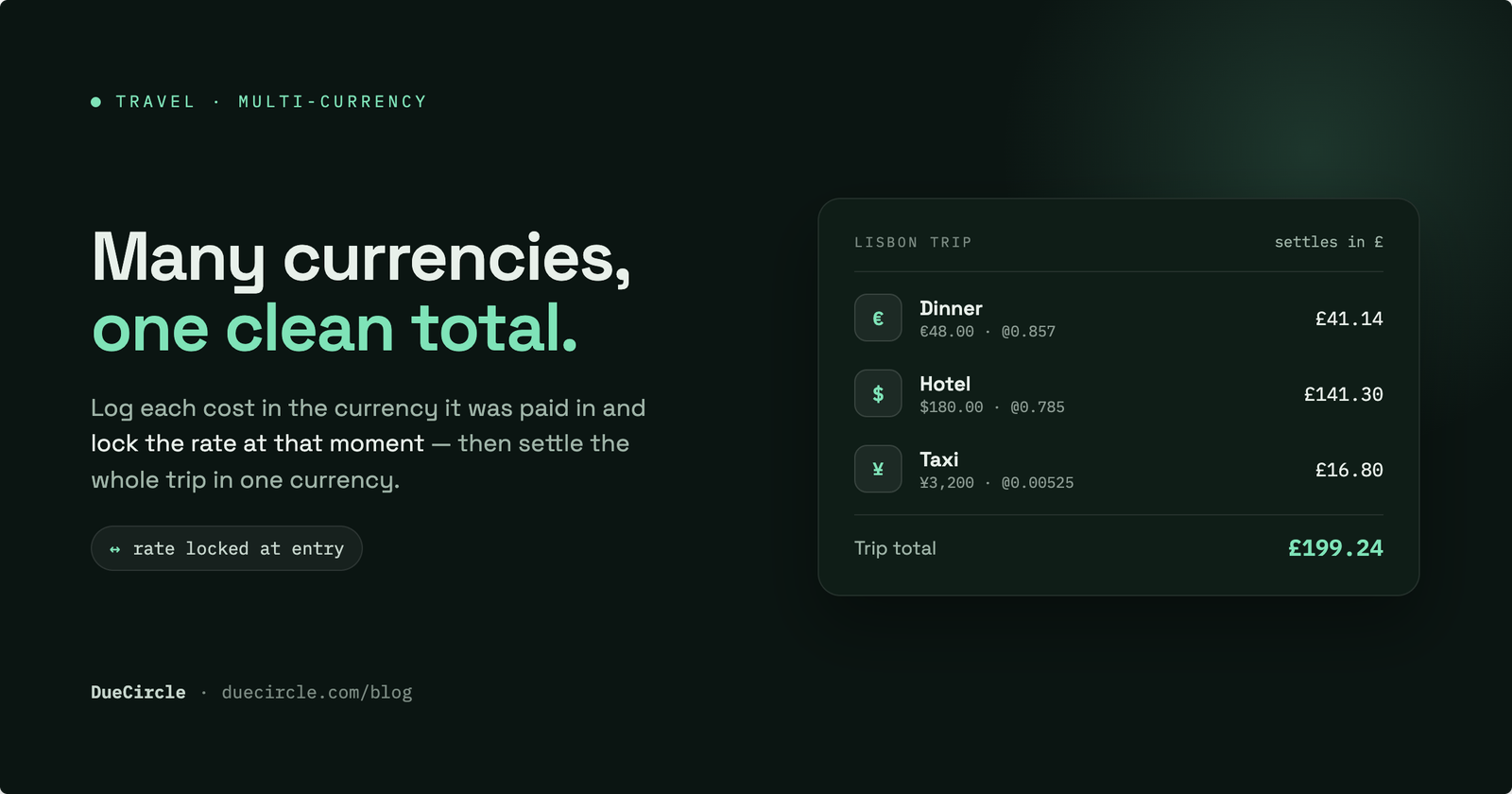
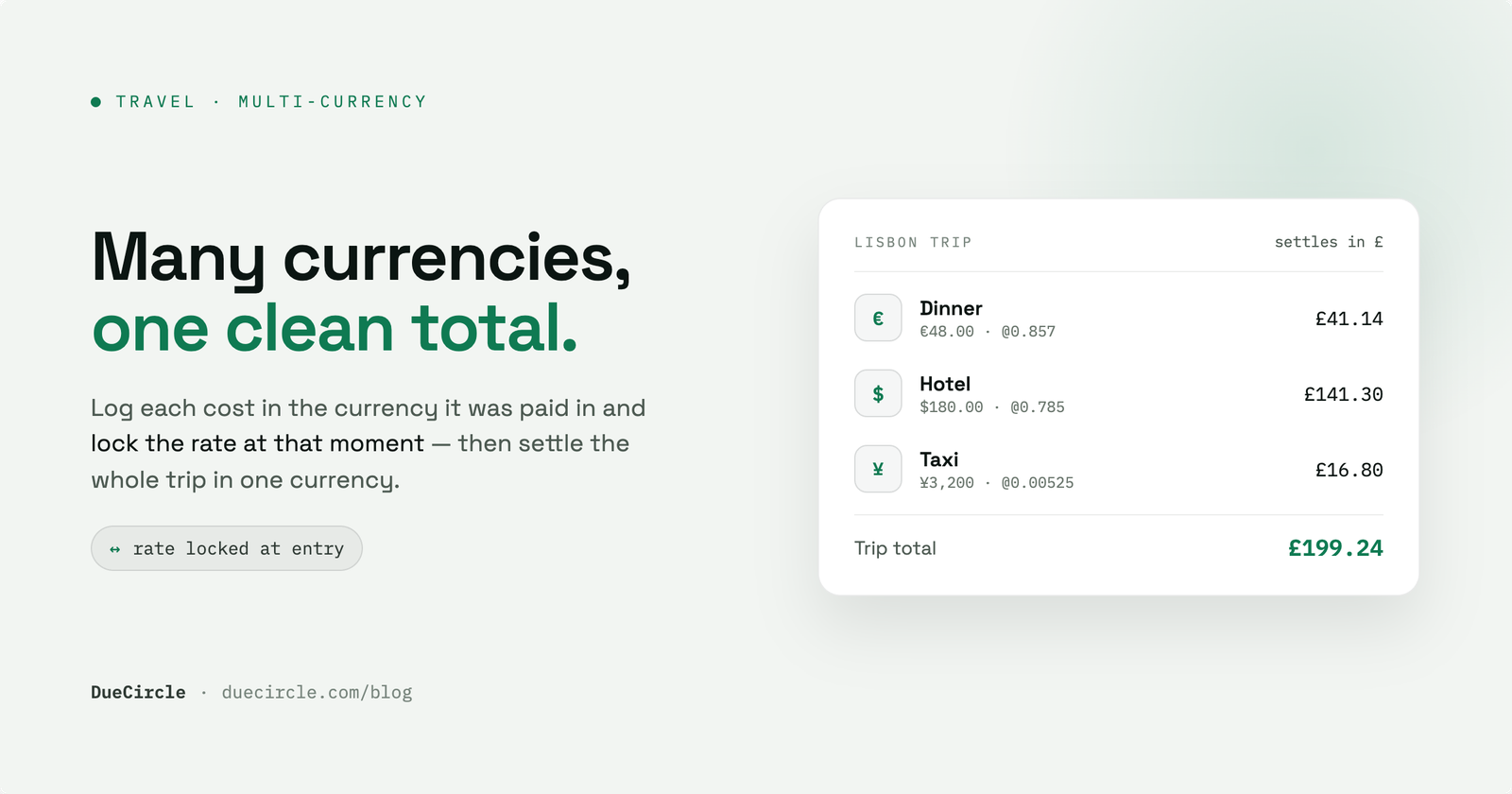
Rates move during the trip and they differ by method. A card network rate, an ATM withdrawal, and a high-street bureau can all price the same euro differently on the same day. So when a conversion does matter, record the rate you used and its source at the time.
This turns a settlement argument into a lookup. If someone later asks why the boat trip was split at 1.17 and not 1.15, the answer is written down: it was the card rate on the day it was paid, noted against the expense. A conversion recorded with its source can be re-checked; a conversion done in someone's head cannot.
You do not need a rate for every line. You need it wherever a foreign cost will eventually be shared or settled, so foreign currency splitting rests on a number you can defend rather than one you half-remember.
Pick participants per expense, and watch a daily budget
Choose who was actually in on each cost. The flat splits four ways, the gallery three, the drink two. A trip expense splitter that lets you set participants per expense means the group changes with the activity, which is how trips genuinely work.
Splits themselves can be equal, by shares, or exact. The room goes equally; the person who took the double bed takes a larger share; the one who ordered the expensive main pays their exact amount. The method is chosen per expense, not fixed for the trip.
Alongside this, watch daily spend against a budget. Seeing that today has already reached its limit by mid-afternoon is more useful than discovering the overrun a week after you are home.
- Equal: the flat, split evenly across the four who stayed.
- Shares: the taxi, weighted two-to-one because two people had the heavy bags.
- Exact: dinner, where each person pays for exactly what they ordered.
A worked example: why converting as you go drifts
Three friends spend a day across two currencies. Anna pays €60 for lunch. Ben pays CZK 1,500 for tickets. Cara pays €45 for the taxi. They want to settle in pounds at the end.
Suppose Ben, keen to be tidy, converts his koruna to euros in his head at 25 to the euro and records €60. But the rate his card actually applied was 24.4, making the tickets €61.48. That €1.48 gap is now permanent, and it favours Ben without anyone intending it. Do this across a dozen expenses and the drift reaches real money.
Now do it the honest way. Lunch stays €60, taxi stays €45, tickets stay CZK 1,500. At the end you apply one euro-to-pound rate and one koruna-to-pound rate, each recorded with its source, and settle up in one currency. Every share is computed from the true figures with a single, documented conversion, so the total reconciles to the penny.
Settle once, then archive
At the end of the trip, choose one base currency and settle. The tracker converts each stored amount using the rates you recorded, nets everyone off, and tells you who owes whom. Because the conversion happens once, over exact figures, the result is reproducible rather than a negotiated guess.
Then archive the trip with its records intact. The koruna stays koruna, the euros stay euros, the rates and their sources stay attached. If a question comes up in six months, the full history is there to re-check, not lost to a tidy-up.
That is the whole discipline: record in the real currency, note the rate and where it came from, choose participants per expense, and convert only at the end. It is free to do, it never touches your bank, and it turns the messiest part of group travel expenses into something that simply reconciles.
Published 7 July 2026.