
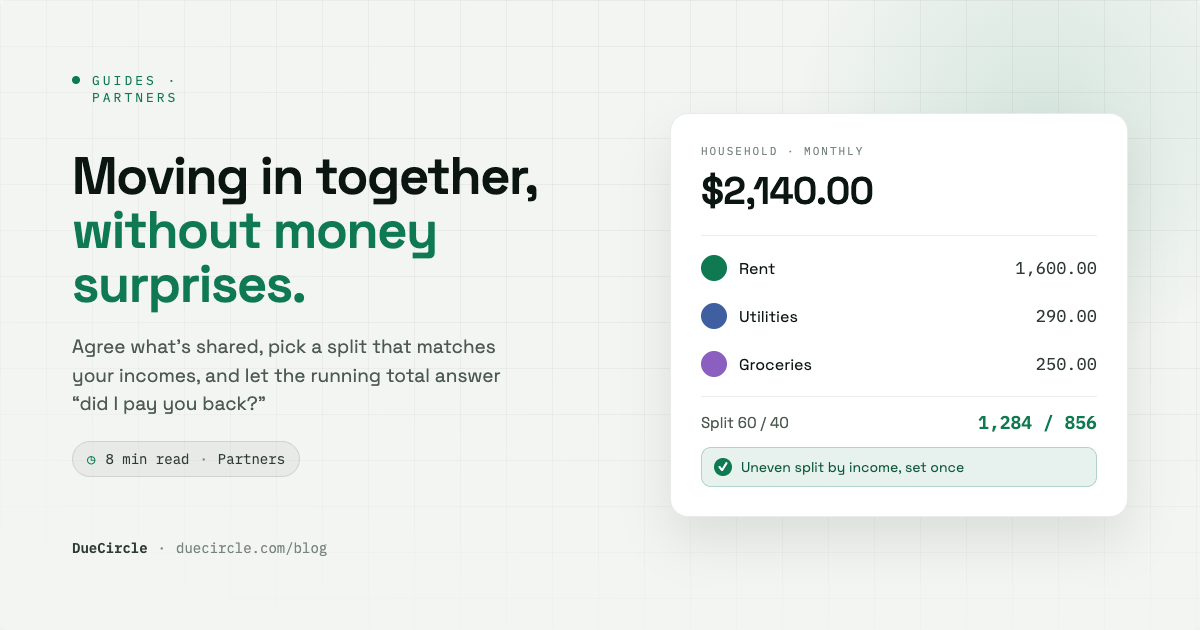
Moving in together is exciting right up until the first joint bill lands and you both realise you never actually agreed how this works. Who pays rent? Do we split the sofa fifty-fifty even though one of us earns a lot more? Is your gym membership a shared cost now?
None of these questions are romantic, and none of them go away if you avoid them. The couples who handle money well are not the ones who earn the same — they are the ones who had a slightly awkward conversation early and then set up a system they stopped renegotiating. This is how to have that conversation and turn it into something you barely think about.
Have the money talk before the boxes arrive
The best time to agree how you split things is before either of you has paid for anything. Once the deposit has gone out of one person's account and the other has bought the bed, you are negotiating with feelings attached instead of a blank slate.
Keep the first talk simple. What is our rent, what are the predictable monthly bills, and roughly what do we both earn? You are not drafting a contract. You are agreeing a starting point you can both look at without flinching.
It helps to say out loud that this is about fairness, not scorekeeping. You are on the same side, trying to build something that does not quietly make one of you feel used.
Agree what is shared and what stays yours
The single most useful line you can draw is between shared and personal. Shared is the stuff you both benefit from — rent, electricity, internet, the weekly food shop, the new kettle. Personal is your phone, your clothes, your hobbies, your nights out with your own friends.
You do not need to merge everything to live together. Plenty of happy couples keep their own accounts and simply share the household costs. What matters is that you both know which bucket a spend falls into, so nobody is silently subsidising the other's takeaways.
Handling uneven incomes without resentment
Splitting everything exactly fifty-fifty feels fair on paper and can feel deeply unfair in real life. If one of you earns ₹80,000 a month and the other ₹40,000, an equal split leaves the lower earner with far less breathing room after the same bills.
A kinder approach is to split shared costs in proportion to income. Say your shared monthly bills come to ₹30,000. Split by percentage — roughly 67 percent and 33 percent — and the higher earner pays ₹20,000 while the lower earner pays ₹10,000. Both of you give up a similar slice of what you actually have, which is what fairness usually means in practice.
In DueCircle you can split any expense by percentage or by shares, so you set those weightings once and every shared bill follows them automatically. When the split does not divide cleanly, the app allocates in whole paise and hands any leftover unit to one named person, so the two amounts always add back to the exact total.
Set it up once so you stop renegotiating
The reason money grinds couples down is repetition. Having the same 'whose turn is it' conversation forty times a year is exhausting in a way no single bill ever is. The trick is to decide the rules once and let a shared record carry them.
Start a group for the two of you — or use a one-to-one split, matched by your partner's mobile number or email, which keeps a single running balance between you. Add rent, bills and the shop as they happen, each under whoever paid, with your agreed split applied.
Here is what that looks like day to day:
- Rent and fixed bills go in with your agreed percentage or shares.
- The food shop and one-off household buys get added under whoever paid.
- Live balances quietly track who is ahead this month.
- Personal spending stays out of it entirely — that is nobody's business but yours.
- You settle the difference on a rhythm that suits you, not per receipt.
Let the record do the awkward part
When everything is written down, money stops being a conversation and becomes a glance. Instead of 'I feel like I always pay for groceries', you both look at one balance and see whether that is actually true. Usually it is closer than either of you thought, and either way you now know.
When it is time to square up, settle-up gives you a plan that clears the balance in a small number of payments. You pay each other however you already do, mark it recorded, and move on with your evening.
DueCircle is free forever, takes just an email to start, and never touches your bank or moves your money. It keeps your shared record private and does the maths, so building a home together does not turn into keeping score.
Published 22 July 2026.