Not every shared expense needs a group. Sometimes it is just you and one other person: a partner, a flatmate, a colleague you keep covering for at lunch. You paid for the cab today, they will grab the groceries tomorrow, and somewhere in the middle you both quietly lose the thread.
You could keep a tally in your head, but heads are terrible at this. DueCircle has a shape built for exactly this: a one-to-one balance between just the two of you, so at any moment you see a single number, who is ahead and by how much.
When it is just the two of you
Think of the money that only involves one other person. You and your partner splitting a weekend. You and your roommate on the odd shared cost that is not rent. You and the friend you always seem to cover because your card is the one already saved.
None of that needs a group with members and settle-up plans for four people. It is a straight line between two of you, and treating it like a committee just adds friction.
The real problem is not the money, it is the remembering. A ₹200 here, a ₹350 there, and by Friday neither of you can say honestly who is up. That vagueness is where small resentments start.
One running balance, not a stack of receipts
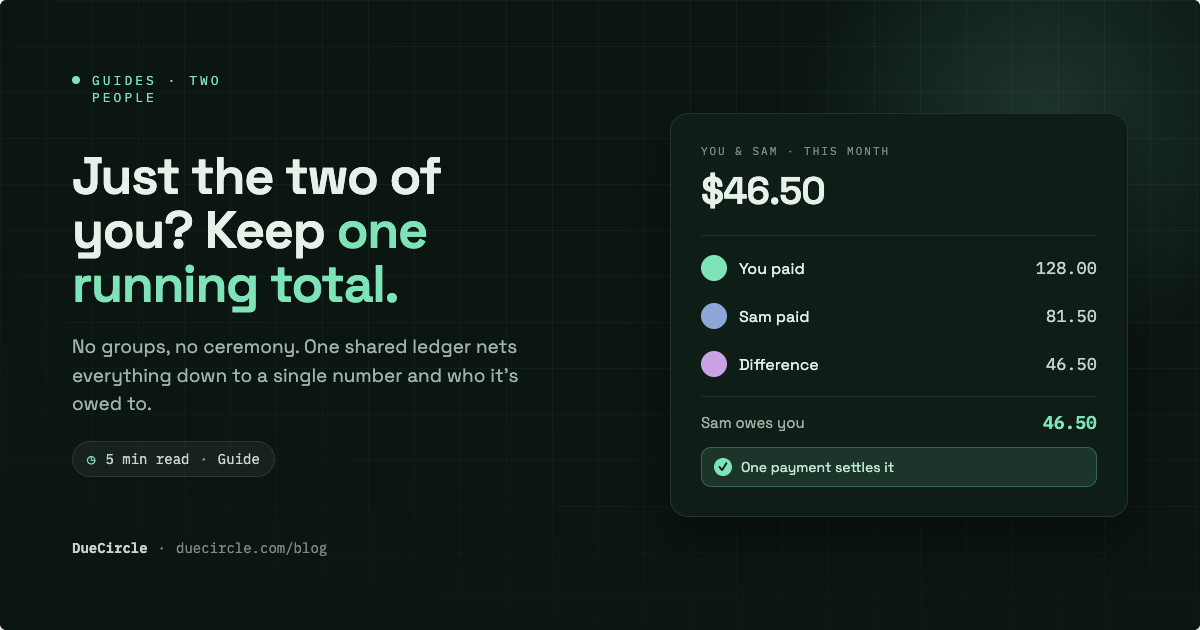
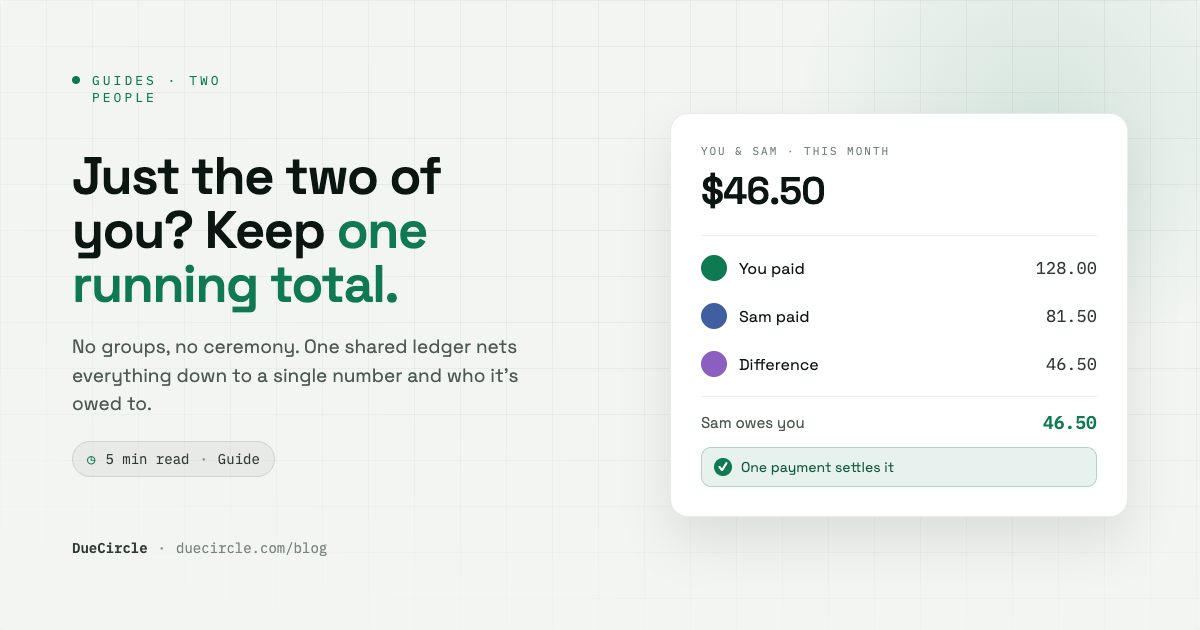
A one-to-one balance keeps a single net figure between you and one person. Every time either of you adds something, it nudges that number up or down, and the app does the arithmetic.
You do not read a list of who paid what and try to add it up. You read one line: they owe you, or you owe them. That is the whole idea, a net number you can both trust without re-checking.
Because it is just two people, there is no puzzle to solve about who pays whom. When you want to clear it, one of you pays the other, outside the app, and marks it recorded.
Finding the other person
To start a one-to-one balance, you look the person up by the exact mobile number or email they signed up with. Match those and you are linked to the same running total; you see one side of it, they see the mirror image.
It stays private between the two of you. There is no group feed, no third party watching the tally, just your shared line of small debts.
- Find them by their exact mobile number, or
- Find them by the exact email they used to sign up
- You both need a free account (an email is enough)
- One shared balance appears, netted to a single number
- Add an expense any time either of you covers something
A quick example in rupees
Say you pay ₹800 for dinner and split it equally, so you each owe ₹400. Your friend now owes you ₹400. Simple enough so far.
The next day they pay ₹1,200 for groceries, split equally, ₹600 each. Now you owe them ₹600. DueCircle nets the two: they owed you 400, you owe them 600, so the running balance settles at you owe them ₹200.
You never did that subtraction. You just opened the balance and read one line: you owe ₹200. When you hand it over and mark it recorded, the number returns to zero.
You never have to reconstruct it
The point of tracking money between two people is not to be strict, it is to stop keeping score in your head. When the number is written down and honest, neither of you has to bring it up awkwardly or pretend to forget.
DueCircle is free forever, with no card and no premium tier, and it never touches your actual money; you pay each other however you already do. It just holds the running total and does the maths, so nobody has to remember, and nobody has to chase.
Published 25 July 2026.