Money between friends is strange. You would happily lend a friend your car for a weekend, but asking them for the ₹600 they owe from last month can feel weirdly enormous. The awkwardness is real, and pretending it is not just makes it worse.
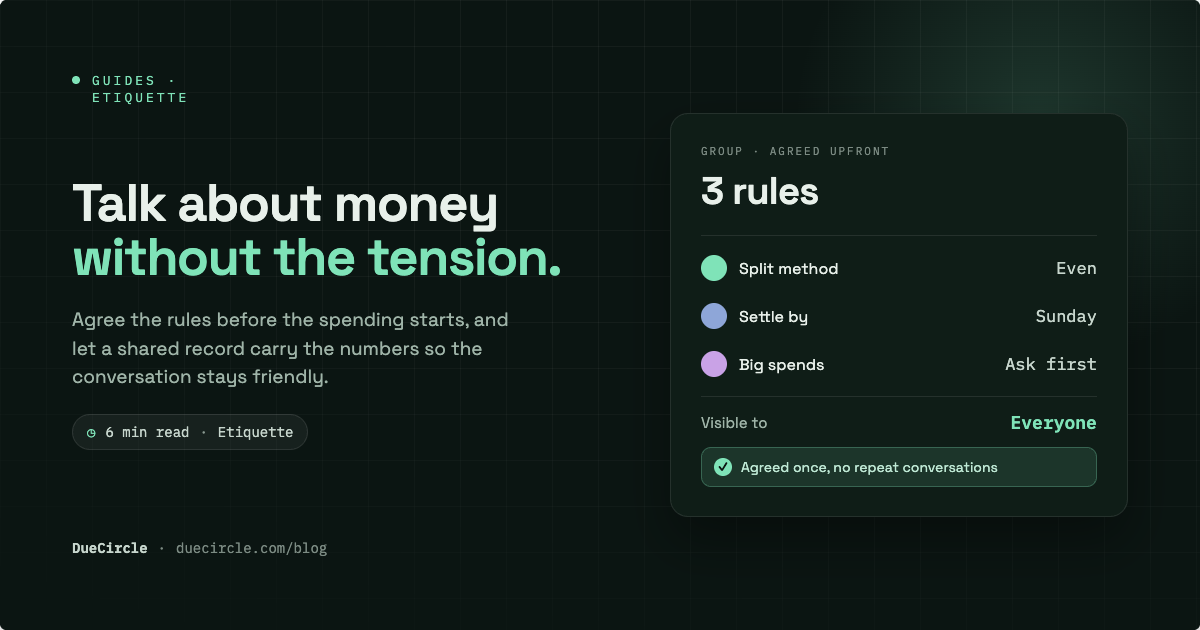
The good news is that almost all of it comes from one thing: unspoken expectations. Say the quiet part early, before the trip, before the dinner, before the favour, and most of the weirdness never gets a chance to form. Here is how to have those conversations, and how a shared record quietly retires most of them.
Why money with friends feels so awkward
With a shop or a landlord, money is just a transaction. With a friend, every rupee also carries a small signal about the friendship: are we equals, do you trust me, am I being generous or a pushover? That mixing of money and meaning is what makes it prickly.
We also tend to guess instead of ask. You assume your friend is fine covering the cab; they assume you will square up later; neither of you says anything, and a small silence turns into a small grudge.
None of this means you are bad with money or bad at friendship. It means money is emotional, and the fix is not to feel less. It is to talk a little earlier and a little plainer.
Set expectations before the money is spent
The easiest money conversation is the one you have before anyone has paid for anything. Nobody is owed yet, nobody is defensive, and you are just agreeing how a plan will work.
Before a trip, that might be: are we splitting everything evenly, or paying for what we each use? Before dinner, it might be: shall we just split the bill equally, or is anyone counting drinks? Ten seconds of asking saves an hour of stewing.
Scripts for the moments that usually sting
Most awkward money moments are just a handful of situations on repeat. Having a line ready means you say the kind, clear thing now instead of the resentful thing three weeks later.
Notice that none of these accuse anyone. They assume good faith, they are specific about the amount, and they give the other person an easy, face-saving way to act.
- Reminding someone: 'No rush at all, whenever you are near your phone it is ₹600 for the cab.'
- Asking to split fairly: 'Mind if we split by what we each ordered? I barely drank.'
- Declining a plan you cannot afford: 'That is a bit out of my budget this month, can we do something cheaper?'
- Chasing an old debt: 'I lost track, did we ever square up for the concert tickets?'
- Offering to pay first: 'I will get this one, you grab the next.'
Let a shared record do the awkward part
Here is the quiet trick: most money conversations between friends are not really about willingness to pay. They are about nobody being sure of the number. Remove the uncertainty and the awkwardness mostly evaporates.
When there is one shared, visible balance that everyone can see, you never have to send the dreaded 'you still owe me' text. The figure is just there, not an accusation from you, just a fact you both agreed to record. Friends pay it because it is obvious and fair, not because you nagged.
A worked example: four friends split a ₹3,200 dinner four ways, ₹800 each. One friend covered the whole bill, so the record simply shows the other three owe ₹800 to that friend. No debate, no reconstructing the evening; the number speaks for itself.
Keep the friendship, lose the accounting
The aim is never to turn friends into debtors. It is to get the money out of the emotional part of your brain and into a plain, shared list, so the friendship is about the friendship again.
DueCircle is free and private, and it does the maths so nobody has to keep a tally in their head or chase anyone by text. Each expense shows who paid, who owes, and how to settle in a few simple payments.
Have the honest conversation once, up front, then let the shared record carry the rest. That is how you talk about money with friends without it ever getting weird: you mostly stop needing to.
Published 7 August 2026.