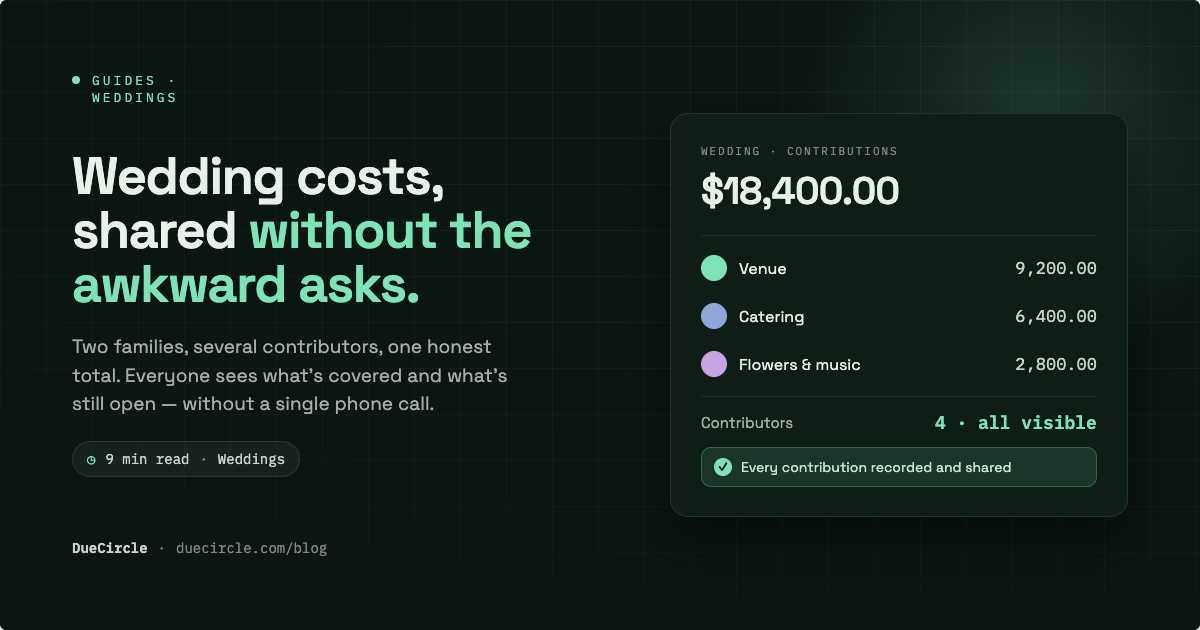
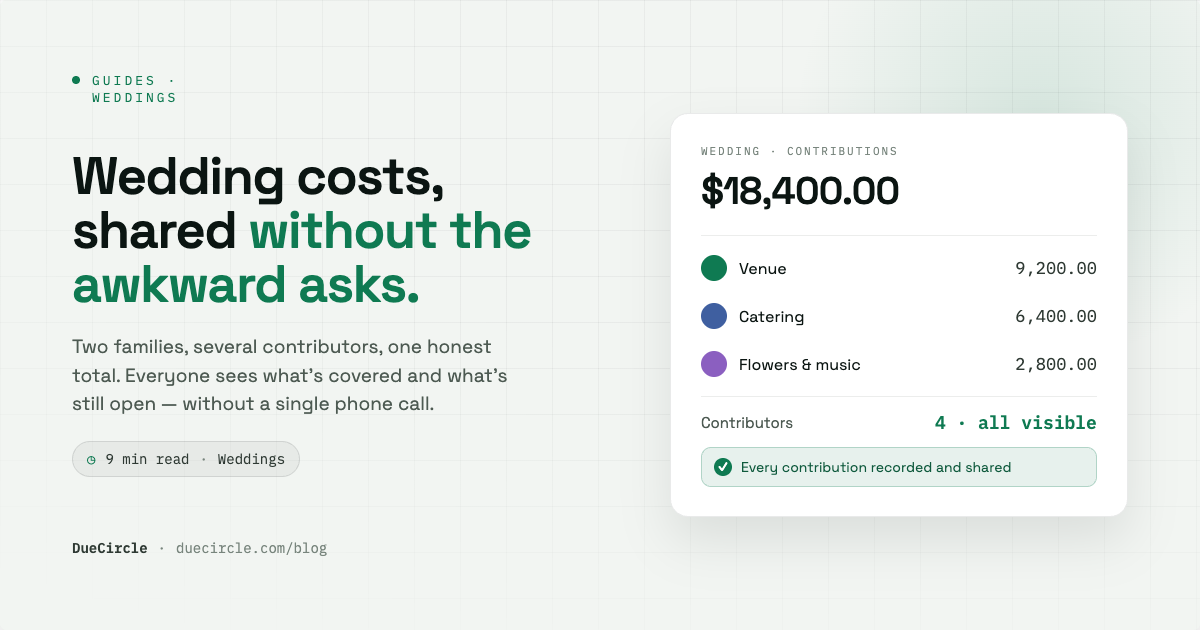
A wedding is the most expensive party most families ever throw, and it is almost never one person paying. Parents chip in, the couple covers part, an aunt insists on handling the flowers.
Once more than two or three people are contributing, the money gets murky fast. Who pledged what, who has actually paid, and who is still saying I will transfer it next week three weeks later. Here is how to keep a clear, un-awkward record when lots of people are chipping in.
Who pays now that the old rules are gone
Tradition had tidy rules — one family took the reception, the other covered this or that. Those rules are mostly gone, and good riddance to the awkwardness of enforcing them.
Today it is usually a blend: the couple pays a chunk, both sets of parents contribute, and a few relatives cover specific things they care about. That is more flexible, and a lot harder to track.
The point of tracking is not to police anyone. It is so nobody double-pays the caterer and nobody's contribution is quietly forgotten.
Pledged is not the same as paid
The trickiest part of shared wedding costs is the gap between what people promised and what has actually landed. An uncle who pledged ₹50,000 and an uncle who has paid ₹50,000 are two very different things for your budget.
DueCircle records real expenses — money actually spent — against whoever paid each one. When the uncle pays the decorator directly, log it as his expense. Until he does, it is not in the balances, which stops pledged from masquerading as paid.
Say the reception is ₹3,00,000, shared as agreed shares: the couple 2, each family 1, four in all. That is ₹75,000 a share — ₹1,50,000 from the couple, ₹75,000 from each family. As each part is genuinely paid it shows up, and whatever is still outstanding is plain to see.
One record everyone can see
When ten people are chipping in, memory fails and side-chats multiply. One shared record everyone can open beats ten different mental tallies that never agree.
Put every real cost in a single group — venue, catering, outfits, photographer — each logged against whoever paid it. Anyone in the group can see where things stand without asking around.
Keep the things one side wants to handle alone as their own expenses, with only that side included, so their generosity does not get charged back to everyone.
- Each vendor payment, against the person who actually paid it
- Shared costs split by agreed shares, not forced evenly
- Costs one side is covering alone, with only them as participants
- Who has paid whom back, marked as recorded
- Nothing until the money is real — pledges live on paper for now
Keeping it un-awkward
Money between family carries feelings. The trick is to make the record boring — plain numbers everyone agreed to, visible to all, with no single person as the gatekeeper.
Split the big shared items by shares so a family covering more of the reception is not charged the same as one covering less. It matches what people actually said they would give.
Because balances update as payments go in, nobody has to send the dreaded so about the money message. The numbers speak, gently.
Settle the last bit cleanly
After the wedding, a little money usually still needs to move — someone fronted the photographer, someone owes the caterer's balance. DueCircle's settle-up gives a short plan that clears everyone in a small number of payments, matching who owes to who is owed.
Mark each payment recorded as it happens, and the record closes itself out. The app never holds or moves the money — people pay each other directly.
It is free forever and private, and it does the maths so nobody in the family ends up chasing relatives for rupees at what should be a happy time.
Published 9 July 2026.