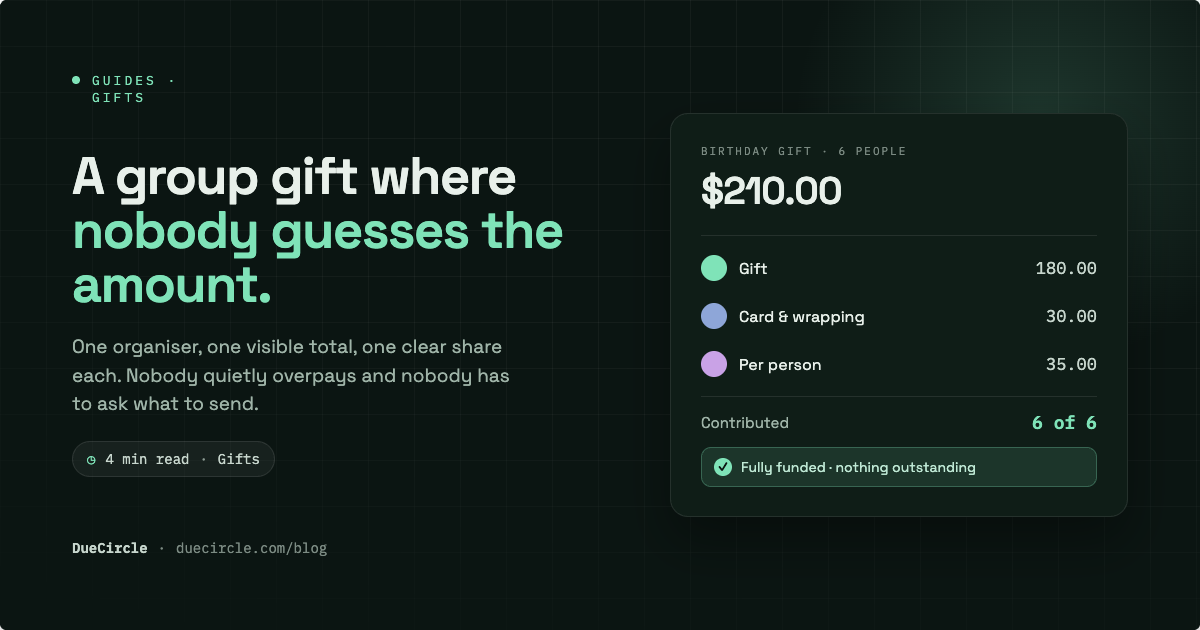
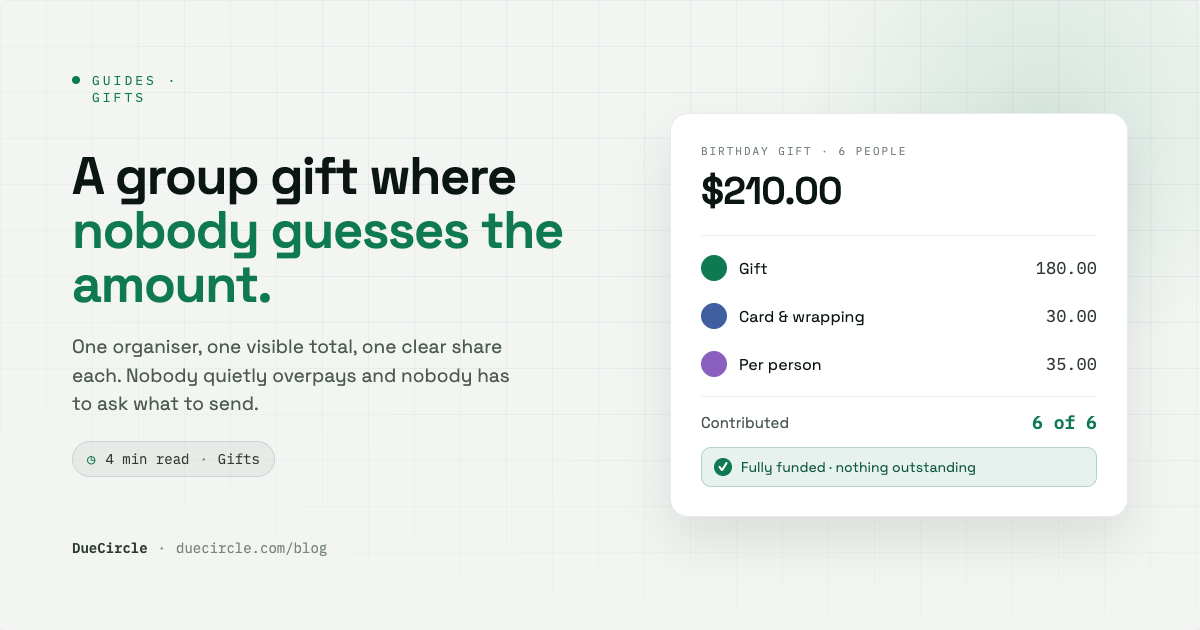
Somebody always starts it: 'Should we all chip in for Anaya's leaving gift?'. Everyone agrees in about four seconds flat. Then comes the part nobody enjoys — working out who has actually paid, and gently nudging the two who keep meaning to.
A group gift should feel warm, not like running a tiny fundraiser out of your phone. The good news is that the money can stay perfectly clear and the surprise can stay intact, as long as you agree the total up front and keep the sums somewhere everyone can see.
Agree the total before you buy
Decide what you are buying and what it costs before you collect a single rupee. A ₹6,000 watch split eight ways is a clean ₹750 a head; the same watch decided on after four people have already sent ₹500 each is a small administrative nightmare.
Fixing the total first also protects whoever is doing the buying. Nobody wants to front ₹6,000 on their own card and then spend a week chasing the last ₹1,500 because the plan kept quietly changing shape in the chat.
If a couple of people want to give a bit more so someone on a tighter budget can give less, that is a lovely thing to do. Just agree it out in the open, rather than letting one generous person silently subsidise everyone else without anyone noticing.
Equal or pay-what-you-can
There are two fair ways to divide a gift, and both are honest. Equal keeps it dead simple. Pay-what-you-can — which DueCircle handles as shares — lets people give at their own comfort level without anyone having to announce their salary to the group.
Say a ₹5,000 gift is split by shares because three friends happily offered to give double. You set shares of 2, 2, 2, 1 and 1 across the five of you, which is eight shares in total. Each single share works out to ₹625, so three people pay ₹1,250 and two pay ₹625, and it all adds up to exactly ₹5,000.
DueCircle rounds every share to whole paise and, if a split ever leaves an odd leftover unit, it hands that single unit to one named person out in the open. The shares always sum to the real total, so the person buying the gift is never left a rupee short at the till.
Collecting from people who are not in the room
Not everyone who wants in will be standing next to you when you collect. Someone is travelling, someone saw the chat three hours late, and someone always, always pays last. That is fine — you just need a way to include them without herding cats across four time zones.
If it is only one other person you are squaring up with, DueCircle's one-to-one splitting lets you settle directly with them by their exact mobile number or email, keeping a single running balance between just the two of you.
A simple way to keep everyone in:
- Add everyone who is chipping in, present or not, so the total is right from the start
- For a single far-flung friend, use a one-to-one split by their number or email
- Let people pay you back whenever suits them — UPI, cash, later tonight
- Mark each payment recorded so the balance always shows who is still to give
Keeping the surprise while keeping the money clear
The awkward bit of a group gift is that the person receiving it must not see the sums flying back and forth. You want the money fully visible to the givers and completely invisible to the guest of honour.
The simplest answer is to keep the gift in its own little group and just not add the recipient to it. Everyone contributing can see the balance and who has paid; the person being surprised never catches a glimpse, because they were never a member in the first place.
The clear part and the kind part
A gift is meant to say 'we thought of you', not 'please settle your ₹625 by Friday'. Keeping the money tidy and quiet in the background is exactly what lets the front of the whole thing stay warm and generous.
DueCircle does the dividing, tracks who has chipped in, and lays out who owes whom if the collectors need to square up between themselves — all for free, with the group's numbers kept private and no money ever passing through the app. You handle the thought; it handles the arithmetic, so nobody has to chase and nobody has to do sums at the card machine.
Published 19 July 2026.