
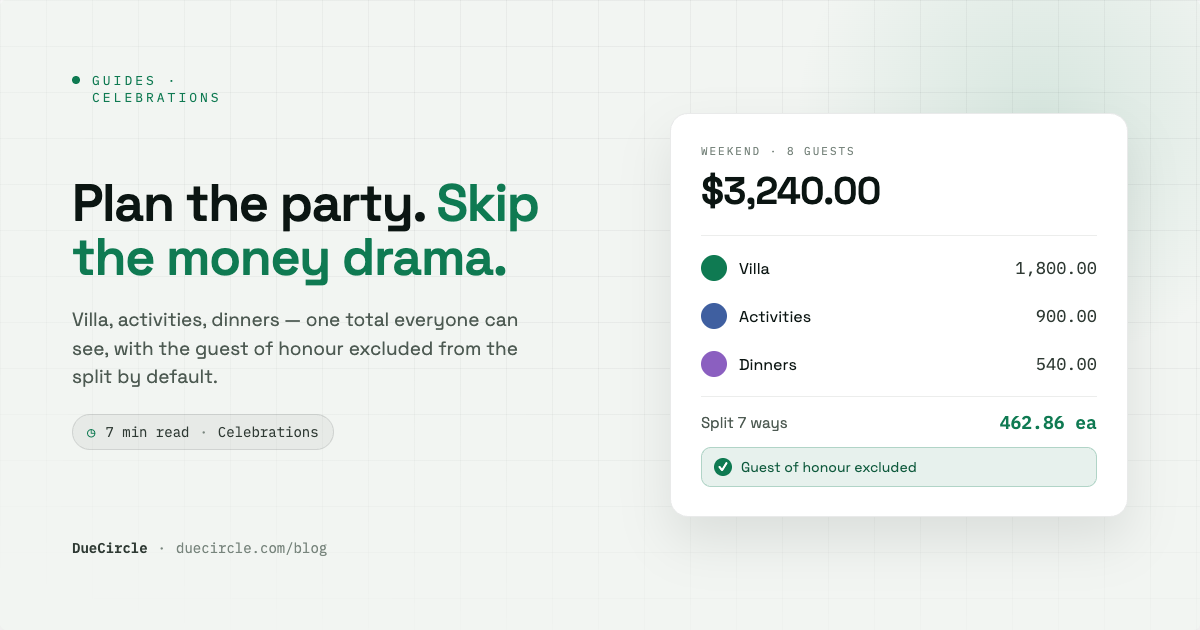
Someone has to plan it, someone has to pay the deposit, and by unspoken tradition the guest of honour does not pay a paisa. That is three money problems before anyone has even booked the karaoke room.
A bachelorette or bachelor party is a gift the group gives one person, which makes the splitting a little unusual. The guest of honour goes free, their share lands on everyone else, and one poor organizer usually fronts half of it. Here is how to keep it fair and shock-free.
The guest of honour goes free — so plan for it
The convention is simple: the person being celebrated does not pay. Their dinner, their share of the villa, their spot on the boat — the rest of the group covers it between them.
That means every cost is divided among the payers, not the whole headcount. Ten people at the party usually means nine wallets.
Say it out loud early. Tell the group the guest of honour is covered so nobody blinks when their share comes out a little bigger than a straight even split.
Exclude the guest of honour, expense by expense
In DueCircle, you add each expense and choose who it applies to. Leave the guest of honour off the ones the group is gifting, and their share spreads across everyone else on its own.
Take a ₹9,000 dinner for ten including the bride. Include her and it is ₹900 each. Leave her off and it splits among nine at ₹1,000 each — that extra ₹100 a head is the gift, and it adds back to exactly ₹9,000.
Some things she may want to pay for herself, like her own flight. Just include her on those and leave her off the celebration ones. You decide per expense, not once for the whole trip.
The organizer who fronts everything
One person books the villa, pays the club deposit, buys the sashes. By the time the trip starts they might be ₹40,000 out of pocket with nothing back yet.
Record every one of those payments as an expense paid by the organizer. Live balances keep a running tally of what each guest owes them, so the debt never lives only in the organizer's head.
A ₹36,000 villa across six paying friends is ₹6,000 each owed to the organizer. Add the club deposit and the dinner and the number climbs — but it stays visible the whole time, never a guess at the end.
No shock bills
The thing that ruins these trips is not the cost. It is the surprise — the friend who thought it would be ₹8,000 and gets asked for ₹15,000 on the drive home.
Add expenses as they happen, not in one lump at the finish. Anyone can open the group and see the running total and their own balance whenever they want.
When people can watch the number grow, there is nothing to flinch at later. The bill stops being a reveal.
- Say up front that the guest of honour is covered
- Add each cost the day it happens, not in one final reckoning
- Let people check their own balance whenever they like
- Keep optional add-ons like a spa or extra bar tab as separate expenses only the takers join
- Settle once at the end, in a few clean payments
Square up when the confetti settles
When it is over, DueCircle gives you a short settle-up plan that clears everyone by matching the largest debtor to the largest creditor. Guests pay the organizer directly and mark it recorded.
No chasing, no awkward reminder texts a week later. The balances already say who owes what.
It is free forever and private — no card, no premium tier — and it does the maths so the friend who planned the whole thing is not also stuck being the bookkeeper.
Published 16 July 2026.