The food was good, the evening was easy, and then the bill arrives and something shifts. Someone reaches for the receipt, someone else does mental arithmetic, and a warm night takes on a faint edge. Nobody wants this part, yet it happens at almost every group dinner.
Knowing how to split the bill is less about maths than about manners. The numbers are simple. The awkwardness comes from not agreeing, before the food ever turns up, on what fairness looks like at this particular table. This is a short guide to doing it gracefully.
Even split or pay for what you had
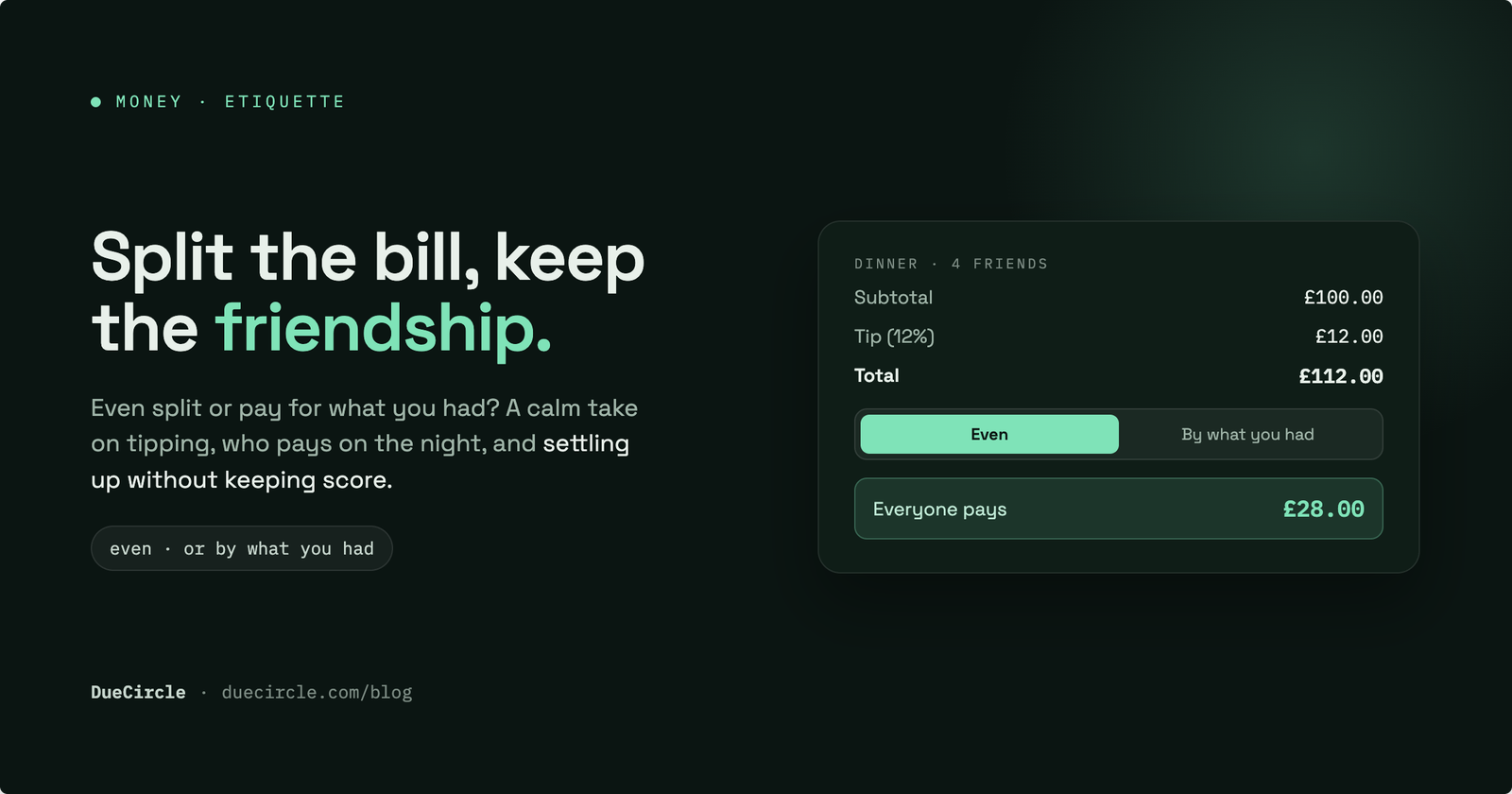
There are really only two ways to split a bill, and most tension comes from people quietly assuming different ones. An even split divides the total by the number of people. Paying for exactly what you had means each person covers their own dishes and drinks. Both are fair. They are simply fair in different situations.
An even split suits a shared, sociable meal: plates in the middle, a couple of bottles between everyone, roughly similar appetites. Totting up who had the third glass would cost more goodwill than it saves. Paying for what you had suits a table where the orders diverge sharply, or where someone is deliberately keeping it light.
The trick is to read the table rather than default to your own preference. If you had the most, lean towards itemising. If you had the least, an even split is a small kindness you can offer without comment.
- Even split: shared dishes, similar orders, a relaxed group who would rather not count.
- Pay for what you had: very different orders, or someone eating and drinking noticeably less.
The awkward cases, handled quietly
Most bills are straightforward. It is the exceptions that make people tense, and each has a graceful answer.
Someone drank nothing, or barely ate. On a night with several bottles of wine, an even split quietly overcharges the person on tap water. The considerate move is to notice before they have to raise it: suggest they cover just their food, or knock the drinks off their share. Let them keep their dignity rather than making them ask.
Someone ordered the lobster. If one person's dish costs twice anyone else's, an even split asks the table to subsidise it. The person who ordered it should offer to cover the difference, and the rest can wave it through if it is small. The rule of thumb: whoever chose the expensive thing raises it first.
The big earner offering to cover more. Generosity is lovely, but it changes the temperature of a friendship if it becomes the expectation. Accept it warmly when offered, decline gently if you would rather keep things even, and never assume it. A one-off round is a gift. A standing arrangement is a different thing entirely.
Who pays on the night, and settling later
Splitting a card machine six ways at the table is slow and slightly grim, and some places will not do it at all. It is almost always smoother for one person to pay the whole bill and everyone to square up afterwards.
This only works if settling up is genuinely quick, and if the person who paid never has to chase. That second part is where friendships quietly fray. Nobody minds fronting the money. People mind sending three reminders and feeling like a debt collector to their own friends.
So take turns being the one who pays, and treat prompt repayment as the real courtesy. The person who covered the bill did everyone a small favour. Paying them back that evening, or the next morning, is how you honour it.
Tipping and the service charge
Tipping is where a tidy split can quietly unravel, because people feel differently about it and often do not say so. Check the bill first: many places now add a service charge automatically, and tipping again on top is a choice, not an obligation. If it is already included, the fairest thing is to fold it into whatever split you have chosen.
If you are adding a tip, agree on it as a group before you divide, not after someone has already worked out their share. A tip decided halfway through the maths forces a recalculation and makes the generous person feel like they are imposing it on everyone.
When the split is itemised rather than even, the neat approach is to add the tip and service proportionally, so the person who spent more contributes a little more to it. It mirrors how the rest of the bill already works, and no one has to argue the point.
Don't keep score out loud
The single biggest thing that spoils a good evening is narrating the money. Announcing who owes what across the table, reminding someone they missed last time, doing sums aloud while others are still talking: all of it turns friends into accounts.
Keeping score is not the problem. A rough sense of who paid last, and whose turn it is, is just being considerate. The problem is performing it. Fairness works best when it is felt rather than declared, and when the arithmetic happens off to the side rather than centre stage.
This is the real reason a shared record helps. Not because friends cannot be trusted, but because writing it down once removes the need to say any of it aloud. The figures live somewhere neutral, everyone can see them, and the conversation stays about the evening.
Settle promptly and let it go
The etiquette of splitting the bill comes down to a few small habits. Agree how you are splitting before the awkwardness arrives. Notice the person who had less. Let whoever ordered the extravagant thing raise it first. Take turns fronting the money, and pay each other back quickly.
Do that and the money stops being a thing you manage and becomes a thing that quietly resolves itself. The bill is settled, the record is clear, and nobody is left chasing or stewing. That is the whole point of getting it right: not to be precise for its own sake, but so the evening is the thing you remember, not the receipt.
Record it once, settle it soon, and say nothing more about it. Good company is worth the small effort of getting the money out of the way.
Published 13 June 2026.