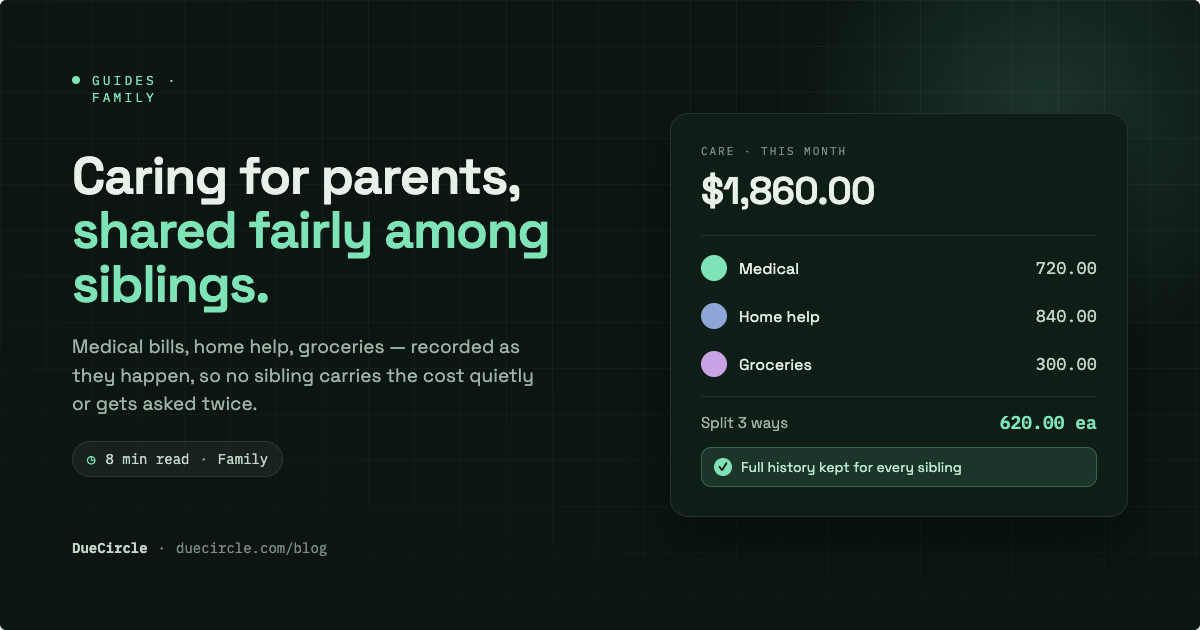
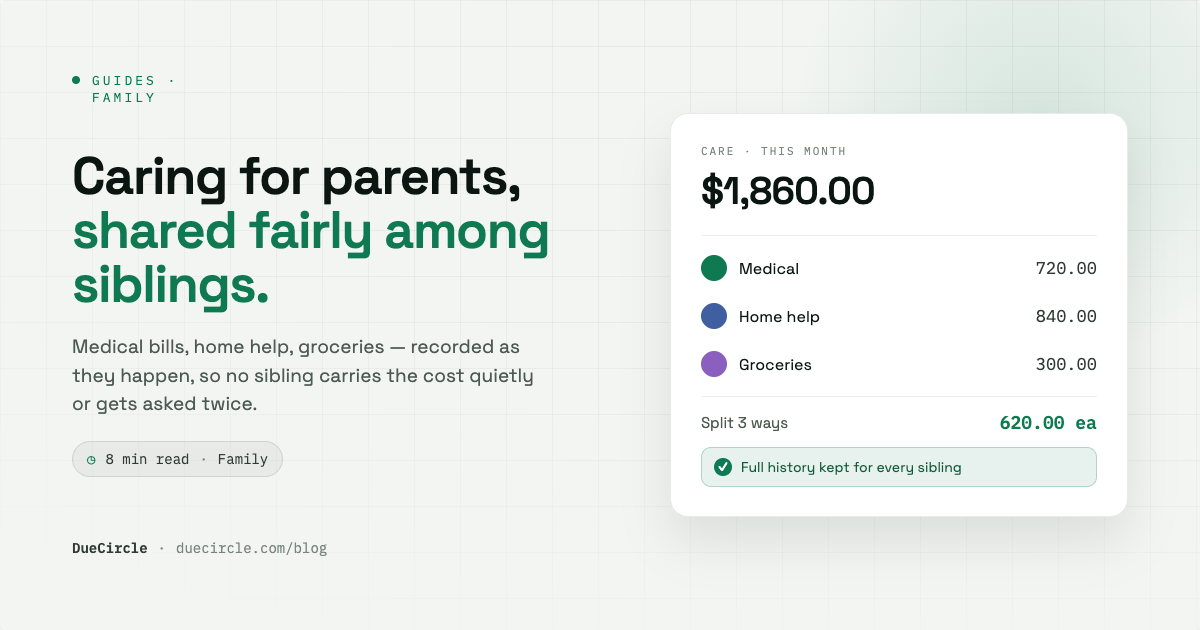
Caring for ageing parents brings siblings closer or slowly pulls them apart, and money is very often the thing that decides which. It is rarely the amounts themselves. It is the silence around them — the sibling who fronts every bill and never asks, the one far away who wants to help but does not know how much, the quiet arithmetic everyone is doing in their head and nobody is saying out loud.
This is not a comfortable topic, and it should not be reduced to a spreadsheet. But a clear, shared record is one of the kindest things you can put in place, precisely because it takes money out of the emotional space where it does the most damage. Here is a gentle way to split costs for elderly parents among siblings so the caring stays the point.
Money is not the hard part — the silence is
Most sibling money conflicts around a parent are not really about a specific bill. They are about the feeling that the load is uneven and nobody will say so. One sibling assumes the others do not care. The others assume everything is handled. Both can be wrong at once.
A shared record does something quietly powerful here: it makes the invisible visible. When everyone can see what has been spent and by whom, the resentment loses its fuel. You are no longer guessing about each other's contributions.
The goal is not to make caregiving transactional. It is to make sure nobody carries it alone in the dark, and that money never becomes the thing your family remembers instead of your parent.
The sibling who fronts everything
There is almost always one. The child who lives nearest, or is simply the one who steps up, pays the pharmacy, covers the carer, sorts the hospital deposit — and rarely asks for it back because asking feels wrong when it is about their own mother or father.
That instinct is generous and it is also unsustainable. Quiet sacrifice curdles into quiet resentment over months, and the sibling who gave the most ends up feeling it the most. The fix is not for them to stop giving. It is to write it down.
Recording what they front is not sending an invoice to the family. It is protecting the relationship — so that a year from now the record shows the truth, and the other siblings get the chance to carry their share instead of never knowing there was a share to carry.
Fair usually means by what each can give
Splitting a parent's costs into equal thirds sounds fair and often is not. Siblings rarely earn the same, and one earning ₹40,000 a month feels a shared ₹30,000 bill very differently from one earning ₹1,20,000. Equal shares can quietly squeeze the sibling who can least afford it.
A gentler measure is to share in proportion to what each person can give. Say a month of a parent's care and medical costs comes to ₹60,000 across three siblings. Split by shares that reflect income — for example 3, 2 and 1 — and the amounts land near ₹30,000, ₹20,000 and ₹10,000 rather than ₹20,000 each. Everyone contributes what is real for them.
DueCircle lets you split any expense by shares or by percentage, so you agree the weighting as a family once and every bill follows it. Because amounts are stored in whole paise and split by the largest-remainder method, the shares always add back to the exact total, with any leftover unit handed to one named person and shown openly — nothing is fudged.
Keep one clear, shared record
The practical heart of all this is a single place everyone can see. Start a group for the siblings, add each cost as it happens under whoever paid, and apply your agreed split. It does not need to be elaborate. It needs to be honest and open to all of you.
A simple way to run it:
- Add every parent-related cost — medicines, carers, deposits, repairs — under whoever paid.
- Apply your agreed split by shares or percentage so each sibling's fair portion is clear.
- Let live balances show who is ahead and who owes, with no chasing required.
- Settle up on a calm rhythm — monthly, say — rather than bill by bill.
- If the situation is a defined chapter, archive the group later so the records stay intact and read-only.
Let the record hold the trust
When everything is written down, the hardest conversations get easier. Nobody has to accuse anyone of doing too little or claim they did too much. The balance is simply there, agreed in advance and updated as you go, and you can all look at the same truth.
When you settle, DueCircle gives you a plan that clears the balances in a small number of payments by matching the biggest debtor to the biggest creditor. You pay each other directly, mark it recorded, and the app never holds or moves a rupee of it.
DueCircle is free forever, needs only an email, and keeps your family's record private — never on a bank connection, never on the public web pages. It does the maths and holds the history, so that in a season that asks so much of you, money is the one thing that never poisons the love underneath it.
Published 8 July 2026.