Every shared house has one person who somehow always ends up at the till. They grab milk on the way home, they notice the loo roll has run out, and their card is the one that keeps paying for the shared shelf. It is rarely a decision. It just happens, and then it quietly builds into resentment.
Groceries are trickier to split than rent because they are not one flat number. Some of it everyone eats, some of it only you eat, and some of it is that oat milk your housemate swears they will replace. The good news is you do not need to itemise every banana to be fair. You need a simple rule for the shared stuff and an easy way to handle the exceptions.
Decide what counts as shared before you shop
The cleanest houses agree on this early: staples that everyone uses are shared, and anything personal is on you. Shared usually means the boring, communal things — rice, oil, salt, dish soap, bin bags, tea, the bread nobody claims but everybody eats.
Personal is your protein powder, your specific brand of yoghurt, the snacks you hide in your room. Nobody should have to chip in for a taste they do not share. Write the shared list down once, stick it on the fridge, and you stop having the same debate every week.
This one agreement removes most grocery arguments before they start. What is left is just doing the maths, which is the part an app can take off your hands.
Equal splitting is fine more often than you think
For the shared staples, splitting the shop equally is usually fair and almost always simpler. If four of you use the same rice, oil and cleaning supplies, arguing over who used three more grams of butter is not worth the friendship.
In DueCircle you add the shop as one expense, choose an equal split, and pick the housemates it applies to. The balances update straight away, so everyone can see the shared shelf is genuinely being shared and not carried by one person.
The 'I don't eat that' problem
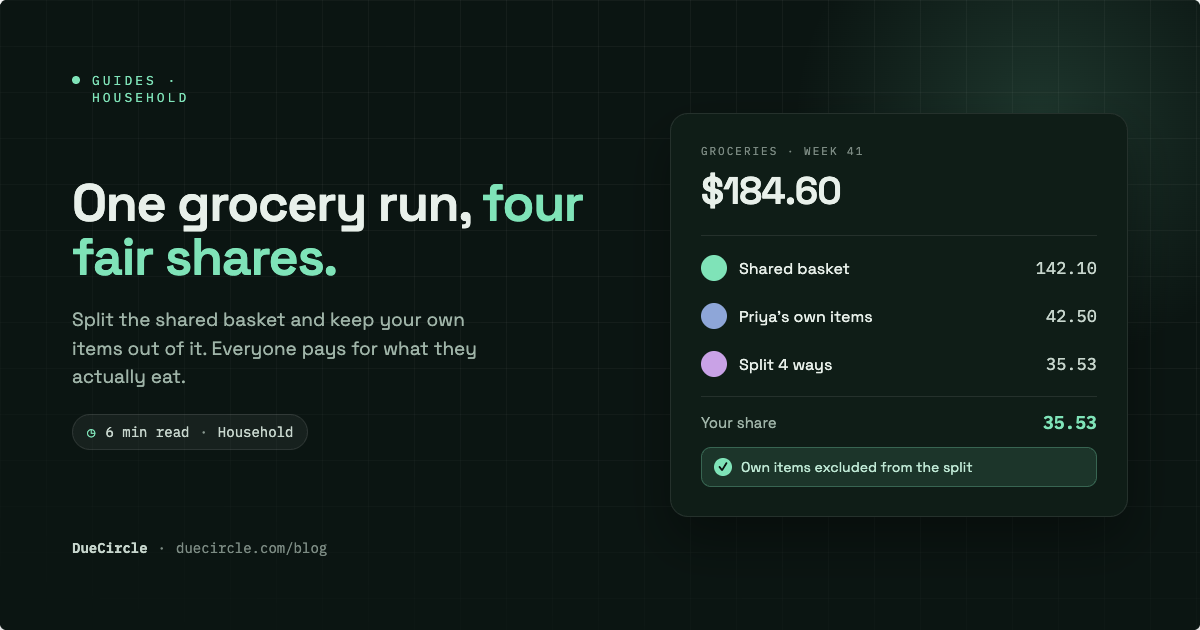
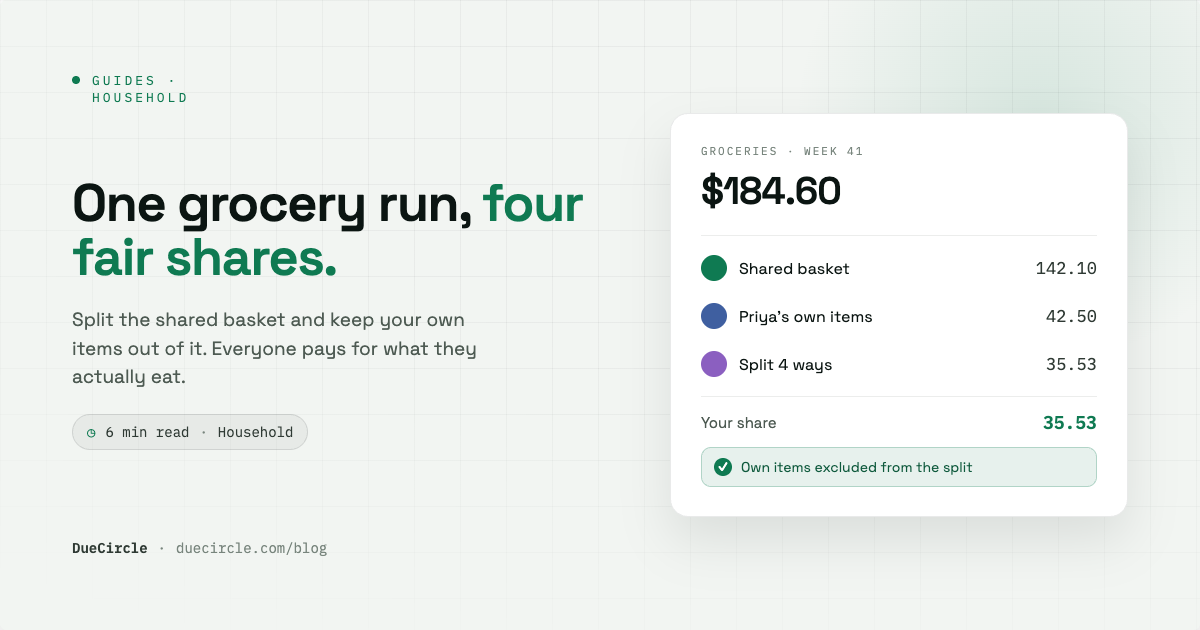
Equal breaks down the moment one shop is lopsided. Say you do a ₹2,000 run: ₹1,200 of it is shared staples for all four of you, but ₹800 is snacks that only two housemates touch. Splitting the whole ₹2,000 four ways would quietly overcharge the two who never eat the snacks.
The fix is to stop treating it as one lump. Record the ₹1,200 of staples as an expense split equally among all four, so ₹300 each. Then add the ₹800 of snacks as a separate expense and exclude the two who do not eat them — DueCircle lets you choose participants per expense, so it splits ₹400 each between just the two snackers.
When shares are genuinely uneven — one housemate cooks big meals, another barely uses the kitchen — you can split by shares instead of exactly equal, giving the heavy user more weight without you doing fraction sums by hand.
Log every shop against whoever paid
The single habit that fixes the 'I always end up buying it' feeling is logging each shop against the person who actually paid. It does not matter that it is your card three weeks running, as long as it is recorded. Over a month it evens out, and if it does not, the balance shows exactly by how much.
Here is the whole routine, kept deliberately short:
- Add the shop as an expense the moment you get home, under whoever paid.
- Split shared staples equally; put personal-taste items on a separate split and exclude anyone it does not apply to.
- Let live balances track who is ahead and who is behind.
- Once a week or month, open settle-up and clear the net in a small number of payments.
- Mark each payment recorded after you actually send the money.
Settle the net, not every receipt
You do not pay each other back shop by shop. You let the balances run and settle the difference. DueCircle also handles the fiddly rounding you would otherwise fudge: a ₹1,000 staples shop split three ways cannot divide evenly, so it becomes ₹333.34, ₹333.33 and ₹333.33 — the leftover paisa is handed to one named person and shown, never quietly dropped. The shares always add back to exactly ₹1,000.
When it is time to square up, settle-up gives you a plan that clears everyone in a few payments by matching the biggest debtor to the biggest creditor. People pay each other however they like — UPI, cash, a transfer — and mark it recorded in the app.
DueCircle is free forever, with no card and no premium tier, and your grocery list stays private — the app never sees your bank and never moves your money. It just does the maths so the person holding the receipt does not have to chase anyone.
Published 23 July 2026.