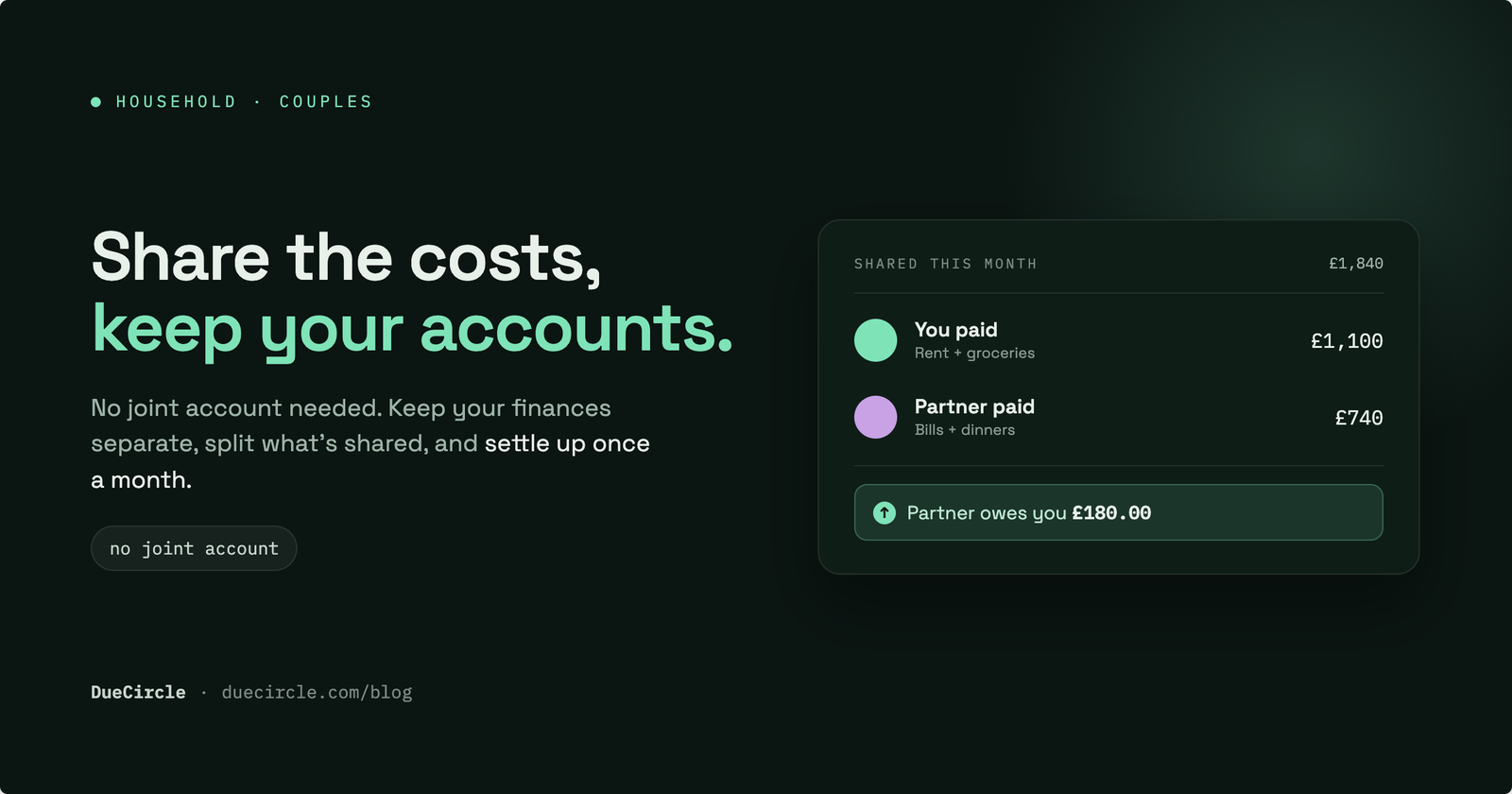
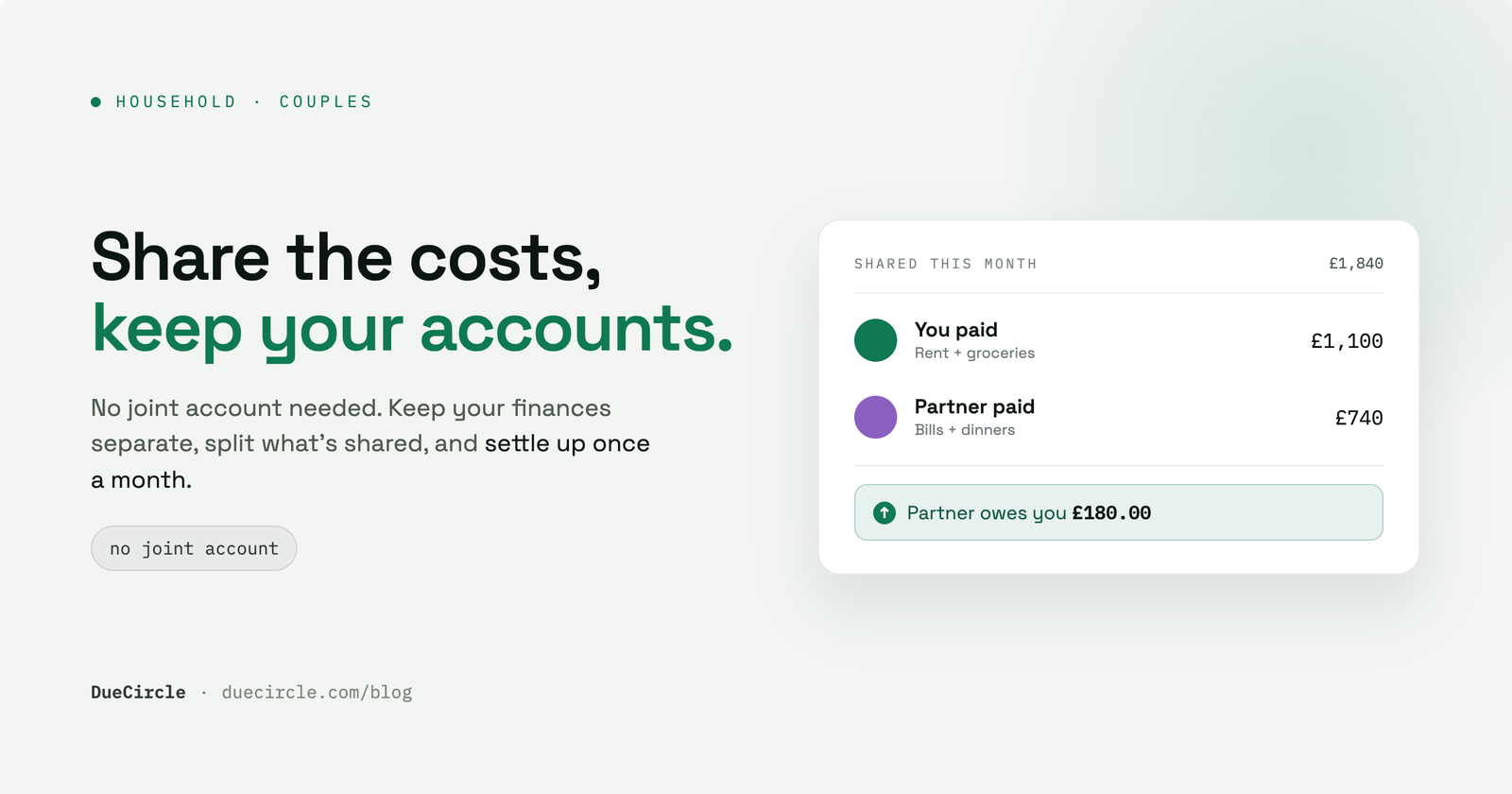
Plenty of couples never open a joint account. They keep their own current accounts, their own savings, their own sense of what is theirs, and they share the costs of a life together anyway. Rent, groceries, the standing order for the streaming bundle, the weekend away. The money stays separate; the expenses are joint.
The difficulty is not the arrangement. It is the admin. Without a shared pot, every shared cost becomes a small question of who paid, who owes, and whether it has been squared up yet. This guide sets out a way to split expenses with your partner that keeps your accounts your own, keeps the shared side visible, and settles cleanly once a month.
Why couples keep finances separate
A joint account merges two financial lives into one balance. For some couples that is the right call. For many it is more than they want, at least for now. Keeping separate accounts is not a sign of distance; it is often just a preference for autonomy, or a practical response to different pay dates, existing commitments, or a wish to keep individual spending private.
The catch is that separate accounts do not remove shared costs. You still split the rent. You still fill a fridge you both eat from. You still book a table on a Friday. So the real task is not merging money, it is tracking the overlap: the slice of each month that genuinely belongs to both of you.
Done badly, that overlap turns into a running tally in your heads, or a chat thread you scroll back through at the end of the month. Done well, it is a single shared record that both of you can see, so the money never becomes a memory test.
Fair does not always mean fifty-fifty
The instinct is to split everything down the middle. Fifty-fifty is simple, and when two incomes are close it is perfectly fair. When incomes differ, an even split can quietly ask the person who earns less to carry a heavier load relative to what they bring in.
A proportional split addresses that. Instead of halving each cost, you share it in line with income. If one of you earns more, that person covers a larger percentage of the shared total, and the smaller earner covers less. The rule is agreed once, out loud, and then it just runs.
There is no single correct answer here. Some couples split everything evenly and top up unevenly elsewhere. Some go fully proportional. The point is to choose deliberately, together, rather than defaulting to fifty-fifty because it is the only option the maths offers you.
A worked example: one couple's month
Take Ama and Joel. Ama earns 3,000 a month, Joel earns 2,000, so they have agreed a 60/40 proportional split on shared costs. Their separate accounts stay exactly as they are; only the shared line is split.
Over the month the shared costs are rent of 1,200, groceries of 400, and a dinner out of 100, for a shared total of 1,700. Under 60/40, Ama's fair share is 1,020 and Joel's is 680. But bills rarely fall neatly. Ama pays the rent in full from her account; Joel puts the weekly shops and the dinner on his card, paying 500 in total.
So Ama has paid 1,200 against a fair share of 1,020, leaving her 180 ahead. Joel has paid 500 against a fair share of 680, leaving him 180 behind. The running balance is clear: Joel owes Ama 180. Nobody reconstructs anything. At the end of the month Joel sends 180, records the payment, and they both start the next month at zero.
- Shared total for the month: 1,700
- Ama's fair share at 60 per cent: 1,020
- Joel's fair share at 40 per cent: 680
- Ama actually paid: 1,200 (she is 180 ahead)
- Joel actually paid: 500 (he is 180 behind)
- Settlement: Joel pays Ama 180
Keeping shared costs visible without merging accounts
The example works because both people can see the same figures. That is the part a joint account usually provides and separate accounts usually do not. You can recreate it without merging anything by keeping one shared record that logs every joint cost as it happens: who paid, how much, and how it splits.
Recurring costs are worth setting up once. Rent, a subscription, a standing utility bill: enter the amount and the split a single time, and it repeats each month without either of you re-entering it. That leaves only the variable costs, the groceries and the dinners, to add as they come.
A live running balance then does the arithmetic for you. Rather than two people each keeping a private count, there is one number both of you trust, updated the moment a cost goes in. The account balances stay separate. Only the shared ledger is shared.
Settle monthly and keep it low-conflict
A month is a natural rhythm for settling. It lines up with rent and pay dates, it is short enough that the balance stays small, and it gives a clean point to reset to zero. Some couples prefer to settle the moment the balance crosses a threshold; either works, as long as it is agreed.
When the time comes, one transfer clears it. The person behind pays the difference, records the payment so there is proof it happened, and the balance returns to zero. There is no negotiation because the number was never in dispute; it was visible the whole way through.
This is what keeps the arrangement low-conflict. Disagreements about shared money usually come from ambiguity, not from the amounts. When both people can see the same record, the same split, and the same balance, there is nothing to reconstruct and little to argue about. The transparency does the work.
Choosing a tool that respects the arrangement
You can run all of this on a shared spreadsheet, and some couples happily do. A purpose-built expense tracker mainly saves you the upkeep: it applies the split automatically, handles recurring costs, keeps the running balance current, and stores the record of who settled what.
DueCircle is built for exactly this shape of arrangement. A private group for the two of you, uneven splits as a first-class option rather than an afterthought, recurring shared costs set up once, a live balance, and a way to record a settlement with proof. It is free, it never connects to a bank, and it never holds your money. Your accounts stay yours; the app just tracks the overlap.
Whatever you use, the principle is the same. Keep your finances as separate as you like, make the shared costs visible to both of you, agree a split that fits your incomes, and settle on a rhythm. The arrangement was never the hard part. Keeping it clear is, and that is a solvable problem.
Published 23 June 2026.