A family holiday is rarely a clean even split. There are grandparents who insist on treating everyone, a couple of siblings with kids, one household that fronted the villa deposit months ago, and a pile of shared meals nobody wants to itemise. Per-head splitting falls apart fast when the heads belong to very different households.
The trick with extended-family trips is to stop thinking in people and start thinking in households. This is about splitting a multi-generation, multi-family holiday by household or by shares, deciding who covers the kids, and settling the whole thing in a few payments once everyone is home.
Split by household, not by head
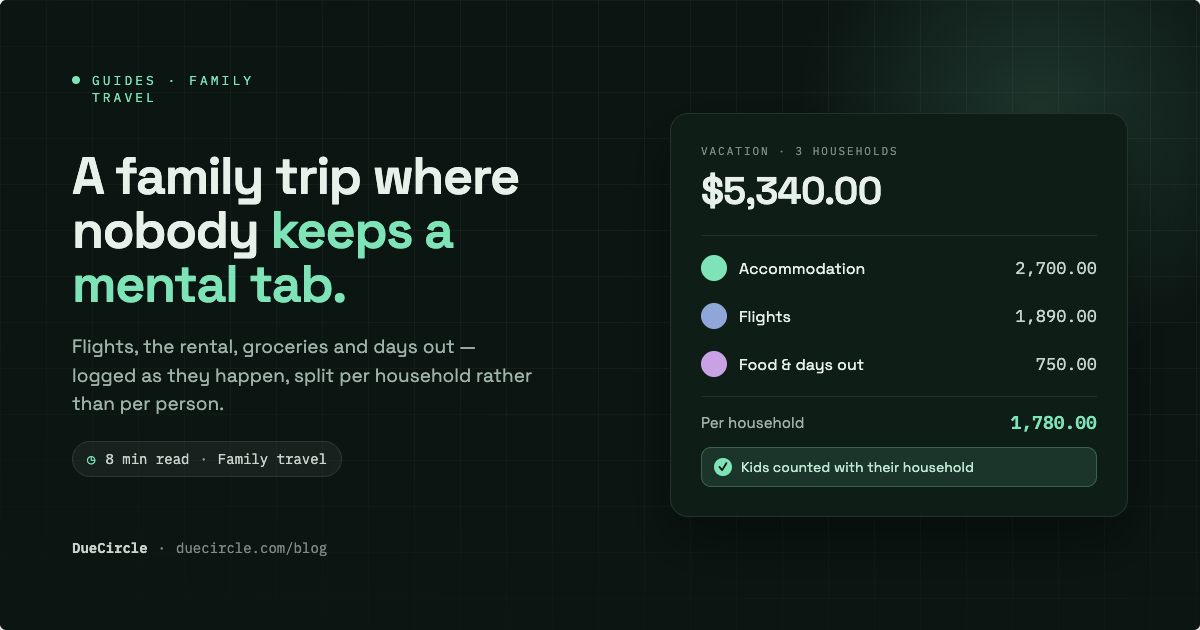
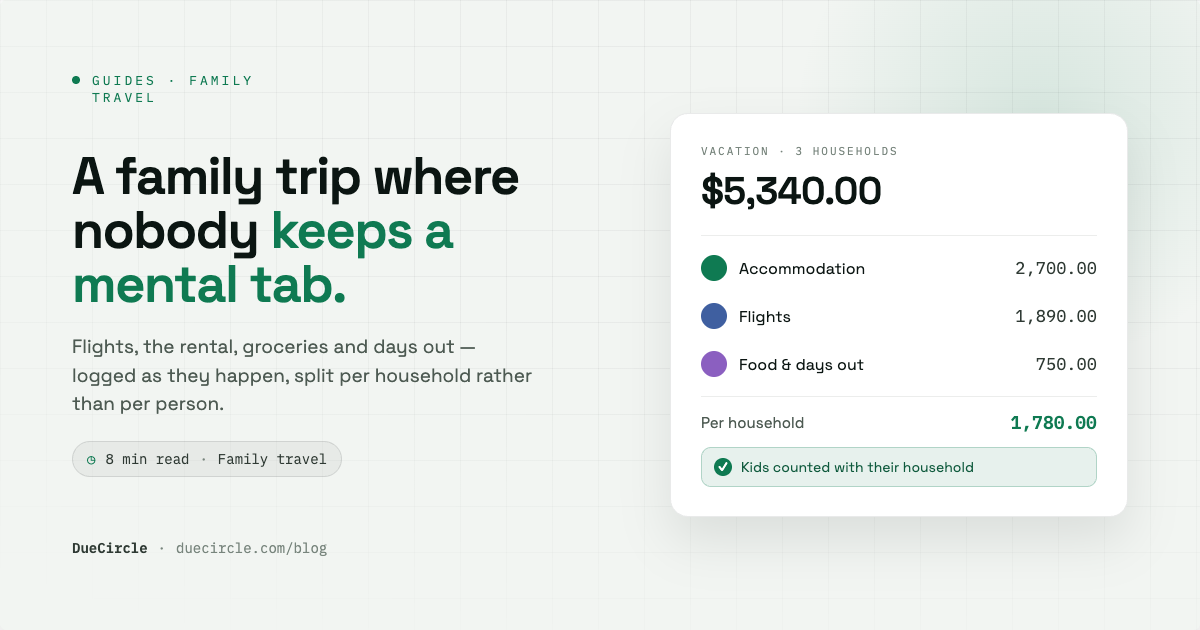
When three families travel together, the fairest unit is usually the household, not the individual. A family of four does not neatly owe four times a solo aunt, and counting toddlers as full payers rarely feels right to anyone.
So group the shared costs, the villa, the big dinners, the rental van, and split them across households by a rule everyone agrees. Sometimes that is an even split per household; sometimes it is weighted, because a family of five uses more space and food than a couple.
Individual extras stay individual. One family's theme-park tickets or a grandparent's spa afternoon are theirs alone, added only against them, not smeared across the whole group.
Who pays for the kids?
Children are the question that quietly stalls most family-trip maths. Counting a five-year-old as a full share for the villa feels off; leaving them out of the food entirely is not right either. The answer is whatever the families agree, and the important thing is to agree it out loud.
A common middle path is to count each child as a half share, or to fold kids into their own household's weight rather than the group total. Any rule works as long as everyone hears it before the booking, not after the bill.
One household fronts, everyone squares up later
On family trips, one household almost always pays for the big things up front, the villa deposit six weeks early, the group dinner on the card. That is fine and generous, as long as it is recorded so they are paid back properly.
Here is a worked example. Three households share a ₹36,000 villa and agree an even split by household, so ₹12,000 each. The household that paid the full ₹36,000 is simply owed ₹12,000 by each of the other two, and the record shows exactly that, so nobody has to remember it a month later.
The same holds for weighted splits. Agree shares of 3:2:2 for a family of five and two couples, and the ₹36,000 villa splits as roughly ₹15,428.57, ₹10,285.72 and ₹10,285.71. Because amounts are held as whole paise and split by the largest-remainder method, the odd leftover paisa goes to one named household and the shares still add up to exactly ₹36,000.
Keep each currency separate if you go abroad
If the trip crosses a border, money gets a second layer. You might pay for the hotel in rupees but taxis and meals in another currency. Trying to mash them into one figure with a made-up exchange rate is how disputes start.
Keep each currency on its own. Record every amount in the currency you actually spent, and let each currency keep its own separate balance, so rupee debts and, say, dirham debts are tracked side by side, not blended.
The app does not convert or settle a mixed-currency trip into one base currency. That is deliberate, so nobody argues about which rate to use, and each currency simply squares up on its own.
- Record each expense in the currency you paid
- Do not invent an exchange rate to merge them
- Let each currency keep its own balance
- Settle each currency separately at the end
- Keep individual extras out of the shared pot
Settle up once everyone is home
Family trips generate a swirl of who-paid-for-what, and chasing it around a group chat after everyone has scattered is nobody's idea of a holiday. Far better to have the numbers ready before you land home.
A settle-up plan matches the biggest debtor to the biggest creditor, so the whole family clears in a few payments instead of a dozen tiny transfers. People pay each other directly, by UPI, bank, or cash across the dinner table, and mark it recorded; the app never holds or moves money.
DueCircle is free forever and keeps your family's numbers private, and it does the maths so no one relative ends up playing accountant. Split by household, agree the kid rule, let one home front the villa, and settle up clean, and that is a family holiday that stays about the family.
Published 5 August 2026.