Splitting money between two or three people is easy. Splitting between twelve is where it falls apart, whether it is a wedding party, a fifteen-person trek, or an office farewell where somebody always fronts the cash and nobody remembers who owes what by Monday.
The chaos is not really about the money. It is about the forty side-conversations, the screenshots, the 'I will get you next time' that never lands. This post is about running a big group without any of that: paying in the right sub-groups, keeping one shared balance, and settling up at the end in a small number of payments.
Why big groups get messy
In a large group, not everyone is in on every expense. Six people went to the fancy dinner; the other six ate street food. Four shared a cab; the rest walked. Split everything equally across all twelve and half the group pays for things they never touched.
The usual fix is a spreadsheet and a lot of goodwill, but both wear thin fast. By day three of a trip, the spreadsheet has a formula error and two people have stopped updating it. The maths is not hard; keeping it current across a dozen people is.
The other trap is memory. 'You paid for the taxi, I will cover lunch' works for two people for one day. Across twelve people and a week, it is a guaranteed argument.
Only charge the people an expense applied to
The single biggest thing that tames a big group is choosing who each expense applies to. Not everything is a whole-group cost, and pretending it is just moves the unfairness around.
So when six people share a ₹4,800 dinner, split that ₹4,800 across those six only, ₹800 each, and leave the other six out of it entirely. The villa everyone slept in gets split across everyone; the spa trip three people took gets split across those three.
You still add every expense to the same group. You are just picking participants per expense, so each cost lands on the right shoulders without spawning a separate chat.
- Shared accommodation: usually everyone
- Group meals: only who ate
- Cabs and tickets: only who rode or attended
- One person's shopping run: only who wanted the items
- A whole-group activity: everyone who joined
One shared balance beats forty side-chats
When every expense lives in one place, the group stops needing to track anything by hand. Instead of twelve people each keeping a mental tally, there is a single running balance: what each person has paid, what they owe, and where they stand right now.
That visibility does most of the emotional work. Nobody has to send the awkward 'hey, you still owe me' message, because the number is already there for everyone to see. The record does the reminding, so no person has to.
Settling up without twelve separate transfers
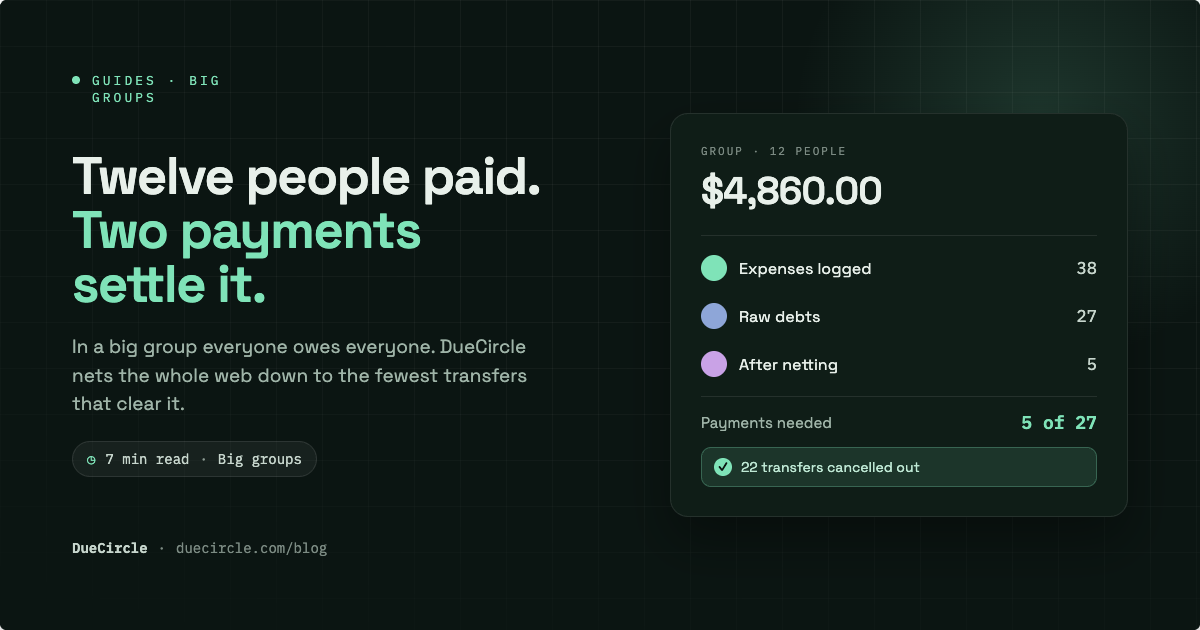
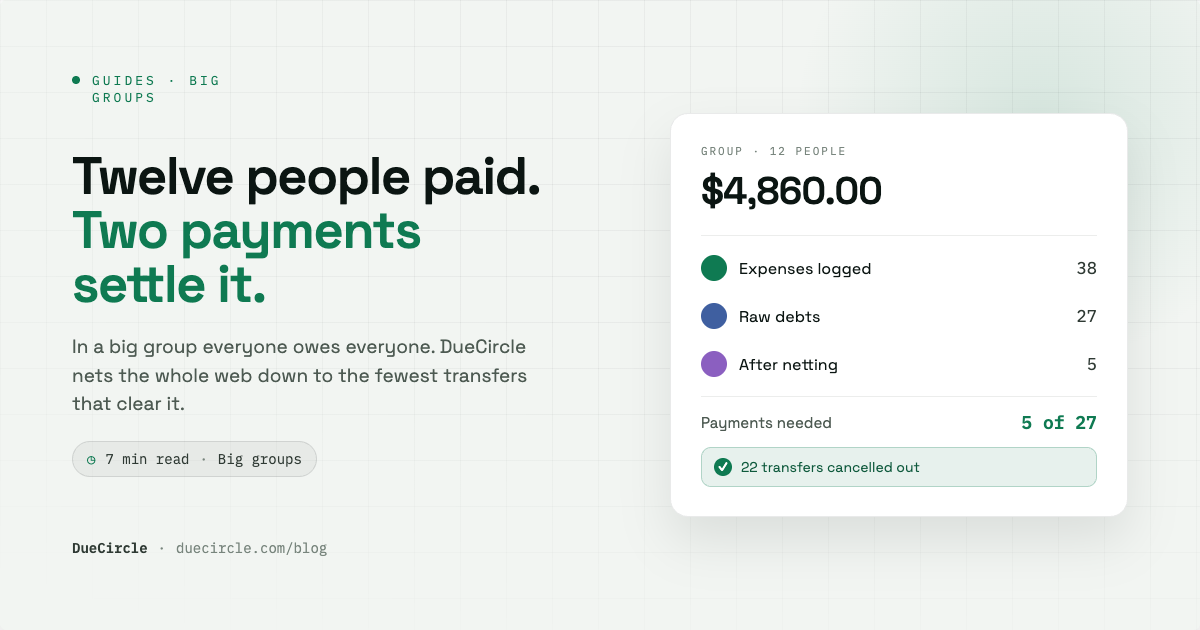
The dread of a big group is imagining everyone paying everyone, which is potentially dozens of tiny transfers. It does not have to work that way.
A settle-up plan matches the biggest debtor to the biggest creditor and works down from there, so the group clears in a small number of payments rather than a tangle of them. If you owe ₹2,000 and someone else is owed ₹2,000, you pay them directly and you are both done.
People pay each other outside the app, by UPI, cash, whatever suits, and mark it recorded. The app never holds or moves your money; it just tells you a short, sensible list of who should pay whom.
Let the group see the same numbers
A big group works when everyone is looking at the same honest record instead of their own half-remembered version. That is the whole idea behind doing it in one shared space.
DueCircle is free forever, with no premium tier and no card, and it keeps your group's numbers private, since ads only ever appear on public website pages, never on your group data. It does the arithmetic across all twelve of you and lays out a short settle-up plan at the end.
So the fifteen-person trip ends with a clear list of a few payments, not a week of chasing. Everyone paid for what they actually shared, everyone can see it, and nobody is left playing accountant.
Published 8 August 2026.