
Most disagreements about shared money are not really about money. They are about method. Two people can look at the same restaurant bill, both act in good faith, and still land on different numbers, because one is splitting it equally and the other is splitting it by what each person actually ordered. Neither is wrong. They are answering different questions.
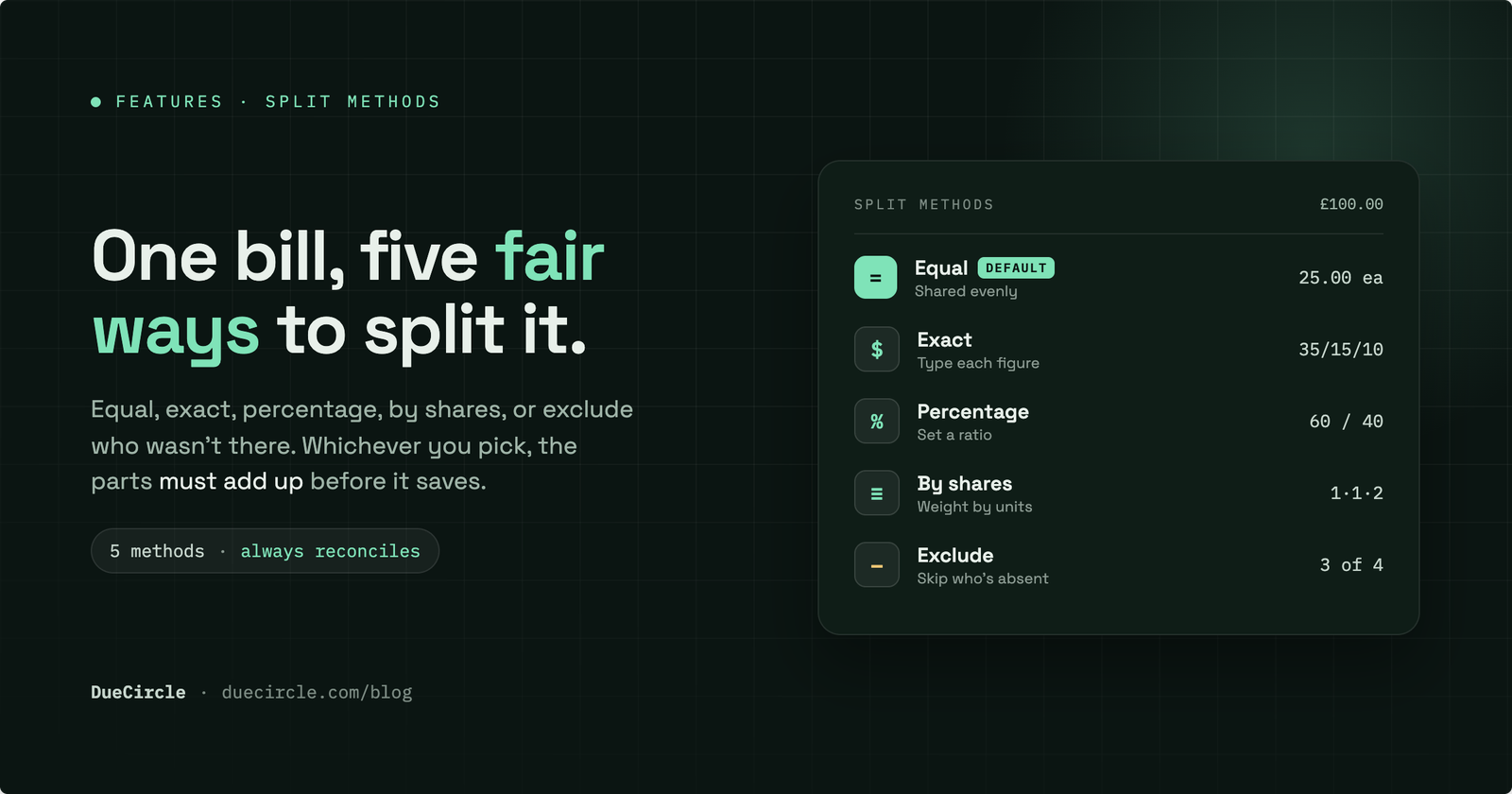
Learning how to split expenses well is mostly learning which method fits which situation. DueCircle gives you five: equal, exact amounts, percentage, by shares, and excluding people who were not there. This piece walks through each one with a concrete example and the case where it is the fairest choice, so you can reach for the right one without thinking too hard about it.
Equal: the sensible default
An equal split divides the total evenly across everyone involved. It is the right choice when the benefit is genuinely shared and roughly the same for each person: a taxi across town, a bottle of wine for the table, the cost of a shared streaming subscription.
Say four people share a meal that comes to 100.00 pounds. Split equally, each owes 25.00. Nobody has to itemise anything, and the arithmetic is obvious to everyone at the table, which is part of why it works. When no single person clearly consumed more than another, equal is the least contentious option.
The only awkward case is a total that will not divide cleanly. Split 100.00 three ways and each exact share is 33.333… pounds. DueCircle handles this by working in whole pennies and giving the leftover penny to one named person, so the three shares come to 33.34, 33.33 and 33.33 and still sum to exactly 100.00. You are never left with a balance that refuses to reach zero.
Exact amounts: when everyone's share is different
An exact split lets you type the precise figure each person owes. It suits any bill where people consumed clearly different things and you already know the numbers: a supermarket shop where you can see who bought what, or a restaurant bill that itemises each person's order.
Imagine a grocery run totalling 60.00 pounds. One person's items came to 35.00, another's to 15.00, and a third's to 10.00. You enter those three figures directly. There is no formula to reason about, because you are simply recording what is already true.
The one rule is that the parts must add up to the whole. Enter 35.00, 15.00 and 10.00 and the split is valid. Enter figures that come to 58.00 against a 60.00 total and DueCircle will not let you save it, because a two-pound gap means someone, somewhere, is not being charged for what they bought.
Percentage: proportional shares that are easy to state
A percentage split assigns each person a share of the total by proportion. It is useful when the fair division is a ratio you can name but not a fixed cash figure, especially for recurring bills where the total changes each month while the proportions stay the same.
A couple splitting utilities in proportion to income might agree on 60 and 40. On a 200.00 pound electricity bill that is 120.00 and 80.00. Next month the bill is 250.00, and the same 60/40 split gives 150.00 and 100.00 with no renegotiation. You set the ratio once and it holds as the numbers move.
Percentages have to total 100. If they do not, the split is under- or over-allocating the bill, so DueCircle blocks it in the same way it blocks a mismatched exact split. When a percentage produces an uneven penny, the largest-remainder rule places the odd unit and names who carries it, so the shares still reconcile to the exact total.
By shares: weighting without doing the maths
A share split assigns each person a number of units and divides the cost in proportion to those units. It is the most flexible way to handle an uneven split, because you describe the weighting in plain terms and let the app work out the money.
Three housemates share a 900.00 pound rent. Two have standard rooms and one has the large room with an en suite, so they agree the big room counts double. That is one, one and two shares: four shares in total, worth 225.00 each. The two standard rooms pay 225.00 and the large room pays 450.00. You never calculated a percentage; you counted rooms.
Shares suit anything measured in natural units. A holiday cottage split by nights stayed, a shared car split by who drove how far, a group gift split by how many people each household is covering. You give the counts and DueCircle turns them into exact amounts, distributing any indivisible remainder by the same stated rule it uses everywhere.
- Standard room: 1 share → 225.00
- Standard room: 1 share → 225.00
- Large en-suite room: 2 shares → 450.00
- Total: 4 shares → 900.00
Excluding people who weren't there
Not everyone in a group takes part in every expense. On a trip, two people skip the expensive dinner; in a flat, one housemate is away when the others order a takeaway. Excluding people lets you split a single expense across only those who were actually involved, without removing anyone from the group.
Four friends share most costs on a weekend away, but one leaves early and misses a 120.00 pound dinner. Exclude them from that one expense and it splits three ways at 40.00 each, while every other cost still divides across all four. The group stays intact and only the affected bill is adjusted.
This is often fairer than the alternatives people fall back on: paying someone back in cash later, or quietly absorbing the cost to avoid a fuss. Excluding the right people at the point of entry keeps the ledger honest, so when you settle up at the end nobody is carrying a charge for something they never had.
Why every method has to reconcile
The five methods look different, but they share one guarantee: whatever you choose, the parts must add up to the total before the expense can be saved. An exact split whose figures fall short, a percentage that does not reach a hundred, a share split with a missing weight — none of them will save while they leave money unaccounted for.
This matters because a split that does not reconcile is not a small error you can fix later. It is a permanent gap that keeps a balance from ever reaching zero. By validating against the total at the moment you enter it, DueCircle turns fairness from a matter of trust into a matter of arithmetic that anyone in the group can check.
So the practical answer to how to split expenses is to name the situation first. Shared benefit, use equal. Known individual amounts, use exact. A proportion you can state, use percentage. A weighting you can count, use shares. Someone genuinely absent, exclude them. Then let the app confirm the numbers close, and settle up knowing the total was never quietly bent to make the split work.
Published 16 July 2026.