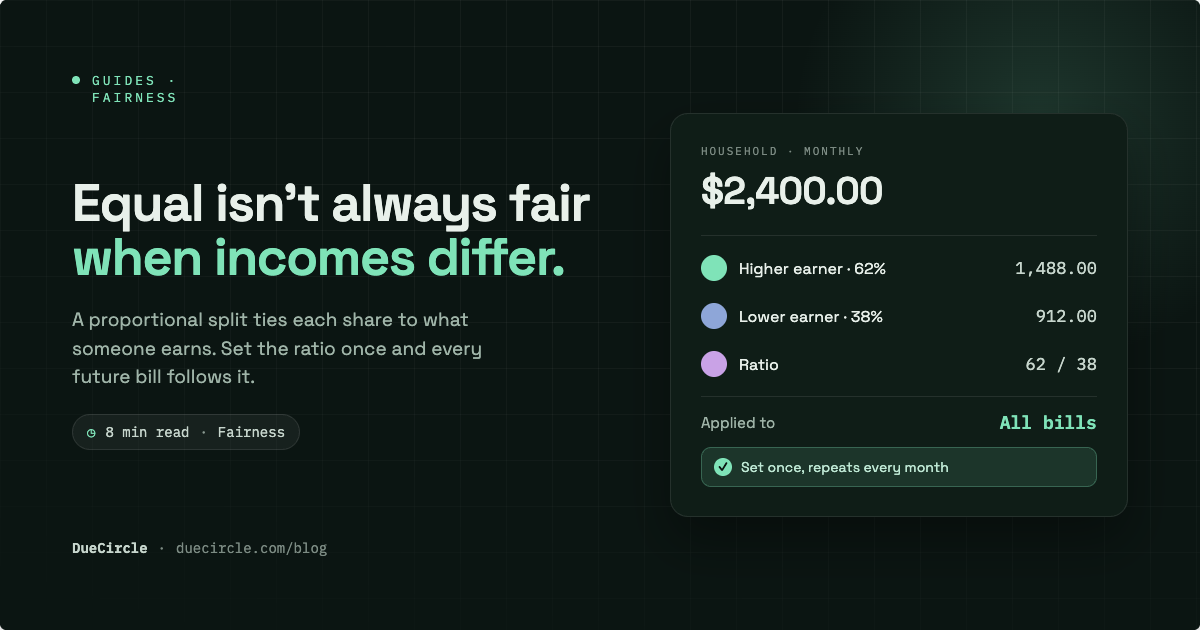
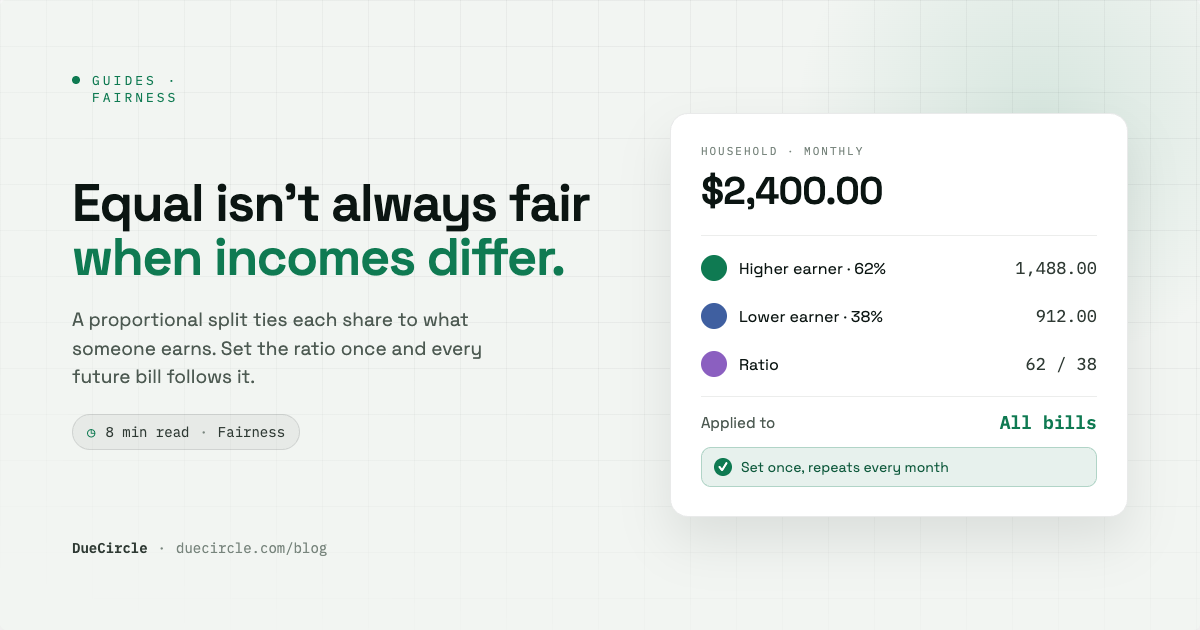
Splitting rent and groceries straight down the middle feels fair until you notice one person earns twice what another does. When incomes are genuinely far apart, an equal split quietly squeezes whoever has the least room to spare.
This post is about splitting by income instead, sometimes called proportional splitting, for any shared household or group, not only couples. You will see when equal is fine, when proportional is fairer, how to set it up with percentages or shares, and a worked example that reads the same for three roommates or a family pooling for a parent.
Equal is simple, but it is not always fair
An equal split is easy to explain and easy to trust. Everyone pays the same, nobody does maths, and for a group with similar incomes it is usually the right call. The trouble starts when incomes are genuinely far apart.
If one flatmate earns ₹30,000 and another ₹80,000, an equal ₹10,000 rent share is a third of the first person's income and an eighth of the second's. Same rupees, very different weight. Proportional splitting tries to make the weight fairer, not the rupees identical.
There is no law that says you must split by income. It is a choice a household makes together. The point is to choose on purpose, out loud, rather than defaulting to equal and letting quiet resentment build.
How to split by income with percentages
Percentages are the most direct way to split by income. Add up everyone's take-home pay, work out each person's slice of the total, then apply those slices to each shared bill.
Say three friends share a flat. One earns ₹30,000, one ₹50,000, one ₹20,000 a month, so ₹1,00,000 together. Their slices are 30 percent, 50 percent and 20 percent. On ₹20,000 rent that is ₹6,000, ₹10,000 and ₹4,000. On a ₹5,000 electricity bill it is ₹1,500, ₹2,500 and ₹1,000. Same percentages, any bill.
Percentages are worth revisiting when someone's income changes, like a raise, a new job, or a gap. You are not locked in; you just agree a fresh set of numbers and use them going forward.
- Use take-home pay, not gross salary
- Add everyone's income to get the total
- Each person's percentage is their income over that total
- Apply the same percentages to every shared bill
- Redo the numbers when someone's income changes
When shares are easier than percentages
Percentages get fiddly when incomes are close or keep shifting. Shares are a rougher, friendlier tool: instead of exact income, you agree simple weights like 2:2:1.
Imagine two people work full time and one is between jobs. You might agree the two earners take two shares each and the third takes one, five shares in total. On a ₹1,000 internet bill that is ₹400, ₹400 and ₹200. Nobody had to reveal an exact salary; you just agreed who carries more.
Shares also suit temporary situations. Someone travelling for two weeks might take a smaller share of groceries that month, then go back to an even weight once they are home.
Agree the rule before the first bill
The most useful conversation happens before money is spent, not after. Decide which bills are split by income and which stay equal. Many households split rent and utilities proportionally but keep a shared takeaway equal, because it is small and everyone enjoyed it the same.
Write the rule down somewhere everyone trusts. A rule that lives only in one person's head is a rule the others cannot check, and that is exactly where arguments start.
Let the app hold the rule and do the maths
Once you have agreed percentages or shares, you do not want to redo the arithmetic every month. On DueCircle you add an expense, choose split by percentage or by shares, and set each person's number once, and it applies the split and keeps a running balance of who owes whom.
Because amounts are stored as whole paise and split by the largest-remainder method, the shares always add up to the exact total. If a bill will not divide cleanly, the odd leftover paisa is handed to one named person and shown openly, never quietly buried.
DueCircle is free, private, and never touches your bank or your money. It just does the maths so nobody has to chase, and everyone sees the same fair split. For a different-incomes household, that is usually all it takes to stop arguing about rent.
Published 9 August 2026.