The food was great. The bill arrives, someone squints at it, and the table goes quiet doing mental maths that nobody quite trusts.
Splitting a restaurant bill sounds trivial until one person had a starter and a soda while another had two cocktails and the steak. Add tax and tip on top and lets just divide by four starts to feel unfair. Here is how to handle it without a calculator standoff.
Even split or itemized — pick the honest one
Most of the time, an even split is the kind thing to do. If everyone ate roughly the same and drank roughly the same, dividing the whole bill by the number of people is fast and nobody really loses out.
Itemize when the gap is real — the friend who only had a salad should not be subsidising the table's wine. Then you split by exact amounts, each person paying for what they ordered.
The honest test: would the careful accounting take longer than the difference is worth? If someone is overpaying by ₹40, just split evenly and enjoy the rest of the evening.
Share tip and tax by what people ordered
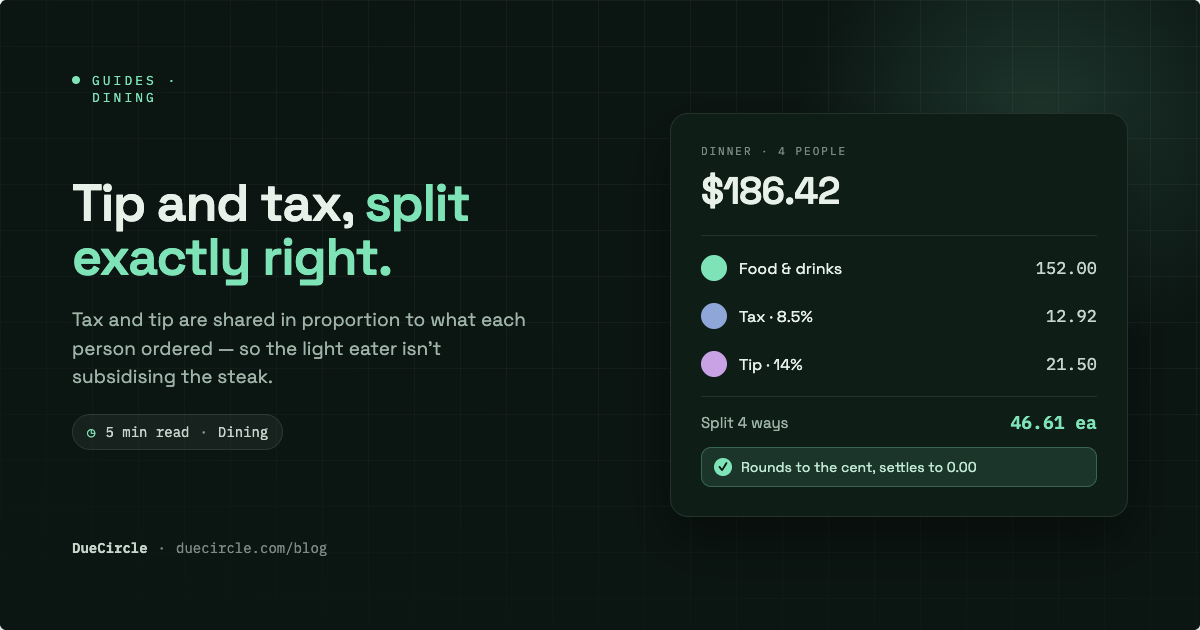
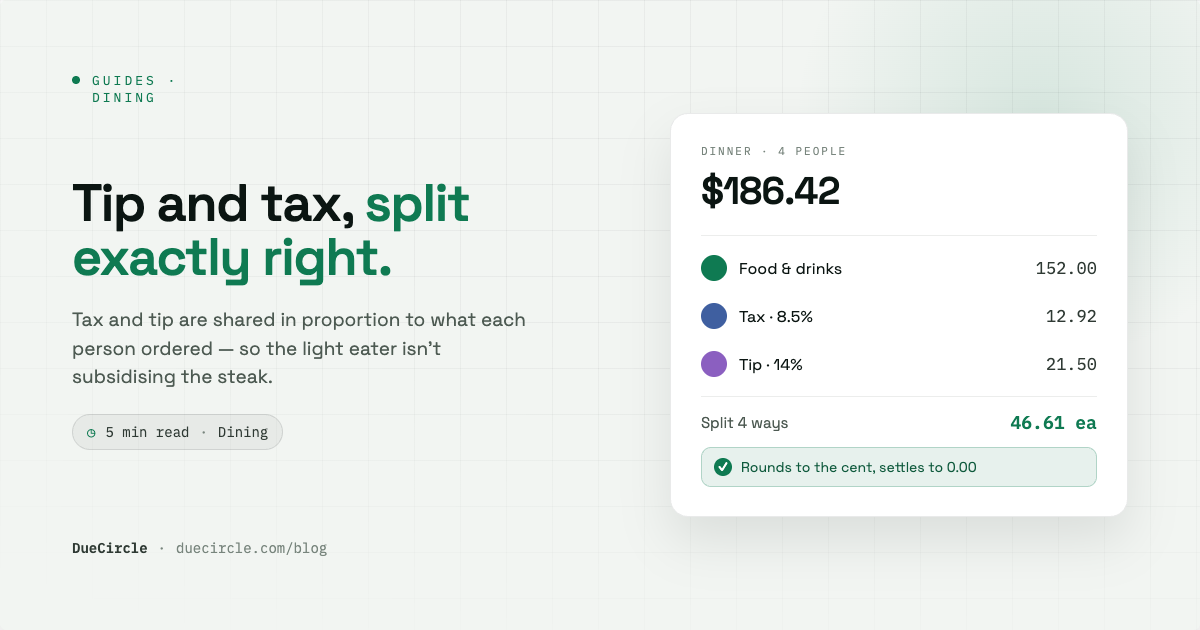
Here is the part people get wrong. Tax and tip should follow what each person ordered, not split flat. The ₹1,200 steak caused more tax and more tip than the ₹300 salad did.
The clean way is to total the bill including tax and tip, then split that total by exact amounts in proportion to each order. The extras ride along on their own.
Take ₹4,000 of food, ₹200 tax and ₹400 tip — ₹4,600 in all. If A had ₹2,000 of food, B ₹1,200 and C ₹800, split the ₹4,600 in that ratio: ₹2,300, ₹1,380 and ₹920. It sums back to exactly ₹4,600, tip and tax already folded in.
The stray paisa has a name
Not every bill divides cleanly. Three people on a ₹1,000 even split is ₹333.33 each — and that one stray paisa has to go somewhere.
DueCircle stores money as whole minor units and splits by the largest-remainder method, so the shares always add back to the exact total. The single indivisible paisa is handed to one named person and shown on screen, never quietly buried.
So the split reads ₹333.34, ₹333.33 and ₹333.33, and you can see exactly who got the extra paisa. It is a rounding cent, not a mystery, and a custom split that does not add up will not save at all.
Know when to stop overthinking
Precision is a tool, not a religion. If your table splits hairs over every paisa, dinner stops being fun.
Reach for the even split by default and only itemize when someone genuinely ordered far more or far less. A good rule: itemize the outliers, split the rest.
Nobody remembers the perfectly fair bill. They remember the friend who made everyone recount their gulab jamuns.
- Everyone ate similarly — split evenly
- One person had far more or less — split by exact amounts
- A couple of pricey items — add those to the right people, even-split the base
- Tip and tax — let them ride on the proportional total
- The stray paisa — let the app name it and stop worrying
Let the app hold the receipt
DueCircle does this maths the moment you enter the numbers — even split or exact, tip and tax included, down to the last paisa that always adds up.
Record who actually paid and it shows who owes them, then settle-up hands you a short plan to clear it in a few payments.
It is free, private, and never touches your bank — it just does the arithmetic so nobody has to chase the table for their share of the tip.
Published 12 July 2026.