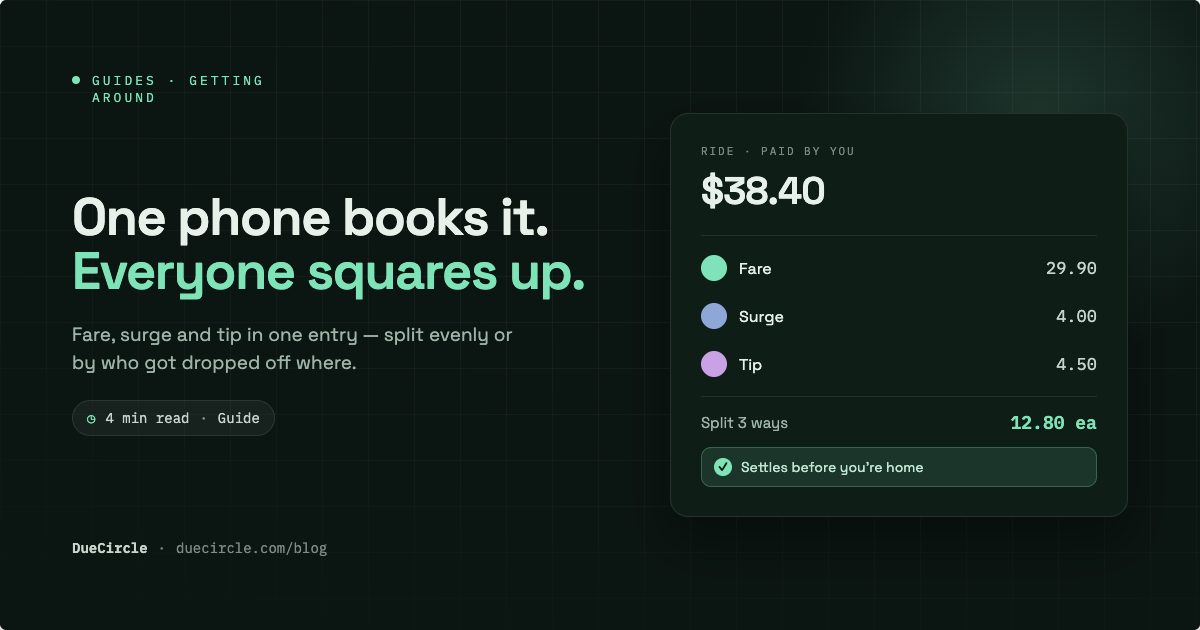
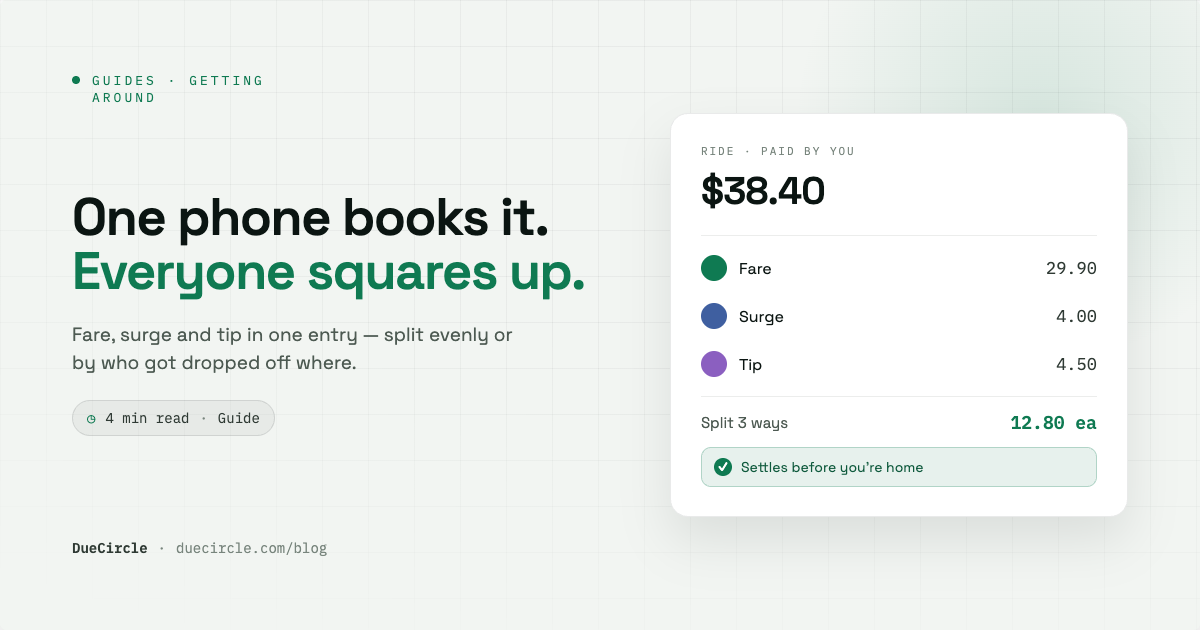
The cab fare is the expense everyone forgets. It is small, it is over in a flash, and one person's phone happened to book it. Ten of those a month and someone is quietly out a few thousand rupees.
The fix is not to split every fare on the spot with change in hand. It is to log it in seconds and let it net out over time, so nobody keeps eating the cost of being the one with the app open.
Split equally when the ride is shared end to end
If four of you get in together and get out together, an equal split is the honest one. A ₹480 fare becomes ₹120 each, and that is that.
This is the common case for a night out or a group heading to the same party. Nobody is doing anything fancy; you just need it recorded so the person who paid gets it back.
DueCircle splits equally in a tap and updates the balance instantly. The booker is no longer silently subsidising the group.
Split by drop-off when people get out along the way
Sometimes the ride is not equal at all. Three friends share a cab, but one gets dropped first and two carry on across town. An even split would overcharge the person who barely rode.
That is where exact amounts come in. If the total is ₹600 and the fair share is ₹150 for the short leg and ₹225 each for the two longer legs, you enter those exact figures. DueCircle checks that ₹150 plus ₹225 plus ₹225 lands on ₹600 before it lets you save.
You do not need a formula for this. A quick eyeball of who travelled how far is usually fair enough, and the app makes sure the numbers still add up.
The real trick: log it in ten seconds
The reason cab fares cause friction is not the amount, it is the forgetting. The ride ends, everyone scatters, and the ₹120 evaporates from memory.
So make logging faster than forgetting. Open the group, add the fare, pick equal or exact, save. Done before you have left the drop-off point.
Over a month these tiny entries pile into a balance that means something, and it settles without anyone feeling nickel-and-dimed in the moment.
A worked example over a week
Say Aarav, Isha and Ravi share cabs all week. Aarav books a ₹480 fare split three ways, so ₹160 each. Two days later Isha books ₹300 split between just her and Ravi, ₹150 each, because Aarav was not in that one.
DueCircle keeps those separate but folds them into one live balance. By the weekend it can show that Ravi owes a bit to both, and the settle-up plan clears everyone in a couple of transfers instead of six awkward ones.
Nobody sat with a calculator. The app matched who owes to who is owed and handed back a short set of payments.
Just for two of you? Even simpler
If it is usually the same friend you share rides with, you do not need a whole group. DueCircle's one-to-one splitting keeps a single running balance between the two of you, found by their exact mobile number or email.
Every fare either of you books goes onto that one line. It is free, it is private, and it never touches your bank. The app does the adding up so the cab stops being the cost that quietly always lands on you.
Published 11 August 2026.