Splitting everything down the middle feels fair until it obviously is not. One person ordered the ₹900 platter, another had a soup. Someone was not even there for half the trip. An even split quietly makes the light spender pay for the heavy one.
Splitting unequally is not about being stingy. It is about the numbers matching what actually happened. Here are the three ways to do it, and when each one fits.
Exact amounts: when you know each person's slice
The cleanest uneven split is one where you already know who owes what. The bill itemises it, or someone did the sums, and you just want to record it.
Enter the precise figure for each person. On a ₹1,600 dinner, that might be ₹700 for the one who went all in, ₹500 for the next, and ₹400 for the light eater. DueCircle blocks the save if those do not add up to the total, so a typo never slips through.
This is the go-to when the difference is about specific orders rather than a neat ratio.
Percentages: when the ratio is the fair part
Sometimes fairness is proportional, not itemised. Two people earn very differently and have agreed rent should follow that, or one housemate uses a shared cost far more than the other.
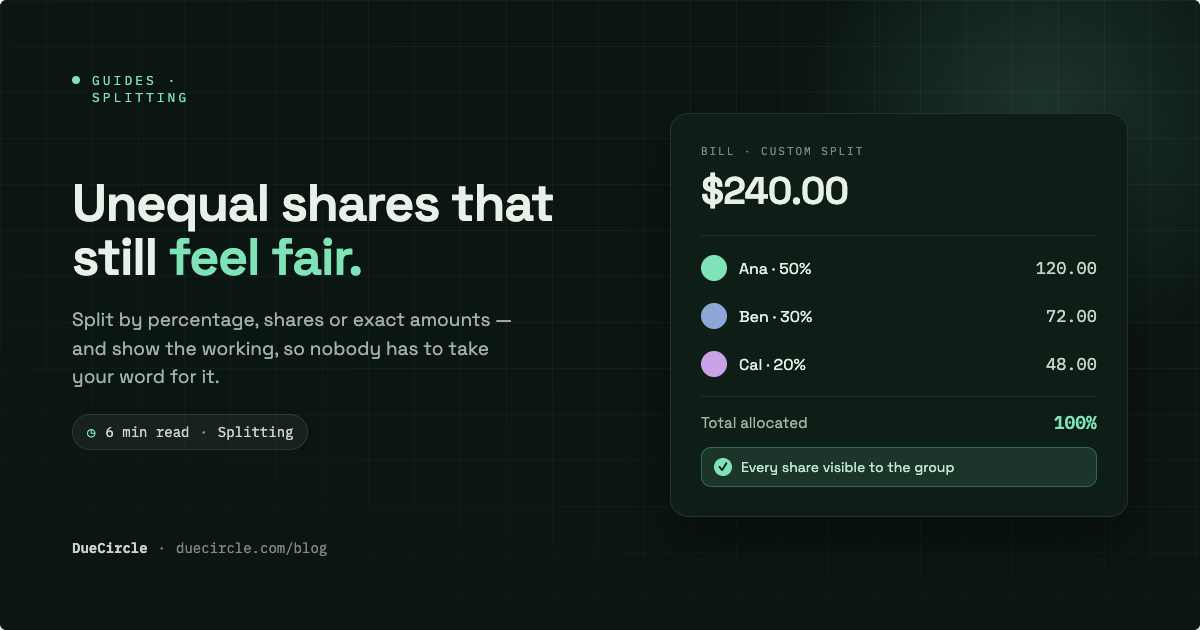
A percentage split lets you say 60 and 40, or 50, 30 and 20, and let the app do the arithmetic on any total. Change the bill amount next month and the ratio still holds without you recalculating.
It is the tidiest choice when you want a rule you can repeat, rather than a fresh negotiation every time.
Shares: fairness in plain counting
Shares are percentages without the maths. You hand out units. One person counts as two shares, another as one, because that is roughly how the cost falls.
For a family meal where two adults eat far more than a child, you might set two shares, two shares, and one share on a ₹1,000 bill. That works out to ₹400, ₹400 and ₹200. Nobody argued about decimals; you just counted plates.
Shares are the friendliest way to be unequal, because everyone can see the logic at a glance.
- Exact amounts: you already know each person's precise figure
- Percentages: a fixed ratio you want to reuse across changing totals
- Shares: quick whole-number weighting when plates or usage differ
- Exclude someone: they simply were not part of this expense
- Any method: the shares always sum back to the exact total
Leaving someone out entirely
The most unequal split of all is zero. Not everyone in the group was part of every expense, and pretending otherwise is where resentment starts.
DueCircle lets you choose the participants on each expense, so the friend who skipped dessert, or was out of town that weekend, is simply not on it. The cost divides only among the people it actually applied to.
A worked example that lands fair
Four friends have a ₹2,000 dinner. Two shared a big platter and drinks, one had a modest main, and the fourth only had coffee and needs to leave early. Even splitting would charge the coffee drinker ₹500 for a ₹90 evening.
Instead you use exact amounts: ₹750, ₹750, ₹410 and ₹90, which totals ₹2,000. DueCircle confirms it adds up, records it, and folds it into the running balance so the two big spenders carry their share.
That is the whole point of splitting unequally. The numbers finally match the night. DueCircle is free and private, and it does the fairness maths so nobody has to feel short-changed, or chase the person who was.
Published 10 August 2026.