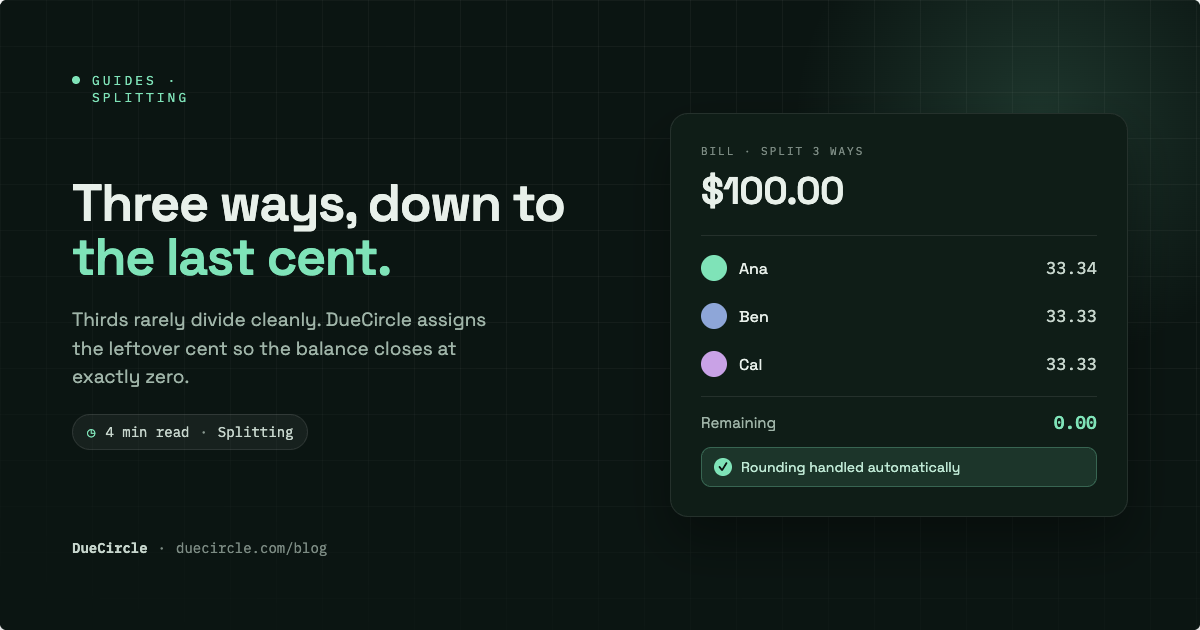
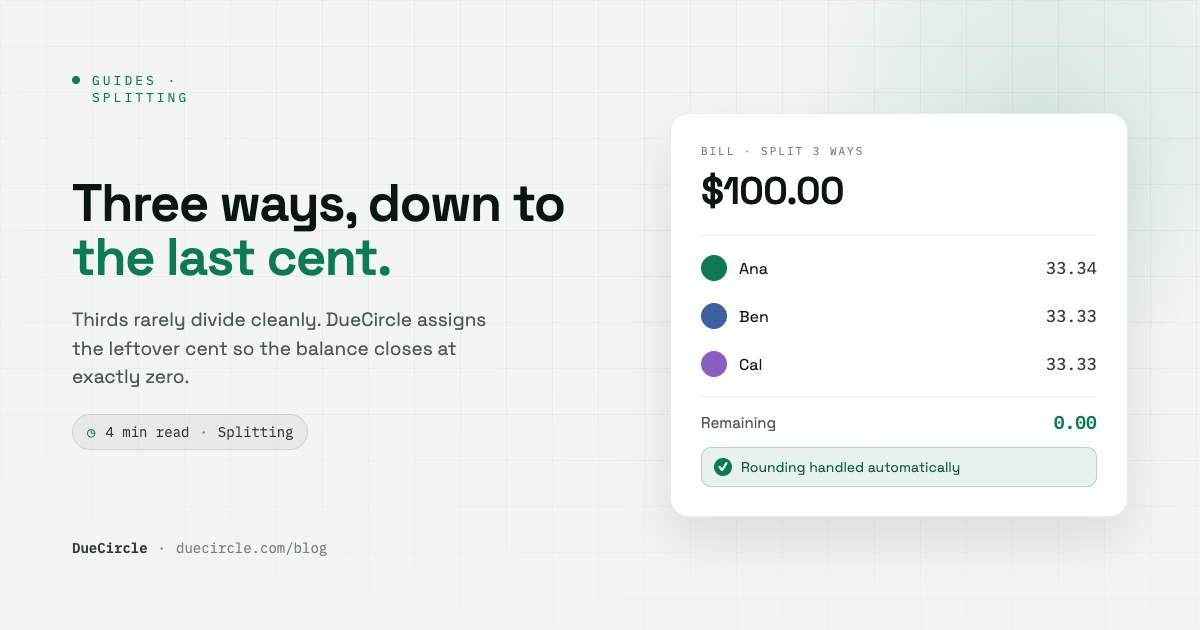
Three is the number that trips up bill-splitting. Two people halve cleanly, four quarter neatly, but three almost never divides without a remainder. Try ₹100 between three friends and you get ₹33.33 each, forever.
That leftover paisa is tiny, but it is where splits go wrong. If everyone rounds to ₹33 the shares fall short of the total; if everyone rounds up, they overshoot. Here is how to handle it so the numbers always land exactly on the bill.
Why 3 rarely divides evenly
Money comes in whole paise, and most totals are not multiples of three. Split ₹100 three ways and the honest answer is ₹33.33 recurring, which no wallet can actually pay.
So a split into thirds nearly always leaves one indivisible unit hanging. It is not a bug in the maths; it is what happens when a number that does not divide by three meets a currency that stops at the paisa.
The question is never whether there is a leftover. It is who carries it, and whether anyone can see how it was handled.
The wrong fixes people reach for
The usual move is to eyeball it. Everyone pays ₹33 and the extra rupee just disappears, or one person mutters 'I will cover the rest' and no one records it.
That works until it does not. Do it across a dozen expenses and the balance drifts away from reality, and someone eventually notices they are quietly out of pocket.
The better approach is boring on purpose: split it precisely, assign the leftover to one named person, and show it. No disappearing paise, no vague rounding.
How DueCircle handles the leftover
DueCircle stores every amount in whole paise and splits by the largest-remainder method, so the three shares always sum back to the exact total. Nothing is lost and nothing is invented.
When a unit cannot divide evenly, it does not vanish. It goes to one named person, and the app shows you who. Split ₹100 three ways and you get ₹33.34, ₹33.33 and ₹33.33, which adds back to exactly ₹100.
Because the leftover is visible and attached to a name, it is fair over time. Next time it can land on someone else, and nobody is silently absorbing rounding on every bill.
A quick way to think about three-way splits
You do not need to run any of this in your head. But if you like knowing what the app is doing, here is the shape of it.
The steps below are exactly what happens under the hood, whether the bill is ₹100 or ₹4,001.
- Take the exact total in whole paise
- Give everyone the base share that divides evenly
- Hand any leftover unit to one named person
- Show that assignment so it is never hidden
- Confirm the parts sum back to the full total
Let the app carry the paisa
A single leftover rupee is not worth an argument, and it is definitely not worth a spreadsheet. But over many bills, unrecorded rounding is how friends end up feeling short-changed without knowing why.
Splitting three ways is the everyday case where this matters most, precisely because three is so awkward. DueCircle is free and private, does the paisa-level maths, and names who carries the odd unit, so the total always adds up and nobody has to chase the difference.
Published 4 August 2026.