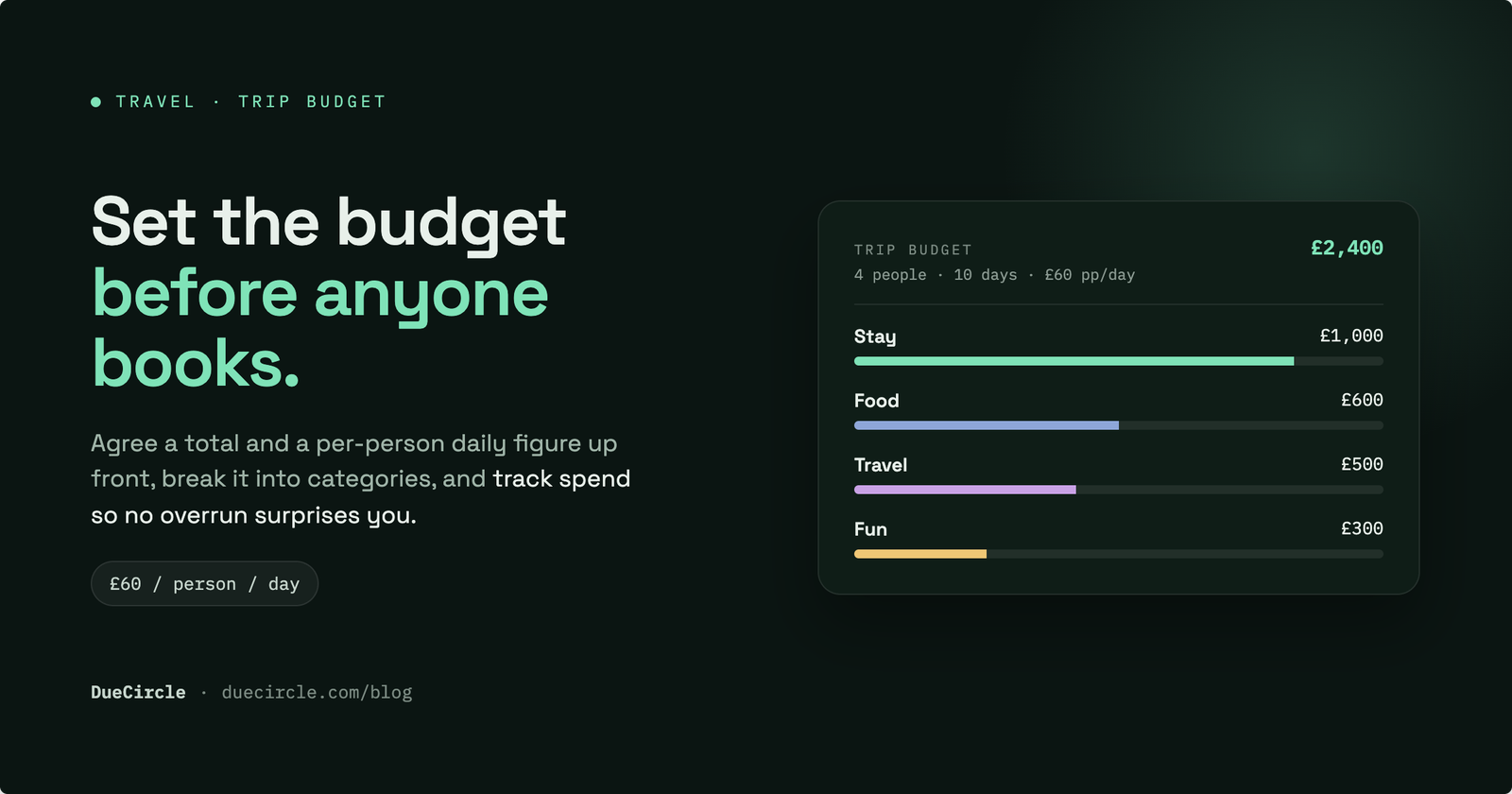
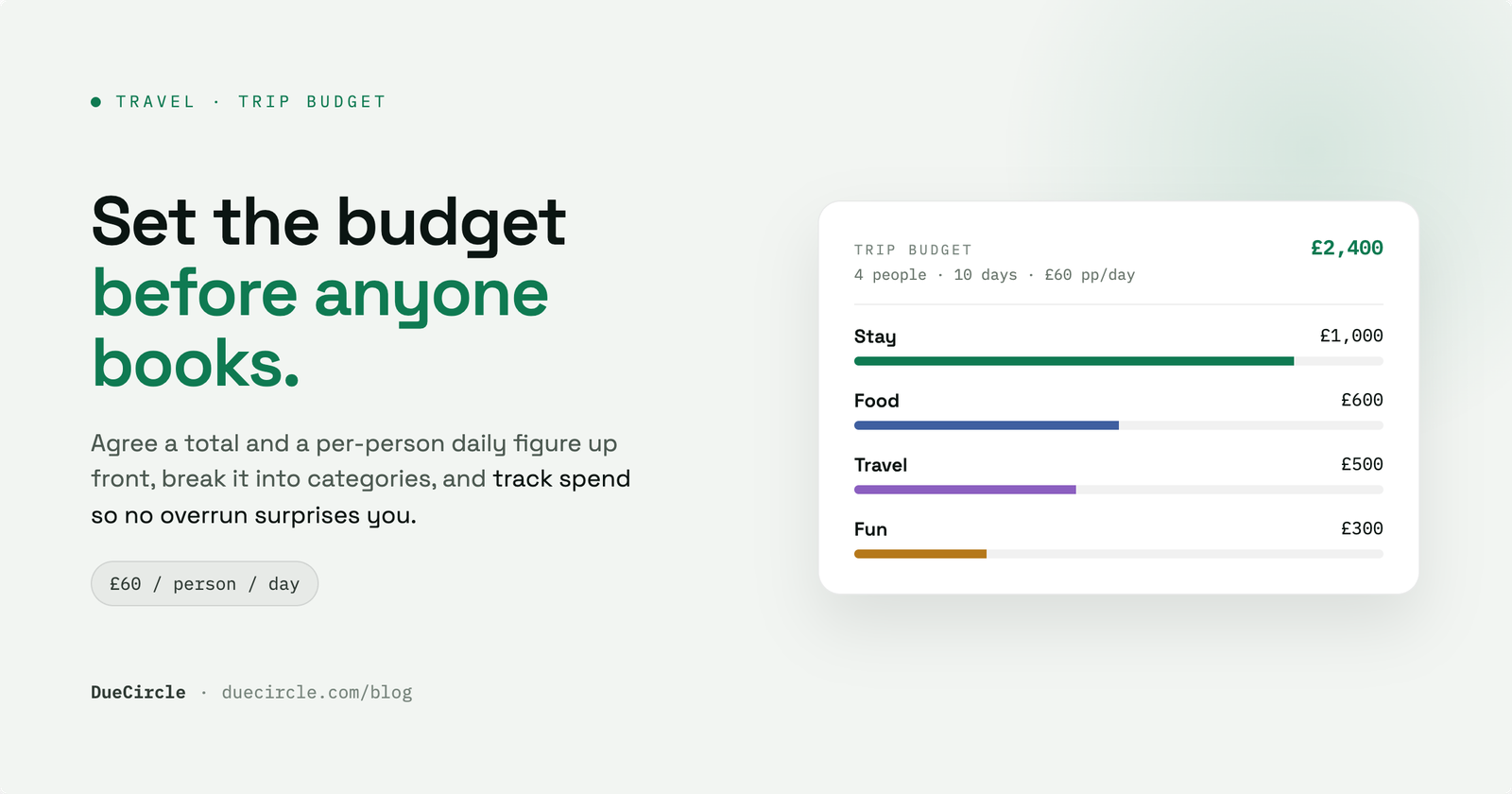
Most group trips are not overspent at the end. They are overspent at the beginning, in the quiet gap between someone suggesting a weekend away and anyone agreeing what it should cost. Flights get booked, a nicer flat gets picked, an activity gets added, and the number nobody set drifts upward until the trip is more expensive than half the group meant it to be.
The fix is dull and effective: decide the money before the plans. Agree a group trip budget and a per-person daily figure first, break it into a few categories, and then let the bookings fit the number rather than the number chase the bookings. This is a planning exercise, done once, before anyone spends anything.
Agree the total and the daily figure before you book
Start with the two numbers that govern everything else: the total each person is comfortable spending, and the per-person daily budget that follows from it. The order matters. If you begin with the flat and the flights and only add up the total afterwards, the total is whatever the choices happened to cost, which is how trips overrun.
Ask everyone privately for a ceiling, the figure above which the trip stops being fun and starts being a stretch. Take the lowest honest answer as the working total, because a budget that only suits the most comfortable person is not a group budget. Then divide by the number of days to get a per-day figure that every plan has to respect.
A daily number is easier to hold in your head than a lump sum. Four hundred pounds for a weekend is abstract. A hundred a day, once the fixed costs are set aside, is something you can actually check yourself against on the second afternoon. The point of setting it early is that it shapes the bookings while they are still decisions rather than receipts.
Break the budget into categories
A single total hides where the money goes, and money that is hidden is money that overruns. Split the trip into a handful of categories so each has its own ceiling and each can be checked on its own. Most trips fit five: travel, stay, food, activities, and a buffer.
Travel and stay are the fixed costs, known before you leave and paid up front. Food and activities are the variable costs, spent day by day, and they are where a daily budget does its real work. The buffer is not optional padding you cut when the sums look tight. It is the category that absorbs the taxi you did not plan, the round nobody expected, and the entry fee that turned out to be cash only.
Set a rough share for each before booking, then let the fixed categories firm up as you commit to flights and a flat. Once travel and stay are locked, whatever remains of the total, divided by the days, is your genuine spending money per day. That is the figure worth writing where everyone can see it.
- Travel — flights, trains, transfers, fuel. Fixed, paid up front.
- Stay — the flat or rooms for the whole group. Fixed, paid up front.
- Food — groceries, coffee, dinners. Variable, tracked daily.
- Activities — tickets, tours, the one big thing. Part fixed, part daily.
- Buffer — 10 to 15 per cent, held back for the unplanned.
Kitty or pay-as-you-go: pick one on purpose
There are two honest ways to run the money on the ground, and choosing before you go saves a great deal of friction. The first is a kitty, or float: everyone puts an equal amount into a shared pot at the start, and shared costs come out of it. The second is pay-as-you-go: whoever is nearest the till pays, it gets recorded, and the group settles up at the end.
A kitty is simple in the moment and quietly enforces the budget, because when the pot is visibly half gone on day one, everyone can see it. Its weakness is that it suits costs shared evenly by the whole group. The moment two people skip the pricey dinner or one does not drink, a single pot starts to feel unfair, and topping it up mid-trip is awkward.
Pay-as-you-go handles an uneven, changing group far better, because each expense records exactly who was in on it. Its weakness is memory: it only works if costs are logged as they happen rather than reconstructed from a group chat on the journey home. In practice many trips run a small kitty for the genuinely shared, everyday costs and record the rest as it falls. Whichever you choose, DueCircle records who paid and who owes either way, and produces one settle-up at the end so nobody is doing sums in a hotel lobby.
When people have different budgets in the same group
The hardest part of a group trip budget is rarely the total. It is that a group is not one wallet. One person is saving, another is relaxed about money, and a plan that suits the second quietly excludes the first. Pretending everyone has the same budget is how someone ends up either overspending in silence or opting out of half the trip.
Name it early and without drama. Set the shared baseline at a figure everyone can genuinely meet, and treat anything above it as optional and individual. The group dinner is in the baseline; the tasting menu two people want is on those two people. This keeps the core trip inclusive and lets the bigger spenders add to their own experience without pulling the budget up for everyone.
Then let the splitting follow reality rather than an assumption of evenness. Choose participants per expense so the people who did the pricey activity carry its cost, split the shared meal equally, and let someone pay their exact amount when they ordered less. A budget that allows different appetites, and a tool that records them accurately, is what keeps the trip friendly. Fairness is not everyone paying the same; it is everyone paying for what they actually chose.
Track daily spend so you catch an overrun mid-trip
A budget you set and never look at is a wish. The value is in the checking, and the only useful moment to check is while you can still change something. Knowing on Saturday afternoon that the group has already spent Sunday's money too is worth more than any tidy spreadsheet assembled once you are home and the money is gone.
This is what a daily budget is for. Record expenses as they happen and watch the day's running total against its ceiling. If day one lands twenty per cent over, day two can quietly pull back, a cheaper dinner or a free morning, and the trip stays inside its total without anyone feeling policed. The correction is small precisely because it is early.
Use the group notes to plan against the number, not just to list ideas. Keep the agreed daily figure at the top, jot the fixed costs already committed, and note the optional extras and who is in for them. When the plan and the budget live in the same place, the group is deciding with the number in front of it, which is the whole point of setting one.
A worked example: four friends, a weekend
Take four friends going away for a two-night weekend, three days on the ground. They agree a per-person total of 300 pounds, so the trip has 1,200 pounds to work with in all. First they set aside the fixed costs, then divide what is left across the days.
The flat is 480 pounds for the group, or 120 each. Return travel is 60 each. That is 180 per person committed before anyone arrives, leaving 120 each for the three days, which is 40 a day for food, activities and the buffer combined. Writing it that way makes the daily figure concrete: 40 pounds a person, per day, once you are there.
On day one they overspend, as groups do. A long lunch and a paid tour take the day to 55 each, fifteen over. Because it is recorded as it happens, they see it that evening rather than a week later. Day two they cook at the flat and keep a free morning, landing at 28 each. The trip nets back inside its total, the buffer is barely touched, and the settle-up at the end is a single set of payments rather than a reconstruction. No one budget was blown; it was simply watched.
- Per-person total: 300 pounds. Group total: 1,200 pounds.
- Fixed, paid up front: stay 120 each, travel 60 each — 180 committed.
- Left for the trip: 120 each over three days — 40 a day per person.
- Day one 55 each (over), day two 28 each (pulled back), day three on target.
- Recorded as you go, so the overrun shows up on the day, not at home.
Published 20 May 2026.