An IOU is just a small promise: I owe you. You spot a friend for a ticket, cover a round, lend a colleague cash for lunch, and somewhere in your head a little note appears that says they will get you back.
The problem is that heads and notes apps are where those promises go to die. An IOU tracker is simply a proper running record of who owes you, so you never have to remember the amount or reconstruct how it got there.
The notes-app IOU and why it fails
Most people already keep a rough IOU tracker, it just lives in a notes app or the back of their mind. Ankit owes 500. Then, three days later, plus 150 for popcorn, question mark.
By the time you look again, the entry is stale and you are half-guessing. Did they pay part of it back? Was the 150 you or them? The record is only as good as the moment you last remembered to update it.
So the IOU quietly evaporates. Not because anyone is dishonest, but because reconstructing small amounts from memory is genuinely hard, and nobody enjoys the awkward reminder.
What a real IOU tracker does
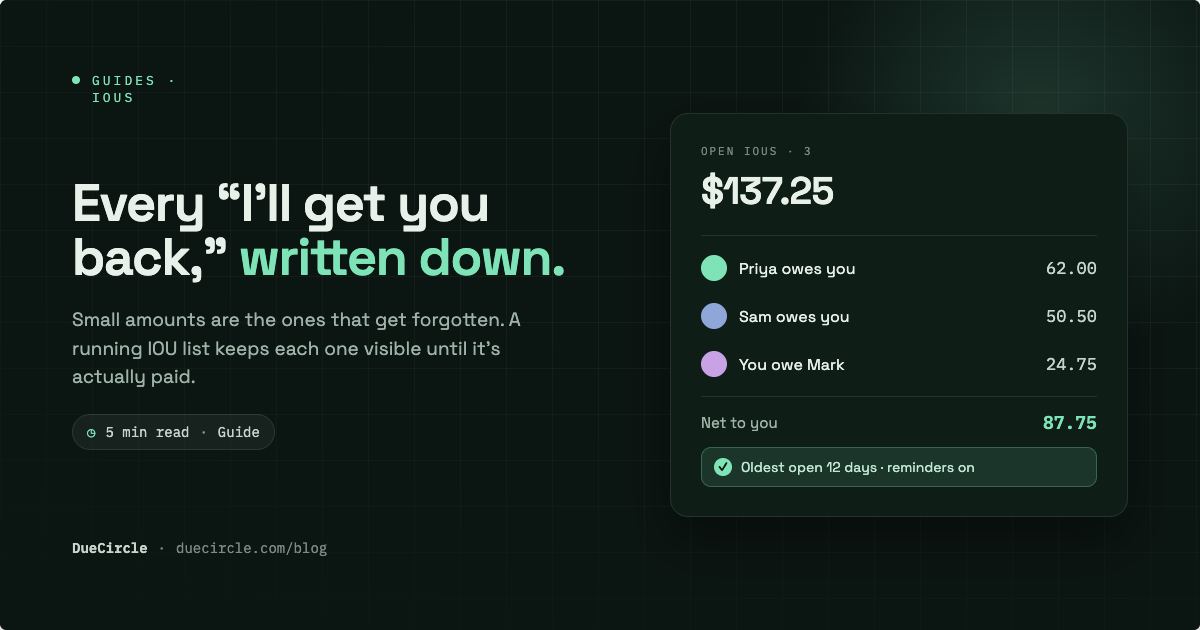
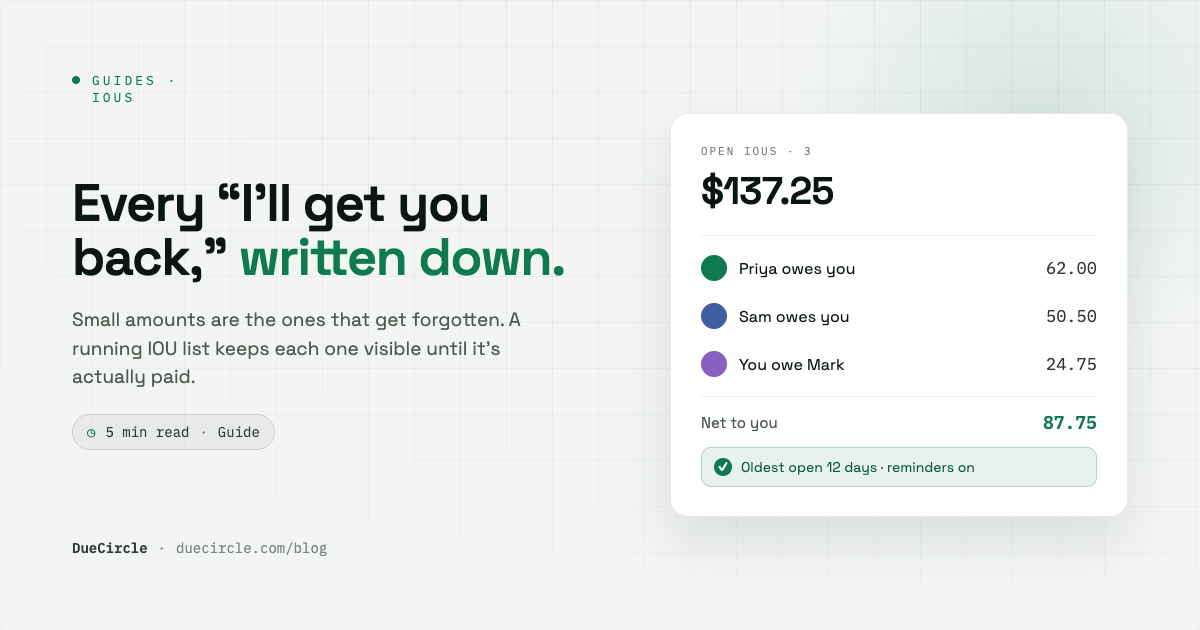
A proper IOU tracker keeps a running record instead of a static note. Every time you add what you covered, the balance updates, so the current number is always right there.
You are not adding up a history each time you want to know where you stand. You read one figure, and it already reflects everything logged so far.
That is the whole shift, from remembering to recording. Once it is written down honestly, the awkwardness of who owes what mostly disappears.
One person or a whole group
IOUs come in two sizes. Sometimes it is one person you keep covering; sometimes it is a group where several small debts float around at once. DueCircle handles both.
For a single person, a one-to-one balance keeps one net number between just the two of you, found by their exact mobile number or email. For several people, a group keeps live balances of who owes whom.
- One person: a single running balance between the two of you
- A group: live balances showing who owes whom
- Add each expense the moment you cover it
- Choose who it applied to, so nobody is charged wrongly
- Read the current number any time, already totalled
A worked example
Say you spot Ankit ₹500 for a movie ticket. You log it, and your one-to-one balance shows he owes you ₹500. So far, so ordinary.
Later that night you grab popcorn for ₹150 and add that too. The balance moves to ₹650 on its own, no scribbled plus-150 with a question mark.
Whenever you wonder where things stand, you open the balance and read ₹650. When Ankit pays you back, you mark it recorded and it drops to zero. You never once re-added the two amounts yourself.
Never reconstruct it again
The point of an IOU tracker is not to be the friend who counts every rupee. It is to spare both of you the vague, low-level worry of a debt nobody quite remembers, which is exactly the kind that sours things.
DueCircle is free forever and private, keeps your records intact, and never touches your actual money, you pay each other the usual way. It just holds the running total and does the maths, so you never have to remember who owes you, and never have to chase to find out.
Published 24 July 2026.