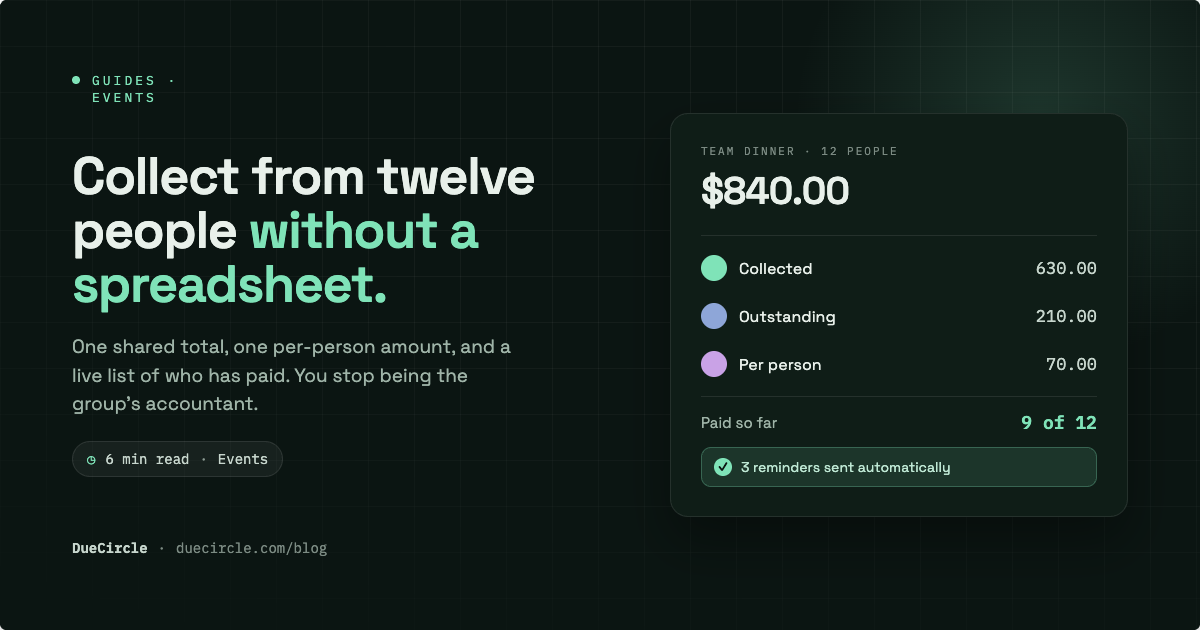
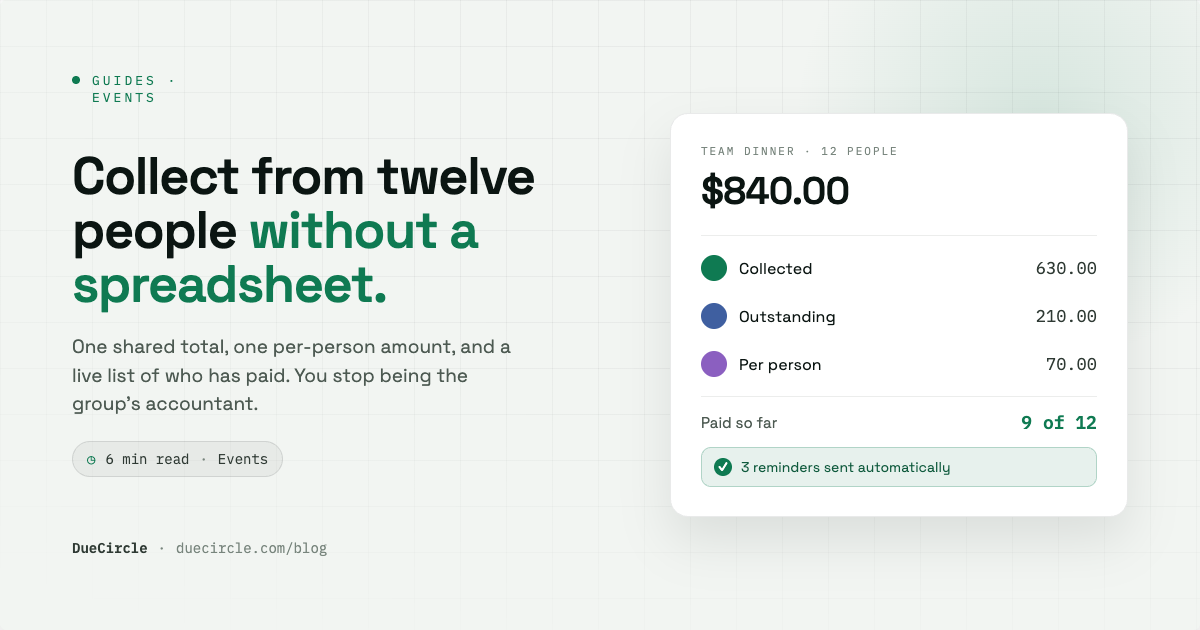
You booked the venue, paid the deposit, and put the catering advance on your own card. Everyone said 'count me in' — and then the day came, the money did not, and you were quietly ₹18,000 out of pocket with a smile on your face.
Collecting money from a group is rarely about people being tight-fisted. It is about the amount being fuzzy, the ask feeling awkward, and nobody actually knowing what they still owe. Sort those three things out and most of the money collects itself.
Start with the real total, not a rough guess
Before you ask anyone for a single rupee, work out the actual number. Add up the deposit, the balance payment, and the little extras you covered on the day — the ₹600 for ice, the ₹250 auto fare for the cake, the ₹400 tip you rounded up. Guesswork is where trust quietly leaks out of a group.
Once you have a firm total, you can divide it honestly, and people can pay you with confidence. A friend is far happier handing over a precise ₹1,450 than a vague 'about fifteen hundred, yeah?'. The exact figure feels fair; the round one always feels like it might be padded in your favour.
This is also the moment to put the number somewhere shared rather than keeping the running total in your head. Your memory is a cheerful but unreliable accountant, and it has a habit of rounding every sum in the direction that suits you.
Split it the way the event actually happened
Not every event splits cleanly down the middle, and pretending it does is how resentment starts. Some people came for the whole weekend and some dropped in for an hour of cake. Some drank the bar dry and some drove everyone home stone-cold sober at 2am.
DueCircle lets you choose how each cost divides, so you can match the split to what really happened instead of forcing one blunt rule across everything. You pick the participants for each expense too, so the person who skipped the dinner is not quietly paying for a meal they never ate.
Here are the ways you can carve up a single cost:
- Equal — the simplest, when everyone got roughly the same thing
- By shares — give the couple who stayed two nights a bigger slice than the day-tripper
- By exact amounts — when you already know Rhea owes ₹800 and Sam owes ₹1,200
- By percentage — handy when one person offered to cover a fixed chunk
- Exclude anyone it did not apply to — the friend who skipped dinner should not pay for it
A quick worked example
A worked example makes the fairness concrete. Say three of you are splitting a ₹1,000 booking fee equally. A third of ₹1,000 is ₹333.33 recurring, which will never divide into three tidy rupees no matter how you squint at it.
DueCircle works in whole paise and shares out the leftover by the largest-remainder method, so two of you are charged ₹333.33 and one is charged ₹333.34. The three shares add up to exactly ₹1,000, and the person carrying the extra paisa is named on screen rather than hidden away. If you tried to save a custom split that did not add up, the app would simply stop you.
It is a tiny sum, of course. But 'the numbers always add up' is precisely the reassurance that keeps a friendly group chat from slowly turning into a forensic audit of who owes what.
Chasing without turning into a nag
The dread of collecting money is almost never about the money itself. It is about feeling like a debt collector towards people you genuinely like. The trick is to let the number do the talking, so you never have to play that role.
When everyone can see the same shared balance, the ask stops being personal. You are not accusing anyone of anything; you are pointing at a figure you both already agree is fair. 'Whenever you get a chance' lands very differently when the amount is right there in front of both of you.
Let the balance keep score, not you
Once people have paid you back outside the app — UPI, cash, a bank transfer, whatever suits them — you mark it recorded and the balance updates on the spot. When several people owe you at once, DueCircle lays out a settle-up plan that clears everyone in a small number of payments by matching the biggest debtor to the biggest creditor.
You never have to hold a running tally in your head or redo the arithmetic every time somebody pays a little back. The app is free, it keeps your group's numbers private, and it never touches or moves your money — it just does the sums, so you can go back to being the friend who threw a brilliant party instead of the one still quietly owed for it.
Published 21 July 2026.