If you have split expenses with friends before, you have probably used Splitwise. It is a good tool, and it popularised the whole idea of a shared ledger for a group. But some of it now sits behind a subscription, and a few too many taps end with a prompt to upgrade.
This is a plain, honest comparison for anyone searching for a free Splitwise alternative. We will be specific about what DueCircle does, what it deliberately does not do, and where each tool fits — no bait, no asterisks.
What people actually want from an expense splitter
The job is small and specific: record who paid, split it fairly, see who owes whom, and settle up with as little fuss as possible. Everything else is optional decoration.
Most of the friction comes from two places — limits on how much you can do for free, and features that get in the way of that core loop. A good alternative removes both rather than adding more.
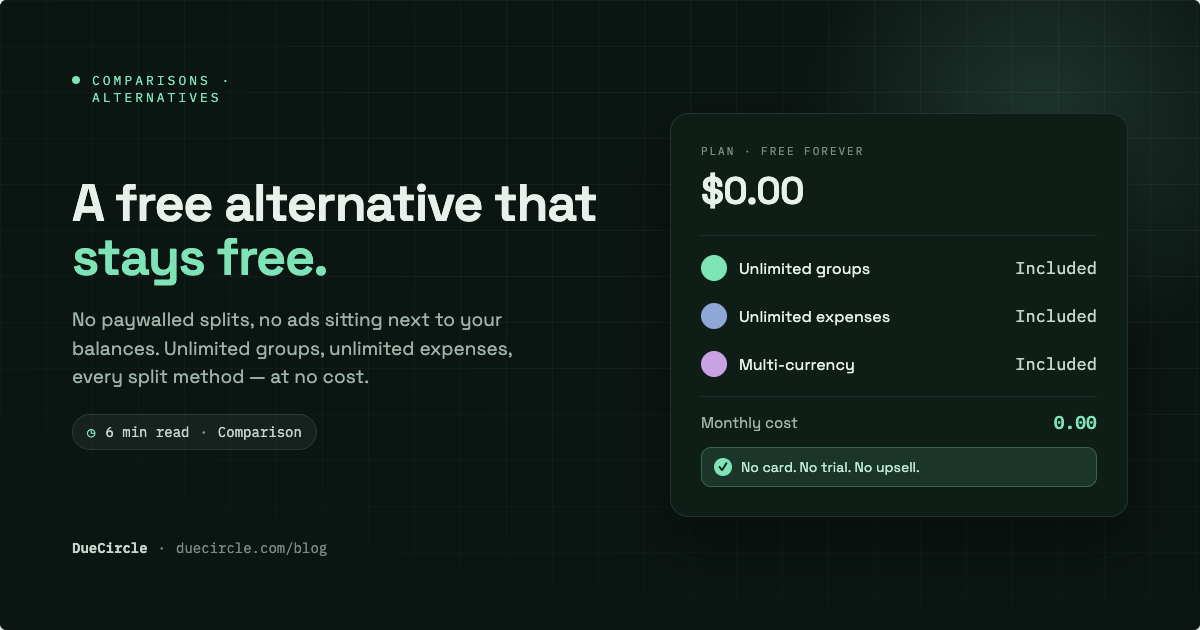
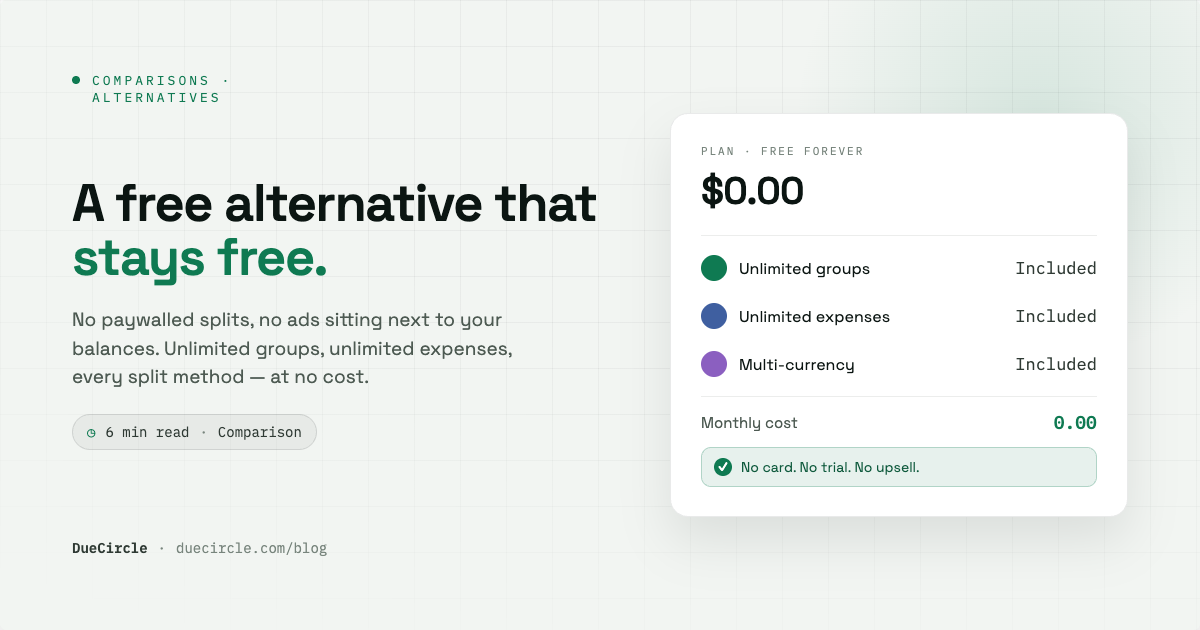
Free means free — there is no paid tier to hit
DueCircle has no premium plan. No limit on groups, members or expense history, and nothing important locked away. It is funded by ads on the public pages of this website, never inside your group data.
That matters because the genuinely annoying moment with any freemium tool is the one where the useful thing you were about to do suddenly asks for money. We removed that moment by not having a paid tier at all.
No card is required to start, because there is nothing to charge it to. You create a free account — just an email — so your groups stay in sync across your devices, and that is the extent of it.
Splitting that always adds up
You can split equally, by exact amounts, by percentage, or by shares, and leave out anyone the expense did not apply to. Whatever you choose, the parts are checked against the total before anything can save, so a split that does not reconcile cannot be entered by mistake.
A ₹4,800 dinner for four comes to ₹1,200 each. A ₹100 bill across three people cannot divide evenly, so instead of quietly losing or inventing a cent, DueCircle hands the leftover unit to one named person and shows it. The shares add up to exactly what was paid, every time.
Balances stay live as you go, so nobody has to reconstruct three months of a group chat to work out where things stand.
Settling up without the spreadsheet
When it is time to square up, DueCircle works out a settlement plan that clears everyone in just a few payments — matching the biggest debtor to the biggest creditor until the group is back at zero. You make the actual payment between yourselves and mark it recorded.
It handles more than one currency without fudging. Each currency's balance is kept separately, so a trip that mixed rupees and euros is never mashed into a single guessed number at a rate nobody chose.
What DueCircle does not do — on purpose, or not yet
It does not connect to your bank, hold your money, or move funds. That is deliberate: it removes an entire category of risk from a product whose whole job is trust. You record expenses yourself, which takes seconds and keeps your finances private.
Some things are simply still on the way. A dedicated bills-and-reminders area, budgets and a group notes section are on our roadmap, not in the app today — and we would rather tell you that than pretend otherwise.
So the honest verdict: if your must-have is automatic bank import, a bank-linked budgeting app is the better fit. If what you want is a free, private, accurate way to split and settle with people you trust, that is exactly what DueCircle is built to be.
Published 29 July 2026.