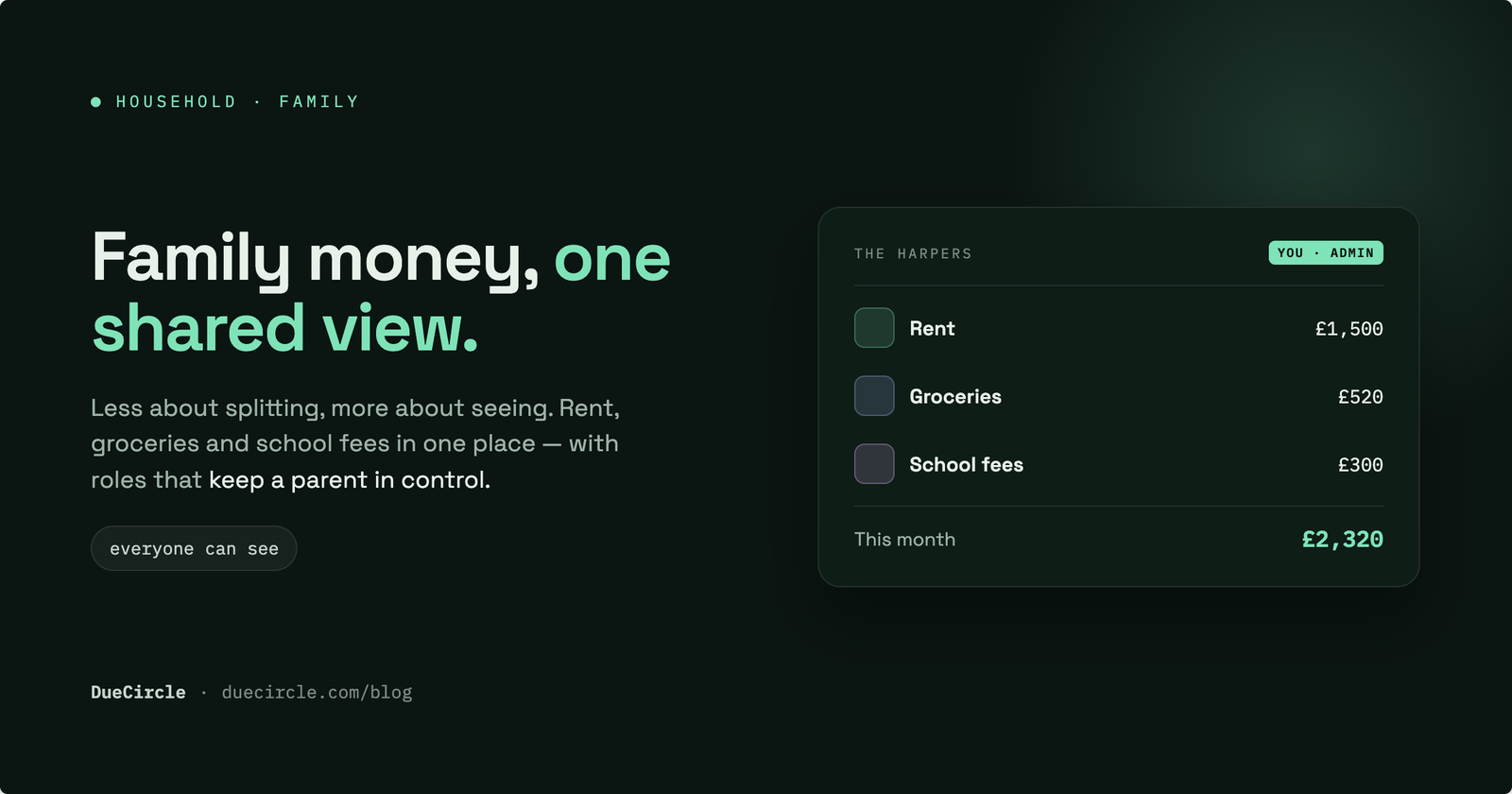
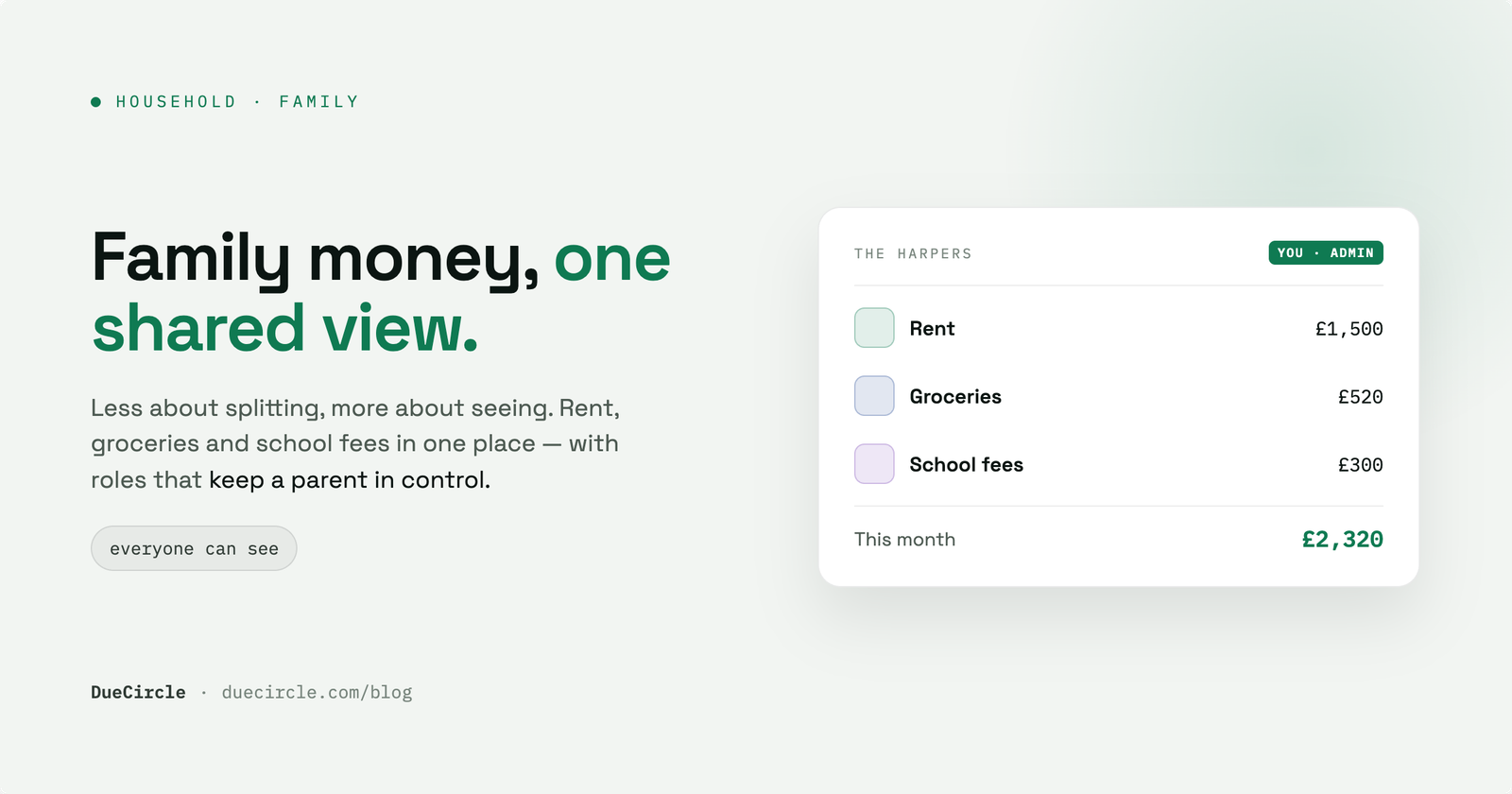
Most budgeting tools are built for one person keeping score in private. A household is not one person. It is rent leaving one account, groceries paid by whoever is at the shop, school fees due on a date nobody quite remembers, and a home loan that goes out whether anyone is watching or not. The money is shared, but the view of it usually is not.
A family budget app should fix that gap. Not by settling debts between people who live together, but by putting the whole month somewhere everyone can look. When the budget is visible, the questions get quieter. Can we afford this. Where did the extra go. Is that bill higher than last time. Those are answered by looking, not by asking.
Family money is about seeing, not splitting
When you split a holiday or a shared flat, the goal is to work out who owes whom. A family rarely works that way. Nobody is chasing a partner for their half of the electricity or asking a child to settle up for the groceries. The money comes from a shared pool and returns to shared decisions.
So the useful question changes. It stops being how do we divide this and becomes what does the month actually look like. A good family expense tracker leans into that. It holds the full picture in one place: what comes in, what goes out, what is fixed and what is still moving. The point is a shared understanding, not a balance to clear.
This is why a tool built purely for splitting often feels wrong at home. It keeps asking who pays whom, when the honest answer is us, from the same place, every month.
One place for rent, groceries and school fees
Household spending is scattered by nature. Rent or the home loan is one large fixed payment. Utilities arrive on their own schedules. Groceries happen several times a week, paid by different people. School fees land in a lump once a term. Kept in separate heads, in a banking app, on a note on the fridge, none of it adds up to a view.
Put them in one shared group and the month becomes legible. Everyone with access sees the same figures, updated as they happen, in exact amounts rather than rounded guesses. There is no reconciling two versions of the truth because there is only one.
It also means the record does not live with one person. If the parent who usually tracks things is away, the household still knows where it stands. The information belongs to the family, not to whoever happened to be holding the receipts.
Set a monthly budget and watch the categories
A number on its own does not help much. Knowing you spent a certain amount tells you nothing unless you know what you meant to spend. So set a monthly budget and let each category sit against it: groceries, transport, eating out, the fixed bills that never really move.
As the month runs, you can see which categories are calm and which are climbing. Groceries creeping past their usual line by the third week is worth noticing before payday, not after. The value is in the early look, not the end-of-month reckoning when the money is already gone.
Then compare this month with last. A single month is a snapshot; two months side by side is a direction. If eating out has quietly doubled, the comparison says so plainly, without anyone needing to remember what last month felt like.
Roles, so a parent keeps control and a teenager learns
A household is not a group of equals with a shared password. A parent needs full control over the budget, the bills and who can see what. A teenager does not need that, but they can gain a great deal from recording their own spending.
Roles make this workable. An owner or admin holds the real control: the budget, the recurring bills, the settings. A member can add and view. A view-only role can see the picture without changing it. A teenager given a member role records what they spend from their allowance and watches it register against a category, in real money, the same day.
That is a quiet way to teach kids money. Not a lecture, but a running record they keep themselves. They see the balance move, they see a category fill up, and they learn the shape of a budget by living inside a small corner of one. The parent still holds the frame; the teenager fills in their part.
Catch a creeping bill before it settles in
Bills rarely jump. They creep. A utility edges up a little each cycle, a subscription renews at a higher rate, an insurance premium quietly resets. Any one change is small enough to ignore. Left unwatched across a year, the small changes add up to a real difference in what the household spends.
Comparing this month with last is what catches it. When a recurring bill sits next to its previous figure, a rise is obvious the moment it appears. You notice it in month one, ask the question then, and decide what to do while it still matters. That is the difference between managing a bill and simply paying it.
None of this needs a bank connection. The record is what the family enters and agrees on, kept private, never linked to an account. The visibility comes from the shared view, not from handing over access to anything.
Recurring bills and reminders, so nothing is late
The most predictable payments are the easiest to forget, precisely because they are automatic in your mind but not always on the calendar. Rent, the home loan, utilities, school fees, the annual renewals. Missing one is rarely about the money and usually about the date.
Set the recurring bills once and they carry forward. Reminders mean the due date arrives with warning rather than surprise. And because next month is already visible, you can see what is coming before it is here. The large fixed payment due in two weeks is on the screen now, so the week it falls holds no shock.
Consider an ordinary month for a family of four. Rent goes out on the first, already logged, already expected. The grocery category runs steady until the middle of the month, then starts to climb; the comparison with last month shows it is genuinely higher, so the weekend shop gets trimmed. The teenager records a few purchases from their allowance and watches the balance fall. A utility bill lands slightly above its usual figure, and because it sits beside last month's, the rise is spotted and queried the same day. School fees are due at the end of the term, but the reminder is already set and next month already shows them. Nothing about the month is dramatic. It is simply seen, by everyone, in one place.
- Rent and home loan: fixed, logged, expected on the day
- Utilities: watched against last month so a rise shows early
- Groceries: a category that moves, checked before payday
- School fees: set as recurring, with a reminder before the term ends
Published 28 May 2026.