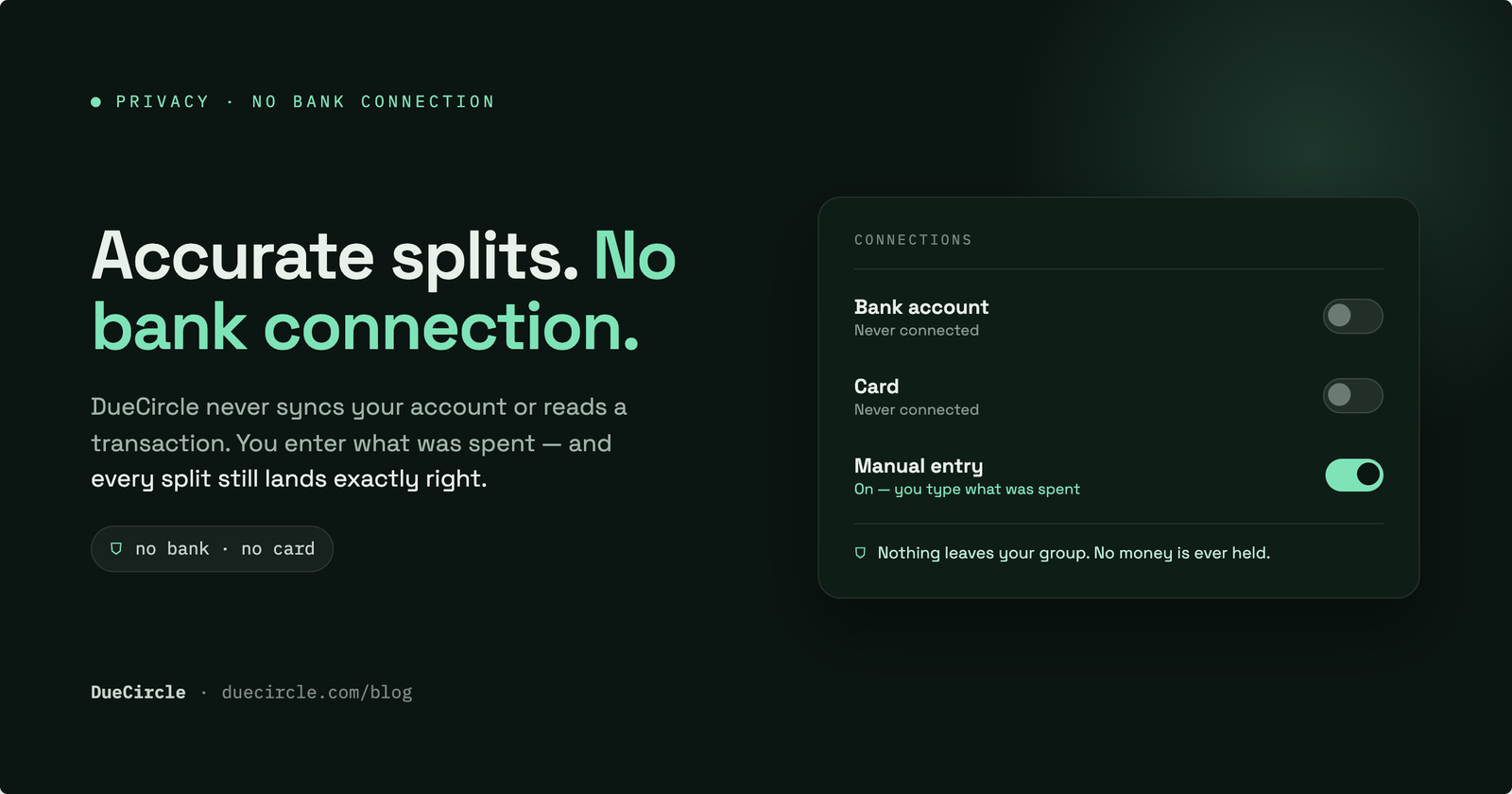
One of the first questions people ask about a shared-money app is whether it links to their bank. It is a fair question, because most money apps now treat that link as the headline feature.
DueCircle does not connect to your bank, and it never will. That is a deliberate decision, not a gap we plan to fill. This post explains what bank sync actually is, why so many apps push it, and why an expense-splitting tool is better without it.
What bank sync actually means
When an app offers to ‘connect your bank’, it is usually using open banking or a transaction aggregator. You sign in through a third party that sits between the app and your bank, and from that point the app can read a continuous feed of your transactions.
That feed is genuinely convenient. Purchases appear on their own, balances update in the background, and you never have to type an amount. For a personal budgeting app whose whole job is to categorise your own spending, that automation is the product.
But convenience is not free, and it is worth being precise about what you hand over to get it. You are not just sharing the few transactions that matter to your shared expenses. You are granting a standing window into everything the account touches.
The real cost of connecting a bank
The first cost is access. A connection reads your whole account, not the handful of transactions relevant to your group. The rent, the salary, the medical payment, the private purchase you would never itemise in a shared ledger are all in the same feed.
The second cost is where that data goes. Bank connections normally route through an aggregator, so a company you did not choose and may never have heard of ends up holding a copy of your financial history. Every party in that chain is one more place your data lives and one more thing that has to stay secure forever.
The third cost is risk concentration. An app holding banking tokens for many users is a valuable target, and that value does not depend on the app's good intentions. There is also the quieter cost of consent fatigue: each new permission screen trains you to click through, until agreeing to share your finances feels as routine as accepting cookies.
A splitting app does not need it
Here is the part that often gets skipped. The hard problem in shared money is not capturing what was spent. You already know what you spent, because you were there when it happened.
The hard problems are agreement and memory. Who paid, who owes, in which currency, and whether everyone remembers the same version of events three weeks later. Those are questions of record and consensus, and a bank feed answers none of them.
A raw transaction line tells you a card was charged. It does not know the dinner was split four ways, that one person was only there for drinks, or that a refund is still pending. Someone has to add that meaning, and that someone is a person, not an API. Once a human is deciding how each expense is shared, the automatic import has saved a keystroke and nothing more.
The trade-off we chose
DueCircle asks you to record expenses yourself. You enter what was spent, choose how it is split, and can attach a photo of the receipt as proof so the record is evidence rather than memory. Recurring bills can be set to remind you, so the things that repeat do not depend on anyone remembering.
When it is time to square up, DueCircle produces a settle-up plan: the shortest set of payments that clears the balances. The money math is done on exact integers, so the totals reconcile to the penny and no rounding error quietly appears. It is multi-currency, so a trip that crosses borders still adds up.
What you give up is automatic import. What you gain is that no third party ever reads your bank, no credential or token is ever stored, and there is an entire category of risk that simply does not exist in this app.
- You record each expense and can attach a receipt as proof.
- Roles (owner, admin, member, view-only) control who can change what.
- Group data never crosses between groups.
- Settle-up gives you the fewest payments needed to clear the balance.
Why it works everywhere
Open banking coverage is uneven. It works well with some banks in some countries and poorly or not at all elsewhere, which is why bank-linked apps tend to launch region by region and leave people behind.
Manual entry has no such limit. If you can read a receipt, you can record an expense, whether your group is in one city or spread across several countries with different banks and currencies.
That is part of why we treat manual entry as a feature rather than a compromise. It is the version of the app that behaves the same for everyone, with no dependence on which bank you happen to use.
How our funding keeps your data out of it
The usual reason a free app reaches for your financial data is that the data is the business model. DueCircle is free forever and funded by ads on our public pages, not by anything inside your groups.
Your group data is never used to target those ads and is never sold. It does not cross between groups, and we store only the minimum personal data needed to run the app. DueCircle never connects to a bank account or card, and never holds or moves money, so there is no payment flow to monetise in the first place.
That alignment is the point. Because we do not earn from your transactions, we have no reason to collect them, and choosing not to connect to your bank costs us nothing we wanted in the first place.
Published 30 June 2026.